
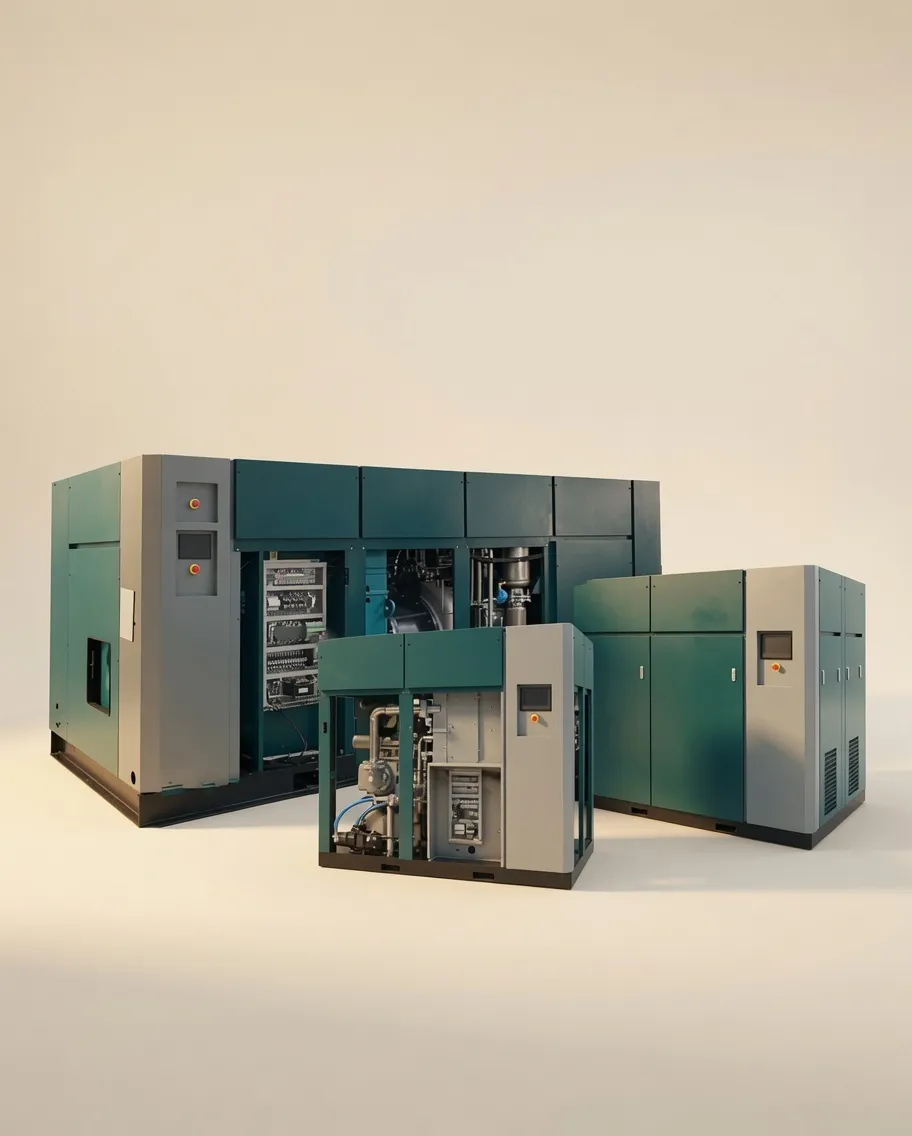
Why Motor Efficiency Matters More Than You Think
The electric motor is the single largest energy consumer in an oil-free air compressor — accounting for 85–95% of total system energy input. The remaining 5–15% covers auxiliary loads: control systems, fans, cooling pumps, and electronic drives. Because motor losses directly translate to wasted electricity and additional heat generation, even a 2–3% improvement in motor efficiency delivers significant real-world energy savings at industrial operating hours.
Traditional oil-free compressors used standard induction motors rated to IE2 or IE3 efficiency classes under IEC 60034-30. These motors are reliable and well-understood, but their efficiency characteristics have a fundamental limitation: efficiency drops significantly at partial loads (below 75% of rated torque), which is where many variable-demand compressors operate for a substantial fraction of their running hours.
Permanent magnet synchronous motors (PMSM) — the technology behind IE4 and IE5 efficiency class compressors — address this partial-load efficiency gap directly. By replacing the induced magnetic field of an induction motor with permanent magnets embedded in the rotor, PMSM designs eliminate the rotor copper losses that cause induction motors to drop efficiency as speed and load decrease. The result is a motor that maintains near-peak efficiency from 25% to 100% of rated load — precisely the operating range of a VSD-controlled oil-free screw compressor in variable-demand service.
Permanent Magnet vs Induction Motors: The Engineering Difference
Understanding the efficiency advantage requires a brief look at how these two motor types generate torque — and where their losses originate.
The practical significance of the partial-load efficiency advantage is substantial. A VSD-controlled oil-free screw compressor in a variable-demand facility may spend 40–60% of its running time at 30–60% of rated load. At these operating points, a PM motor achieves 3–7% better efficiency than an equivalent induction motor — translating directly to measurable energy savings without any change to the compression system or demand profile.
IE Efficiency Classes: What IE4 and IE5 Actually Mean
The International Electrotechnical Commission (IEC) defines motor efficiency classes from IE1 (Standard) through IE5 (Ultra Premium). Each step up the ladder represents a reduction in motor losses — the energy that goes to heat rather than useful shaft work. For oil-free compressor applications, the relevant classes are IE3 (Premium — the current minimum in many markets) through IE5 (Ultra Premium — achieved only with PM motor designs).
| IE Class | Typical Efficiency (45 kW motor) | Motor Technology | Annual Energy vs IE3 (4,000 hrs) |
|---|---|---|---|
| IE2 (High) | 92.0% | Induction (older) | +3,300 kWh more |
| IE3 (Premium) | 93.6% | Induction (standard) | Baseline |
| IE4 (Super Premium) | 95.0% | PM synchronous | −2,900 kWh (AUD $464) |
| IE5 (Ultra Premium) | 96.0% | PM synchronous (advanced) | −4,900 kWh (AUD $784) |
Note: Savings calculated at 45 kW full load, 4,000 annual hours, AUD $0.16/kWh. Actual savings at partial load (typical VSD operation) are proportionally larger due to PM motor’s superior efficiency retention at lower speeds.
The table shows only full-load comparison. At partial loads — where VSD-equipped compressors typically operate — the PM motor advantage grows. At 50% load, a PM motor may be 5–8 percentage points more efficient than an IE3 induction motor, not the 1.4 percentage points shown at full load. This is the key reason PM motors deliver disproportionately large savings in variable-demand applications.
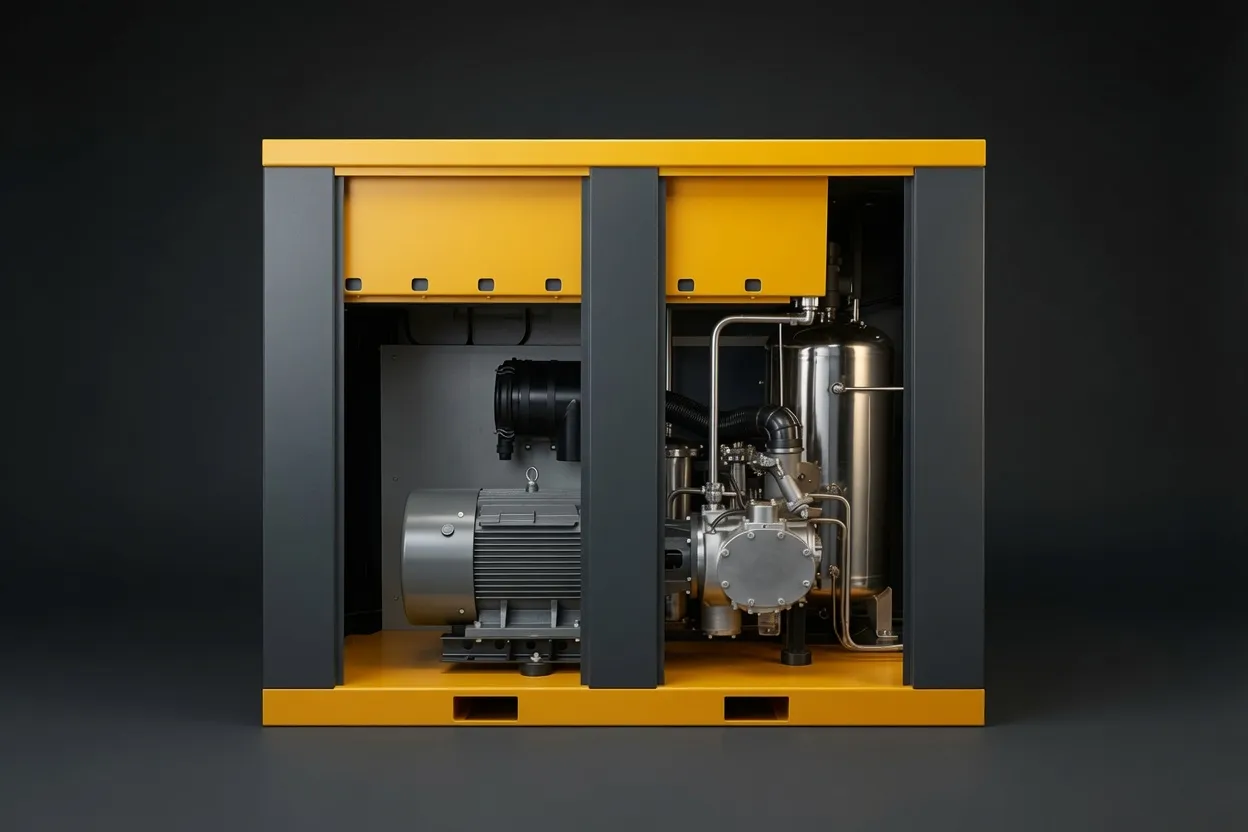
The PM + VSD Combination: Maximum Efficiency at Every Load Point
A permanent magnet motor combined with a variable speed drive compressor control system creates a synergistic efficiency combination that outperforms either technology alone. The VSD modulates speed to match demand; the PM motor maintains high efficiency at every speed point the VSD selects. The result is an oil-free compressor system that delivers near-optimal energy efficiency across its entire operating range — not just at the nameplate design point.
The efficiency advantage compounds at low loads — precisely where it matters most for variable-demand facilities. A facility where the compressor averages 50% load will see PM+VSD deliver approximately 7% more efficient motor operation than induction+VSD across that load band — translating to AUD $3,000–8,000 in additional annual savings on a 45 kW system compared to an equivalent induction VSD unit.
Worked Example: 10-Year Energy Cost Comparison
A logistics company runs a 30 kW oil-free air compressor for their dock pneumatics — 5 days/week, two shifts, approximately 4,500 hours per year. Their demand profile averages 55% of rated load. They are choosing between an IE3 induction VSD unit and a PM IE4 VSD unit with a price premium of AUD $3,500.
IE4 PM VSD @ 55% avg load efficiency (93%): 30 × 0.55 ÷ 0.93 × 4,500 = 79,839 kWh/yr
Annual kWh saving: 86,221 − 79,839 = 6,382 kWh/year
Annual saving @ AUD $0.16/kWh: AUD $1,021/year
Premium payback: $3,500 ÷ $1,021 = 3.4 years
10-year net saving: ($1,021 × 10) − $3,500 = AUD $6,710
A 3.4-year payback with AUD $6,710 net 10-year saving from a $3,500 premium — a strong investment case even for a relatively modest 30 kW compressor running at 55% average load. For larger machines (45–132 kW) running at higher hours and lower average loads, the absolute annual saving scales proportionally, while the payback often shortens to 2–3 years.
The case strengthens further when considered alongside rising electricity prices. At an assumed 3% annual electricity price increase over 10 years, the cumulative 10-year saving from the 30 kW example grows from AUD $6,710 to approximately AUD $8,200 — improving the real-world return on the PM motor premium without changing any of the base parameters.
PM Motor Maintenance and Reliability Considerations
Permanent magnet motors have different maintenance characteristics from induction motors — mostly in the direction of less maintenance, but with a few specific considerations to be aware of:
- → No rotor winding insulation to degrade — key induction motor failure mode eliminated
- → Synchronous operation means no slip-related heat in rotor — lower operating temperatures
- → Reduced bearing thermal loading extends bearing service intervals
- → No rotor current means no rotor I²R degradation over time — efficiency stays stable across service life
- → Compact for rated torque — PM motors are typically 15–25% smaller than equivalent induction motors
- → Must always be driven by VSD — PM motors cannot start direct-on-line (no induction start mechanism)
- → Rare-earth magnets (NdFeB) demagnetise above ~80°C rotor temperature — avoid sustained overtemperature
- → Motor replacement more expensive than induction equivalent if required
- → VSD must be specifically rated for PM motor operation — not all VSD drives support PM motor control modes
- → Requires VSD to be kept in good working order — PM motor cannot operate independently as fallback
The PM motor’s operational dependency on the VSD drive is the most important practical consideration. In an induction motor + VSD system, most manufacturers can configure the drive to bypass mode (direct mains connection) in the event of drive failure — allowing the compressor to run at fixed speed until the drive is repaired. This bypass mode is not available with PM motors. VSD maintenance and monitoring therefore becomes more critical for PM motor-equipped compressors than for standard induction designs.
Air Compressor Horsepower Ratings and PM Motors: What Changes
Compressor air compressor horsepower is always quoted as shaft output power at the coupling — the mechanical power delivered to the compression element. Both induction and PM motors can deliver the same shaft power; the difference is how much electrical input is required to produce that shaft output. A 45 kW (60 HP) PM motor delivering 45 kW shaft output requires approximately 47.4 kW of electrical input (at 95% efficiency), compared to 48.1 kW for an IE3 induction motor (at 93.6% efficiency).
What this means practically: a PM motor-equipped compressor rated at 60 HP (45 kW shaft) draws approximately 0.7 kW less from the grid at full load than an IE3 induction equivalent — and the gap widens to 2–4 kW at partial loads where PM motor efficiency advantage is greatest. When comparing compressor specifications, confirm whether the quoted kW or HP refers to shaft power or input (electrical) power — the distinction matters when calculating operating costs, electrical supply requirements, and energy efficiency claims.
PM Motors and Total Cost of Ownership: The Full 10-Year View
The total cost of ownership of a PM motor-equipped oil-free compressor versus an IE3 induction equivalent depends on the premium paid, the operating profile, and the energy price trajectory. For most Australian industrial users running above 3,000 hours per year at partial loads, the PM premium pays back within 2–4 years — with 6–8 additional years of pure energy saving to follow.
The duty cycle consideration reinforces the PM advantage further. A compressor with a 100% duty cycle air compressor rating that runs 8,000 hours per year at 55% average load will consume approximately 4,400,000 kWh over a 10-year service life (at full load equivalent). The PM motor’s 3–5% efficiency advantage at this average load translates to 130,000–220,000 kWh saved over the decade — at AUD $0.16/kWh, that is AUD $20,800–35,200 in electricity cost reduction from the motor alone.
IE4/IE5 PM Motor Oil-Free Compressors from Australia Oil Free Air Compressor
Australia Oil Free Air Compressor Co., Ltd. supplies IE4 and IE5 permanent magnet motor-equipped oil-free rotary screw compressors across our VSD product range. Our PM motor units are not an upgrade option — they represent the standard specification for VSD-equipped models in our range, reflecting our view that partial-load efficiency is the primary determinant of lifetime running cost for variable-demand industrial users.
Every PM motor compressor proposal from our team at the Charlton Industrial Area facility includes a documented energy comparison against the IE3 induction equivalent, at the customer’s specific operating hours and average load factor. We do not quote PM motor efficiency advantages in isolation from site conditions — the saving is real and measurable, and our calculations are based on your data, not generic averages.
Contact us at [email protected] for a PM motor energy saving projection for your facility.
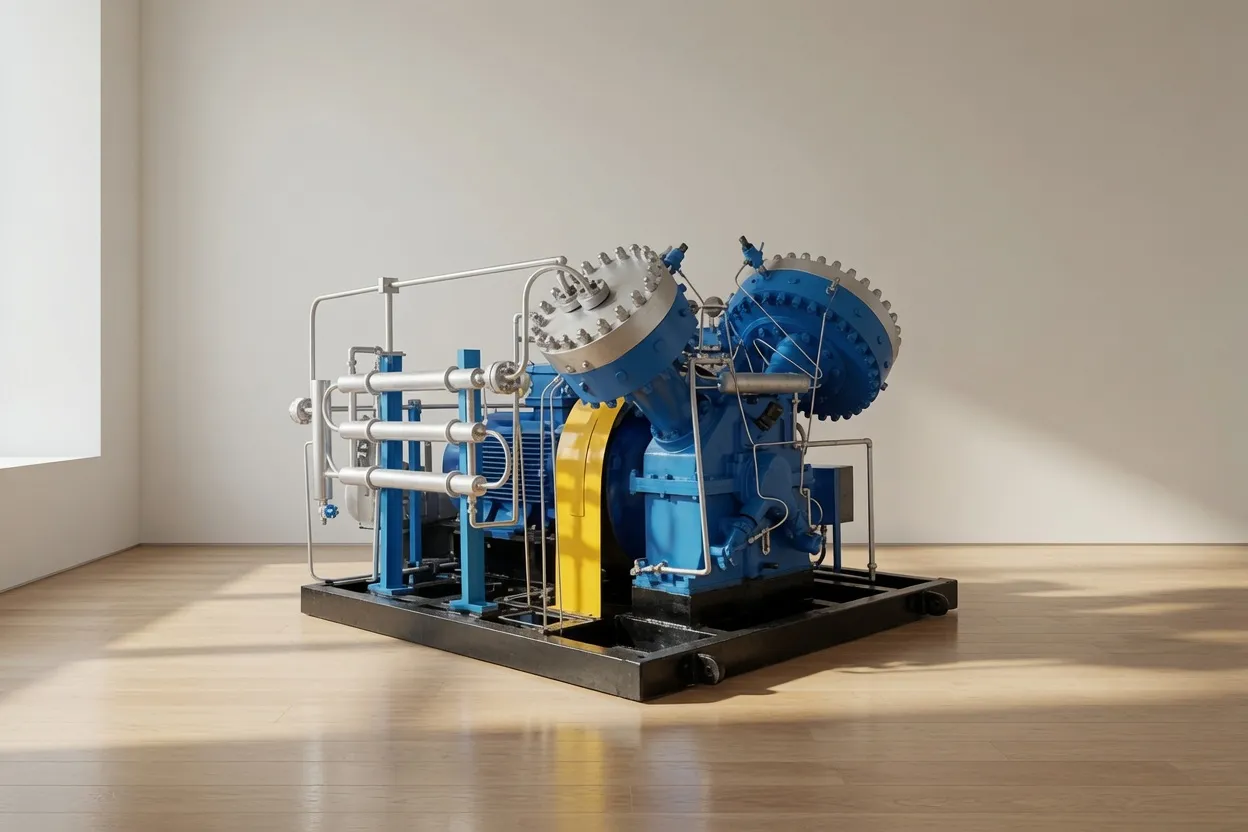
CM132DV — Variable Speed Oil-Free Screw Compressor with PM Motor Technology
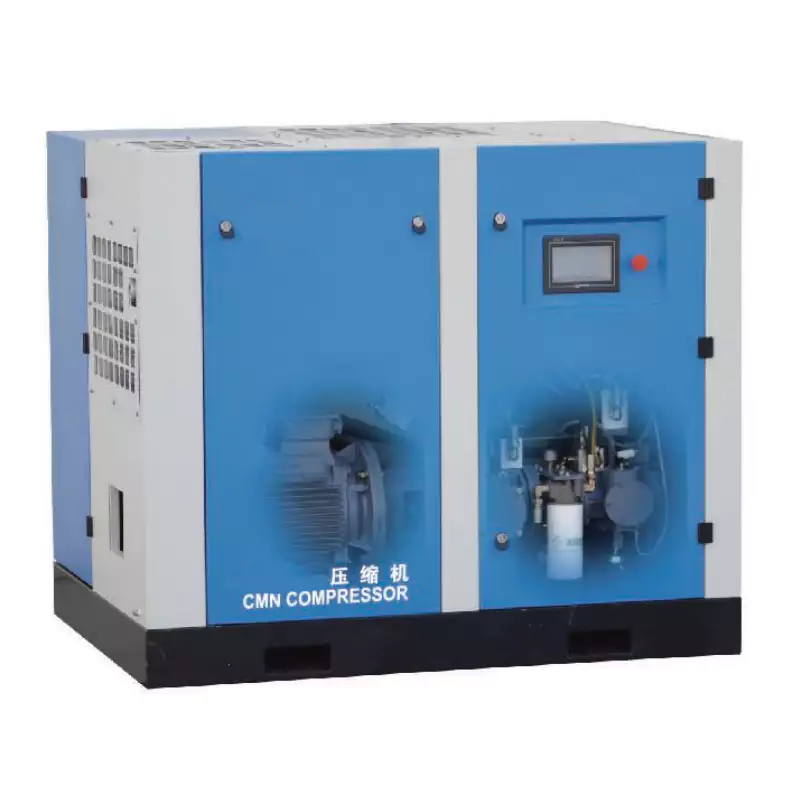
The CM132DV delivers the full combination of efficiency technologies described in this article: water-lubricated near-isothermal compression, permanent magnet IE4 motor, and VSD speed control — integrated into a single certified oil-free system. For industrial users seeking to minimise the lifecycle energy cost of their compressed air system while maintaining ISO Class 0 air quality, the CM132DV represents the most efficient configuration currently available in our range. Its PM motor maintains above 92% efficiency from 30% to 100% speed, ensuring the VSD energy saving is fully realised across the operating profile without the partial-load efficiency drop that induction motor designs experience.
Frequently Asked Questions
Australia Oil Free Air Compressor Co., Ltd.
Charlton Industrial Area, Australia | [email protected]