Description
The Unique Hazard Profile of High-Pressure Acetylene and Why Standard Compressors Fail
Acetylene is unique among the major industrial gases for a characteristic that makes its compression fundamentally different from any other gas engineering challenge: it can decompose explosively without oxygen. Under certain combinations of pressure and temperature, the C≡C triple bond in acetylene breaks down spontaneously, releasing the equivalent energy of a 3,000 kg/m³ mass explosion from a molecule weighing only 26 g/mol. Above approximately 0.2 MPa (2 Bar) without active cooling, this decomposition becomes self-sustaining — a chain reaction that propagates through the gas column faster than any mechanical relief system can respond. The products are carbon and hydrogen, and the energy release is violent.
A standard industrial reciprocating compressor operating at 700–1000 RPM generates compression heat at a rate far exceeding the cylinder wall’s ability to dissipate it into cooling water. The gas temperature spikes on each compression stroke — and for acetylene, a single spike above the decomposition threshold is sufficient to initiate runaway. The second hazard is chemical: copper, silver, and mercury react with acetylene to form metal acetylides, which are shock-sensitive primary explosives. A standard industrial compressor contains bronze bushings, copper electrical connections, and silver-brazed fittings throughout its construction — all of which must be completely eliminated from acetylene service.
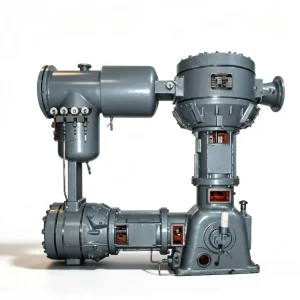
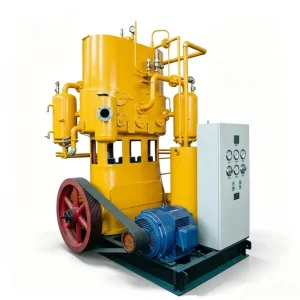
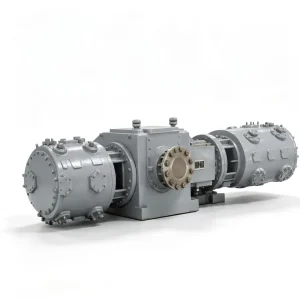
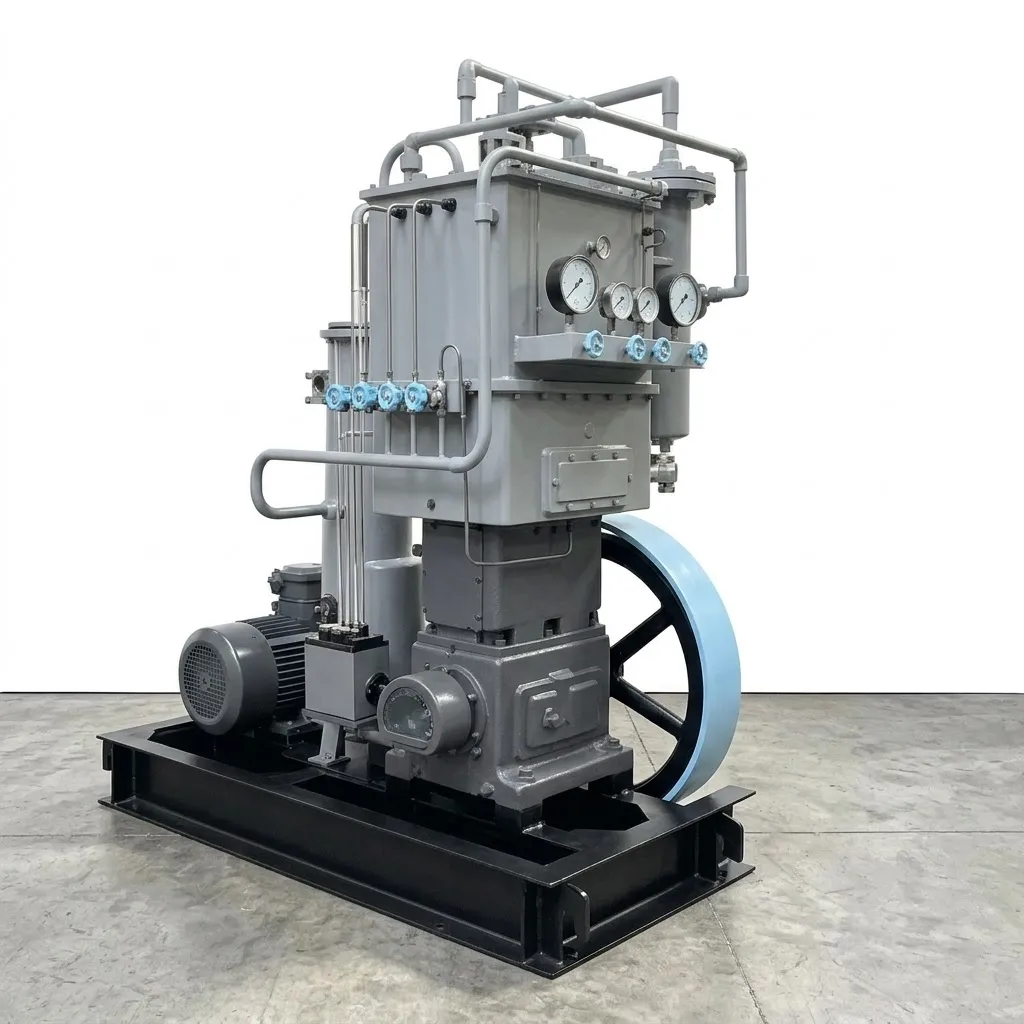
Our Z-Series acetylene compressors are purpose-engineered to manage both hazards simultaneously through ultra-low rotational speed, three-stage water-cooled compression, copper-free metallurgy throughout, and fully integrated YB-Series explosion-proof electrical systems mounted on a single commissioning-ready steel skid.
Ultra-Low RPM Thermal Control
6-pole and 8-pole YB explosion-proof motors reduce piston velocity to a fraction of standard industrial speed, allowing water cooling jackets to extract compression heat before temperatures approach the C2H2 decomposition threshold.
Copper-Free Safe Metallurgy
Every wetted component — valves, cylinder liners, piston rods, intercooler manifolds — manufactured without copper, silver, or mercury. Copper acetylide formation is structurally impossible in any gas-contacting surface.
Fully Skid-Mounted — Plug-and-Play Safety
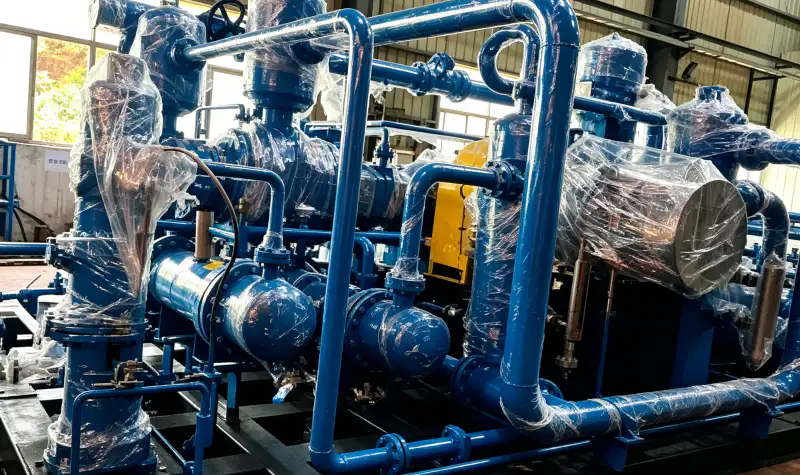
Compressor, intercoolers, moisture separators, safety relief manifolds, and Exd electrical panels all factory-integrated on a single rigid steel skid. Eliminates site piping errors that are the most common cause of acetylene installation incidents.
Four Engineering Disciplines That Make Z-Series the Only Safe Choice for C2H2
Each system below addresses a specific acetylene failure mode that has caused incidents at commercial bottling plants and chemical synthesis facilities using repurposed standard compressors.
Z-Series Acetylene Compressor — Complete Model Specifications
16 standard skid-mounted models cover the full range of commercial acetylene bottling scales — from single-generator small filling stations to high-capacity commercial distribution hubs running three shifts daily. All models are 380V standard supply and arrive pre-assembled and factory-tested.
2Z Series — Two-Row Three-Stage Skid Units (20 to 120 m³/h)
| Model | Capacity (m³/h) | Pressure (MPa) | Drive Motor | Power (kW) | Weight (t) | Dimensions (mm) |
|---|---|---|---|---|---|---|
| 2Z-0.34/25 | 20 | 2.50 | YB160L-6 | 5.5 | 1.80 | 1865×900×2000 |
| 2Z-0.67/25 | 40 | 2.50 | YB160L-6 | 11 | 1.80 | 1865×900×2000 |
| 2Z-0.8/25 | 50 | 2.50 | YB160L-6 | 11 | 1.80 | 1865×900×2000 |
| 2Z-1/25 | 60 | 2.50 | YB200L-8 | 15 | 2.60 | 2035×1240×2234 |
| 2Z-1.34/25 | 80 | 2.50 | YB225S-8 | 18.5 | 2.60 | 2035×1240×2234 |
| 2Z-1.5/25 | 90 | 2.50 | YB225S-8 | 18.5 | 2.60 | 2035×1240×2234 |
| 2Z-1.67/25 | 100 | 2.50 | YB225M-8 | 22 | 2.60 | 2035×1240×2234 |
| 2Z-1.82/25 | 110 | 2.50 | YB225M-8 | 22 | 2.60 | 2035×1240×2234 |
| 2Z-2/25 | 120 | 2.50 | YB225M-8 | 30 | 2.80 | 2035×1240×2230 |
3Z Series — Three-Row Three-Stage Skid Units (140 to 300 m³/h) — Custom up to 600 m³/h
| Model | Capacity (m³/h) | Pressure (MPa) | Drive Motor | Power (kW) | Weight (t) | Dimensions (mm) |
|---|---|---|---|---|---|---|
| 3Z-2.34/25 | 140 | 2.50 | YB250M-8 | 30 | 4.20 | 1840×1660×2400 |
| 3Z-2.67/25 | 160 | 2.50 | YB280M-8 | 37 | 4.20 | 1840×1660×2400 |
| 3Z-3/25 | 180 | 2.50 | YB280M-8 | 37 | 4.20 | 1840×1660×2400 |
| 3Z-3.34/25 | 200 | 2.50 | YB280M-8 | 45 | 4.30 | 1840×1660×2400 |
| 3Z-4.17/25 | 250 | 2.50 | YB315S-8 | 55 | 4.50 | 1840×1660×2400 |
| 3Z-4.5/25 | 270 | 2.50 | YB315S-8 | 55 | 4.50 | 1840×1660×2400 |
| 3Z-5/25 ⭐ | 300 | 2.50 | YB315S-8 | 65 | 4.80 | 1840×1660×2400 |
⭐ 3Z-5/25: largest standard model — 300 m³/h at 2.5 MPa, 65 kW, 380V. Custom 3-row configurations from 300 to 600 m³/h available. Discharge pressures up to 3.0 MPa on request. All models factory pressure-tested before shipment.
Three Principal Applications Served by the Z-Series
Acetylene’s unique combination of combustion temperature (3,160°C), cutting capacity in oxy-fuel applications, and chemical versatility as a triple-bonded carbon feedstock keeps it irreplaceable in three major industrial sectors despite the safety requirements of its compression.
Dissolved Acetylene Cylinder Bottling Plants
The primary commercial application of the Z-Series is compressing low-pressure C2H2 from an acetylene generator (typically calcium carbide and water process) to 2.5 MPa for injection into standard cylinders. Because acetylene is unstable as a free gas above approximately 1.5 Bar, filled cylinders contain a porous mass (calcium silicate) saturated with liquid acetone, into which the compressed acetylene safely dissolves. The 2Z and 3Z series cover every scale of commercial filling operation — from 20 m³/h pilot stations to 300+ m³/h national distribution hubs.
Chemical Synthesis Feedstock Distribution
For chemical plants producing vinyl chloride monomer (VCM) or 1,4-butanediol (BDO) at distributed manufacturing sites, Z-Series compressors serve as the final pressure step before reactor injection — drawing from central acetylene generation and delivering to outlying process buildings where the chemical reactions occur. High-capacity 3Z models at 200–300 m³/h provide the throughput that large VCM and BDO process lines demand while maintaining thermal safety that protects both the acetylene stream and the downstream catalyst beds.
Shipyard and Heavy Industrial Welding Gas Supply
Oxy-acetylene cutting achieves the highest flame temperature of any commercial fuel-oxygen combination, making it the preferred choice for cutting thick hull plate, heavy structural steel, and hardened alloy sections in shipbuilding and heavy fabrication. Major shipyards deploy Z-Series compressors to fill on-site manifold systems directly — eliminating dependence on external cylinder delivery logistics and ensuring continuous gas supply across three-shift construction schedules.
Featured Case Study: National Commercial Gas Distributor Capacity Expansion
Engineering Insight: The root cause of the previous installation’s thermal failures was not a component defect — it was a fundamental mismatch between the gas handling requirements of acetylene and the mechanical characteristics of a general-purpose compressor. Acetylene demands slow piston velocity for safe thermal control. A general-purpose compressor optimised for air or natural gas maximises RPM for efficiency. These two objectives are physically incompatible, and the consequence is predictable: thermal spike, safety shutdown, production bottleneck. The Z-Series solves this at the motor selection stage — there is no faster option on a 6-pole or 8-pole YB motor platform, so the thermal behaviour is locked in by design, not managed by operational discipline.
Installation Safety Requirements and Mandatory Maintenance Protocol
With acetylene, there is no margin for operational shortcuts. Each item below is a mandatory safety requirement, not a recommendation — and we support every installation with commissioning documentation and operator safety training to ensure full compliance from day one.
1
Nitrogen Purge Protocol Before Every Start
Before initial commissioning, after any maintenance, and after any shutdown exceeding 24 hours, the entire compression system — all cylinders, intercooler passages, manifolds, and piping — must be purged with high-purity nitrogen to displace any atmospheric oxygen. Acetylene-air mixtures are explosive across a 2.5%–82% concentration range. A single nitrogen purge cycle of appropriate duration and purge volume is the mandatory safety step that prevents explosive mixture formation inside the machine during any startup sequence.
2
Continuous Cooling Water Flow Monitoring
Cooling water must flow continuously to all cylinder jackets and intercoolers throughout every operating hour. A dedicated flow instrument with low-flow alarm and automatic compressor shutdown must be installed and proven functional before the first acetylene charge. A cooling water supply failure while the machine is running represents the most serious operational emergency in an acetylene filling station — the thermal consequences of even a few minutes of undetected cooling loss can be catastrophic. The monitoring system is not optional under any national standard for acetylene handling.
3
4,000-Hour Valve and Carbon Deposit Inspection
Acetylene under compression tends to leave polymerised carbon deposits on valve faces and seats over time — particularly on the outlet side of each stage where compressed gas is hottest. At 4,000-hour intervals, all stage valve assemblies are removed, cleaned of carbon buildup, and measured for plate wear. Carbon deposits restrict flow and create local hot spots that elevate gas temperatures above the safe operating envelope. Removing them on schedule maintains the thermal safety of the entire filling operation.
Z-Series Dedicated C2H2 vs Generic Flammable Gas Compressors
Repurposing a natural gas or standard flammable-gas compressor for acetylene bottling is an engineering error with documented consequences. The comparison below explains why purpose-built equipment is the only engineering-defensible choice in this application.
| Evaluation Metric | Z-Series (Dedicated C2H2) | Generic Flammable Gas Compressors |
|---|---|---|
| Operating Speed | ✔ 6-pole / 8-pole YB motors — ultra-low RPM, maximum heat dissipation per stroke. | ✘ Standard 4-pole high-RPM motors — compression too rapid for cooling water to remove adiabatic heat safely. |
| Copper Content | ✔ Completely copper-free wetted construction — copper acetylide formation is structurally impossible. | ✘ Bronze bearings, copper tube intercoolers, silver brazing — multiple explosive acetylide formation sites. |
| Thermal Safety | ✔ 3-stage intercooling keeps discharge temperature below 90°C decomposition threshold at all flow rates. | ✘ Standard cooling allows discharge temperatures of 130°C+ — within the spontaneous C2H2 decomposition range. |
| Skid Integration | ✔ Complete factory-assembled skid — all gas piping, instrumentation, and electrical tested before delivery. | ✘ Field-assembled gas connections introduce installation errors and material incompatibilities at the most critical joints. |
Why Acetylene Producers and Gas Distributors Choose Australia Oil Free Air Compressor Co., Ltd.
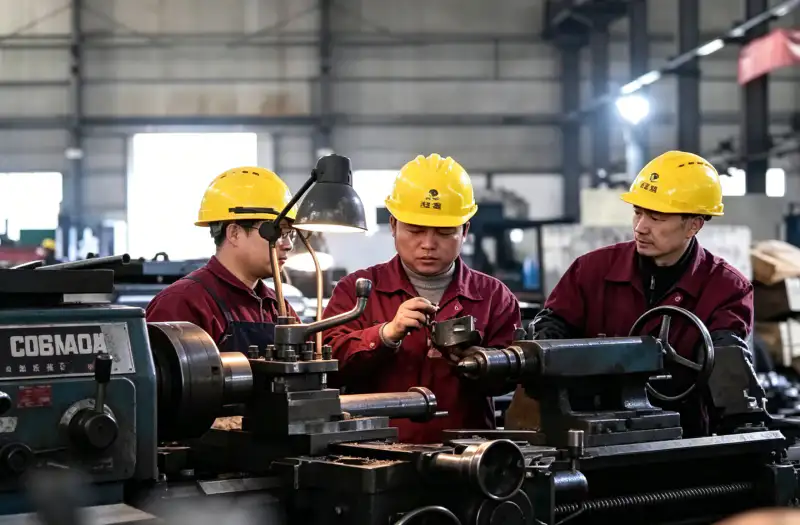
Building machinery that handles acetylene — one of the most thermodynamically unstable industrial gases — at commercial bottling scales leaves zero engineering margin. Every Z-Series pressure vessel, cylinder block, and intercooler manifold undergoes ultrasonic NDT, X-ray weld inspection, and hydrostatic pressure testing before skid assembly. Every Exd electrical component carries valid certification documentation supplied with each unit.
NDT, X-Ray, and Hydrostatic Testing
Every pressure-bearing component inspected and tested before skid assembly — material defects identified and resolved before any gas contact.
Factory Skid Pressure Test
Complete assembled skid pressure-tested at rated discharge pressure with nitrogen before shipment — all gas connections verified leak-free before leaving our facility.
Certified Exd Electrical Documentation
Valid certification documentation for every Exd motor, junction box, and instrument supplied with each unit — essential for ATEX area classification compliance documentation.
Custom Capacities to 600 m³/h
Custom 3Z configurations from 300 to 600 m³/h and discharge pressures up to 3.0 MPa available for large-scale chemical synthesis and major commercial distribution operations.
How to Select the Right Z-Series Model for Your Acetylene Station
Three parameters determine the correct model for any acetylene bottling or chemical synthesis compression project. Confirming all three before purchasing prevents the most common undersizing and safety specification errors.
Determine how many standard cylinders you intend to fill per shift and calculate the gas volume needed. A standard 40 L dissolved acetylene cylinder contains approximately 5–6 m³ of gas at filling pressure. A small filling station targeting 10 cylinders per hour needs approximately 50–60 m³/h (matching the 2Z-0.8/25 or 2Z-1/25). A large commercial hub targeting 50+ cylinders per hour needs 250–300 m³/h (3Z-4.17/25 or 3Z-5/25).
Standard dissolved acetylene cylinders fill to 2.5 MPa (25 Bar). Some chemical synthesis and specialty applications require up to 3.0 MPa. Confirm the target pressure from your cylinder specification or reactor inlet pressure datasheet — custom configurations for pressures up to 3.0 MPa are available with an engineering request submitted at the inquiry stage.
A reliable, dedicated industrial cooling water loop is a mandatory infrastructure requirement — not an option. The thermal safety of acetylene compression depends entirely on continuous, uninterrupted cooling water flow to the cylinder jackets and intercoolers at all times. Confirm your cooling water temperature (ideally 10–25°C), flow rate capacity, and supply reliability before ordering. Contact [email protected] with your cooling water specification for a complete thermal safety review.
Build a Safe, High-Capacity Acetylene Bottling Station
Share your required filling capacity (m³/h), discharge pressure, and cooling water availability with the engineering team at Australia Oil Free Air Compressor Co., Ltd. — receive a fully specified, NDT-tested Z-Series skid recommendation within 48 hours.
Charlton Industrial Area, Australia | [email protected]
Related Reading
For facilities handling acetylene in chemical synthesis applications where air purity and contamination risks intersect with gas safety management: oil free compressor nitrogen generator — why air purity is critical — directly relevant to the nitrogen purge systems that are mandatory in every acetylene compression installation.