
Medical-grade compressed air is a recognised pharmaceutical product under Australian and international healthcare standards. Unlike the compressed air that drives a workshop impact wrench or inflates a tyre, medical air is administered to patients as a therapeutic gas, used to power life-supporting ventilators, and employed as a critical input in the manufacture of medicines and biological products. The consequences of contamination in any of these applications range from equipment malfunction to direct patient harm. An oil-free air compressor for medical applications is not a premium upgrade — it is a baseline requirement under Australian law, international standards, and patient safety obligations. This guide covers the full spectrum of medical compressed air requirements: the regulatory landscape, technology selection, system architecture, application-specific requirements, and maintenance protocols that every healthcare facility, biomedical manufacturer, and medical device company operating in Australia must understand.
The Regulatory Framework Governing Medical Compressed Air
Medical compressed air in Australia operates within a multi-layered regulatory environment. Understanding which standards apply to your specific facility type is the starting point for every procurement and installation decision.
AS 2896 — Medical Gas Pipeline Systems
The primary Australian standard governing medical gas pipeline systems in healthcare facilities is AS 2896:2011 (Medical gas systems — Installation and testing of non-flammable medical gas pipeline systems). This standard specifies the design, installation, testing, commissioning, and maintenance requirements for compressed air systems supplying clinical areas including operating theatres, intensive care units, neonatal units, and general wards. Under AS 2896, medical air supplied to patient areas must meet the quality requirements of the European Pharmacopoeia monograph for Medical Air (Aer Medicinalis) — which defines oil-free purity as a mandatory characteristic and specifies a maximum total hydrocarbon content of 500 ppm (expressed as methane) from all atmospheric sources combined.
TGA — Therapeutic Goods Administration
Medical air used for patient administration — driving ventilators, powering anaesthetic machines, supplying hyperbaric chambers, and delivering respiratory therapy — is classified as a therapeutic good under Australian law and subject to TGA oversight. Manufacturers and suppliers of medical air must hold appropriate TGA registrations, and the production process (including the compressed air supply) must comply with GMP (Good Manufacturing Practice) principles. GMP mandates that manufacturing environments use oil-free compressed air wherever compressed air contacts product — a requirement that extends to the manufacturing of any medicine, vaccine, or biological product.
ISO 8573-1 Class 0 in Healthcare Contexts
ISO 8573-1 Class 0 — total oil content below 0.01 mg/m³, independently certified — is the baseline air quality target for medical applications across all categories. Class 0 is achievable only with a true oil-free compression system; oil-lubricated compressors with downstream filtration cannot achieve Class 0 certification under third-party audit. For patient-administered medical air, additional quality parameters beyond ISO 8573-1 apply, including carbon monoxide limits, carbon dioxide limits, and microbiological content — but the oil-free foundation is the non-negotiable starting point.
AS 2896:2011
Australian medical gas pipeline standard. Governs hospital and clinical facility air systems. Requires commissioning, annual testing, and authorised person sign-off. Non-compliant systems cannot be connected to patient care areas.
TGA GMP Guidelines
Pharmaceutical manufacturing GMP requires oil-free compressed air at every product contact point. GMP audits specifically examine compressed air quality validation records — inadequate documentation triggers critical findings and production suspension.
ISO 13485 — Medical Devices
Medical device manufacturers must demonstrate control of all utilities including compressed air under their ISO 13485 Quality Management System. Oil-free compressed air with documented quality monitoring is a standard audit expectation for device manufacturing facilities.
ISO 8573-1 Class 0
The international compressed air purity benchmark — less than 0.01 mg/m³ total oil content, third-party verified. The only purity class achievable exclusively with oil-free compression technology, not with filtered oil-lubricated machines.
Medical Application Categories: Requirements by Use
Medical compressed air spans a broad spectrum of applications, each with distinct quality, pressure, and flow requirements. Mapping your specific application to the right system specification prevents both under-specification (safety risk) and over-specification (wasted capital).
Choosing the Right Oil-Free Technology for Medical Use
Several oil-free compressor architectures are capable of meeting medical air quality standards. The selection between them depends on facility scale, pressure requirements, criticality of supply continuity, and maintenance infrastructure. Here is how each technology maps to the medical environment.
Water-Lubricated Oil-Free Screw Compressor — Preferred for Healthcare
The water-lubricated oil-free screw compressor is the design of choice for medical facility central plant installations. Water injection into the compression chamber achieves simultaneously: rotor sealing without oil, compression heat removal (discharge temperature typically below 50°C versus 160–200°C for dry screw), and bearing lubrication without hydrocarbon contact. The result is verifiably oil-free compressed air with no theoretical contamination pathway, combined with the lowest discharge temperature of any oil-free screw design — which extends downstream dryer and filter service life and reduces system energy consumption. The water-lubricated oil-free air compressor for medical use requires periodic water quality management (water filtration and pH monitoring) but eliminates all oil-related maintenance.
Dry Oil-Free Screw Compressor — High Capacity Medical Plant
Two-stage dry oil-free screw compressors are appropriate for large hospital central plant requirements with high flow demand (above 15 m³/min) and continuous duty at pressures above 0.8 MPa. The two-stage design with inter-stage cooling keeps discharge temperatures below 200°C and specific power competitive with oil-lubricated machines at these pressures. For large tertiary hospitals with multiple operating theatres, ICUs, and high-dependency wards, the combination of two or more duplex dry screw oil-free compressor units in a medical air plant room provides the N+1 redundancy required by AS 2896 for critical care facility design.
System Design Principles for Medical Compressed Air
A compliant medical compressed air installation is a complete system — not just a compressor. Each component in the chain from compressor inlet to patient or process terminal serves a defined role in maintaining the air quality and supply reliability that medical applications demand. The following design principles are extracted from AS 2896, HTM 02-01, and international medical gas engineering best practice.
✦ N+1 Redundancy
AS 2896 mandates that medical air systems serving critical care areas operate with at least N+1 redundancy — at minimum two compressor units, either of which can supply 100% of peak demand independently. If one unit fails during an operating session, the second continues without clinical interruption. For large hospitals, a 2+1 (two running, one standby) configuration is standard for Level 3 critical care wards.
✦ Inlet Air Location
Medical air compressor intake points must be located in an area free from combustion gases, vehicle exhaust, solvent vapours, and building exhaust stacks. AS 2896 specifies minimum separation distances from pollution sources. Poor inlet location is one of the most common compliance failures found in medical gas audits — it introduces atmospheric hydrocarbons that no downstream filter can fully remove.
✦ Receiver Sizing & Zoning
The air receiver provides buffer capacity that decouples compressor cycling from instantaneous demand spikes. For medical applications, receiver sizing should allow at least 15–20 minutes of demand at average flow without compressor input — providing time for a standby unit to start and reach full output following a primary unit failure. Zone isolation valves allow maintenance of one area of the pipeline without disrupting supply to others.
✦ Drying & Filtration Train
A compliant medical air treatment train comprises: pre-filtration (5 μm) → refrigerant dryer (PDP +3°C) → main particulate filter (1 μm) → fine filter (0.01 μm) → activated carbon filter (where CO or hydrocarbon adsorption is required). Each filter stage must be duplicated (duty-standby) so that filter cartridge changes do not interrupt supply to critical care areas.
✦ Continuous Air Quality Monitoring
For patient-administered medical air, continuous monitoring of carbon monoxide (CO alarm at 5 ppm), carbon dioxide (CO₂ alarm at 500 ppm), dewpoint (alarm if PDP rises above +3°C), and oxygen concentration (alarm if O₂ <20% or >23%) is required under AS 2896. These alarm signals are connected to the facility’s Building Management System and nurse-call infrastructure to ensure immediate clinical response to any air quality deviation.
✦ Pipeline Material Specification
Medical air pipelines must be constructed from Type A or B copper tube (degreased and capped during installation) or stainless steel for pharmaceutical applications. Carbon steel pipework is not acceptable for medical air — internal oxidation products and corrosion debris generate particulate contamination that coalescing filters alone cannot reliably remove to Class 1. All pipework joints must be brazed (not soldered) using BCuP or BAg filler alloys.
Pharmaceutical Manufacturing: GMP Compressed Air Requirements
Pharmaceutical manufacturing compressed air requirements go beyond clinical facility standards in several important respects. The TGA GMP Guidelines (aligned with PIC/S PE 009-16) and the EU GMP Annexes specifically address compressed air in the context of utilities qualification, risk-based contamination control, and continuous compliance monitoring. For any pharmaceutical manufacturer in Australia, the following requirements directly govern compressed air system design and documentation.
Utilities Qualification (IQ/OQ/PQ)
The compressed air system in a pharmaceutical manufacturing facility must be formally qualified through Installation Qualification (IQ), Operational Qualification (OQ), and Performance Qualification (PQ) before it can be used in production. IQ documents that the system was installed as designed (materials, pipework, filter specifications, compressor model). OQ confirms the system operates as intended across its design range (pressure, flow, dewpoint, oil content). PQ demonstrates ongoing compliance through repeated testing under production conditions. This qualification documentation forms part of the facility’s validation master plan and is examined by TGA auditors during GMP facility inspections.
Product Contact vs. Non-Product Contact Air Classification
GMP guidelines require pharmaceutical manufacturers to classify their compressed air uses by risk level. Product contact air — used in tablet coating pans, spray dryers, lyophilisers, mixing vessels, and packaging machine purging — must meet ISO 8573-1 Class 0 with microbiological monitoring. Non-product-contact air — used for pneumatic actuators, cabinet cooling, and laboratory general supply — may be permitted at Class 1 with appropriate risk justification documented in the facility’s Pharmaceutical Quality System (PQS).
Maintenance & Compliance Validation Programmes
Medical compressed air systems require a structured maintenance and validation programme that goes significantly further than general industrial compressor upkeep. The purpose is twofold: ensuring the system continues to deliver compliant air quality, and generating the documented evidence that regulatory audits and accreditation bodies require.
Operational Checks & Auto-Drain Verification
Verify compressor cycling frequency and system pressure stability. Confirm auto-drain function on receiver and filter housings. Inspect inlet filter condition indicator. Check dryer dewpoint indicator reads within specification. Document in facility’s maintenance logbook with date and technician signature — this log is a regulatory compliance record, not an optional task.
Filter Element Replacement & Dryer Service
Replace all filter elements (pre-filter, 0.01 μm fine filter, activated carbon where fitted) on a time-based schedule — not conditional on differential pressure alone, as microbiological contamination does not register as pressure drop until catastrophic. Service the refrigerant dryer refrigerant circuit and clean condenser. Inspect compressor valves and safety relief valves. Complete a partial air quality spot-check (oil vapour content, dewpoint) and document results.
Full AS 2896 Compliance Validation
Full air quality validation test by an authorised person — measuring oil vapour content (ISO 8573-1 Class 0 verification), total oil content, pressure dewpoint, total particulate, CO, CO₂, and microbiological content where applicable. The test report is the primary document demonstrating ongoing medical air compliance. For pharmaceutical facilities, the annual validation report triggers formal re-certification of the compressed air system in the PQS. Retain all records for a minimum of 5 years (10 years recommended for pharmaceutical manufacturing).
Change Control Revalidation
Any modification to the compressed air system — compressor replacement, pipework addition, filter change to a different specification, pressure regulator replacement — must be managed through a formal change control process and followed by a revalidation test before the modified system is returned to service in clinical or pharmaceutical production areas. This applies even to component replacements “of the same specification” if the original validation documentation does not explicitly cover equivalent substitutions.
Why Healthcare Facilities Choose Australia Oil Free Air Compressor Co., Ltd.
Medical compressed air procurement is not a commodity transaction. It requires a supplier with documented technical competence in healthcare standards, a complete product range covering all facility scales, and an after-sales service capability that supports the validation and compliance lifecycle of the system — not just the initial sale.
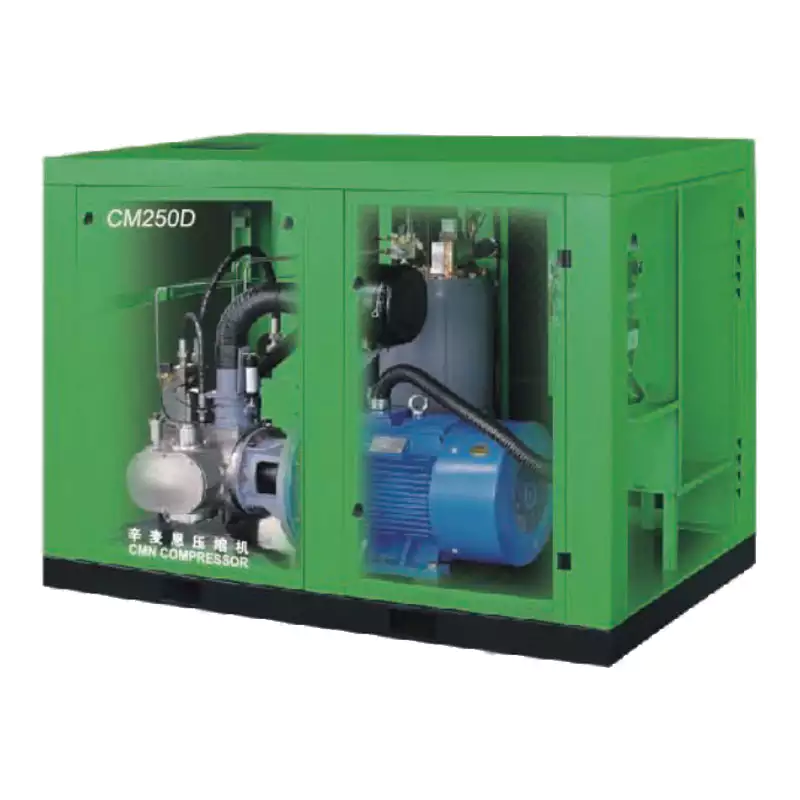
CM132DV Water-Lubricated Oil-Free Screw Compressor
Designed for continuous medical facility duty. Water lubrication guarantees zero oil contamination risk. ISO 8573-1 Class 0 certified. Discharge temperature below 50°C preserves downstream treatment train efficiency. Variable speed drive optimises energy use across the hospital’s variable daily demand profile. IQ/OQ/PQ documentation support available.
Frequently Asked Questions
Discuss Your Medical Compressed Air Requirements
Whether you are designing a new hospital medical gas system, validating a pharmaceutical manufacturing facility, or upgrading an existing clinical air plant — our team provides compliant, documented, and fully supported oil-free medical air solutions across Australia.
Request a Medical Air Consultation
Email: [email protected] | Contact Us Online | About Us