
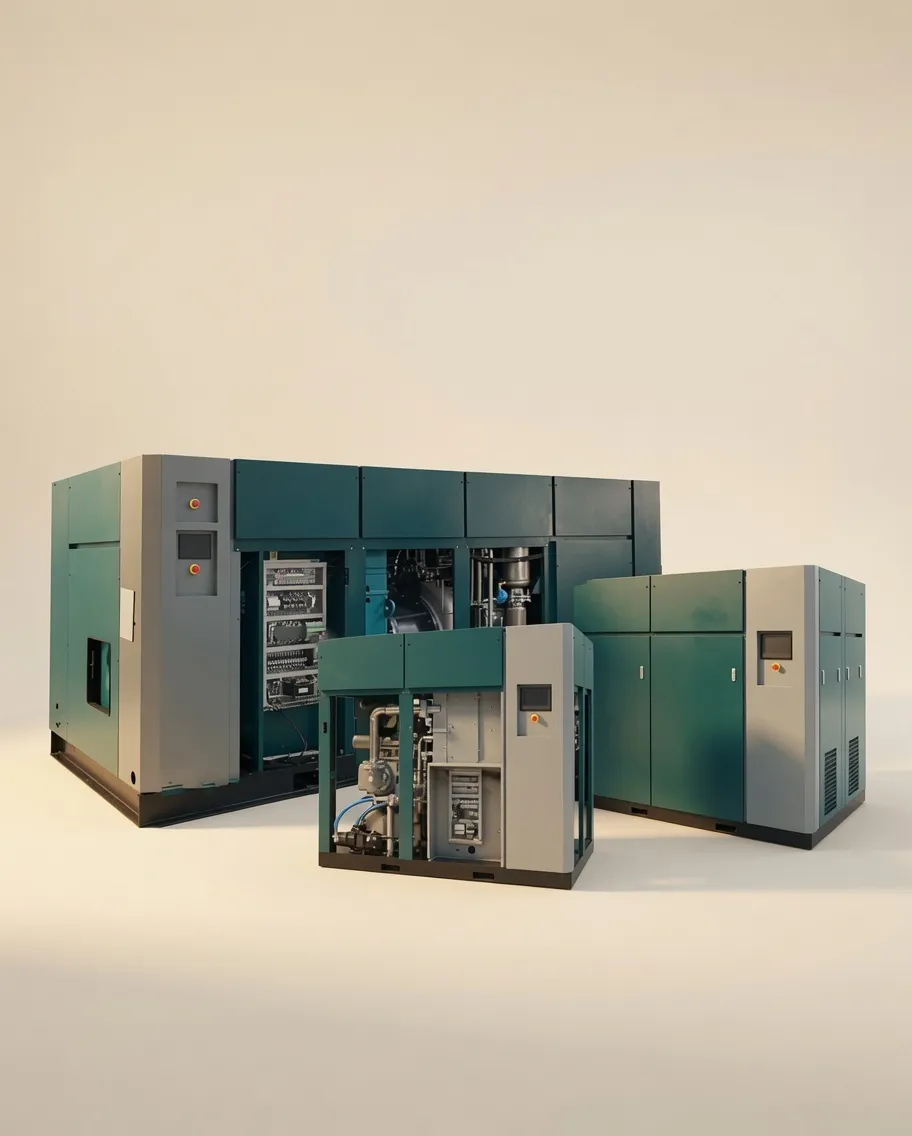
When Outdoor Installation Makes Sense — and When It Does Not
Outdoor installation of an oil free compressor is driven by one of several practical constraints: no suitable indoor space is available, the building structure cannot accommodate the machine’s weight or ventilation requirements, the compressor needs to serve multiple buildings with a central outdoor location, or an existing indoor room is needed for other equipment. These are all legitimate drivers — but each one should be evaluated against the cost and complexity of outdoor installation before committing.
The central challenge is that most industrial oil-free compressors are designed for indoor installation in a controlled environment. Their standard enclosures protect against incidental water splash (typically IP23 or IP44 — fine for indoor installations where no rain or hose cleaning occurs) but are not designed for sustained outdoor weather exposure. Taking an indoor-rated machine outdoors without appropriate protection accelerates electrical component failure, bearing corrosion, control system damage, and structural deterioration at a rate that shortens service life by 30–50% compared to a sheltered equivalent.
- → IP55+ weatherproof enclosure is specified or available
- → An appropriate weatherproof canopy or housing is constructed
- → Ambient temperature range falls within compressor specification
- → A containerised installation is used
- → The machine serves multiple buildings where central outdoor location is optimum
- → Site is in a mild Australian climate (not tropical or extreme desert)
- → Building space is available with adequate ventilation
- → Pharmaceutical, food, or medical application (air quality certification)
- → Tropical zone (Darwin, Cairns, Broome) with extreme humidity and temperatures
- → Coastal installation within 500m of saltwater (severe corrosion risk)
- → Desert installation where ambient regularly exceeds 45°C
- → Budget does not support proper weatherproof enclosure
The Six Risk Categories of Outdoor Compressor Installation
Rain, condensation, and cleaning water are the most immediate outdoor risks. Electrical control panels, motor terminal boxes, and VSD electronics are all vulnerable to water ingress above IP23 protection — enough for indoor drip protection but not for driving rain or spray cleaning. Even in a covered outdoor location, condensation during temperature cycling can cause moisture accumulation inside sealed control panels.
Direct sunlight on a dark compressor enclosure can raise the surface temperature to 60–70°C during Australian summer — well above the 40–45°C maximum ambient rating of most equipment. This solar-induced heat load adds to the compressor’s own heat output, causing the machine to run at its thermal limit and triggering overtemperature shutdowns during the hottest hours of the day when cooling air temperature is also at its peak.
Australian outdoor temperature ranges are extreme by world standards — daily swings of 20–30°C are common in inland areas, and seasonal ranges of 10–45°C are experienced across most of the continent. Most oil-free rotary screw compressors specify a minimum operating temperature of 5–10°C. In southern Australia (alpine regions, ACT, southern Victoria, Tasmania), overnight winter temperatures can drop below this threshold, requiring either cold-start protection or insulated housing.
Outdoor compressor installations in Australia are particularly vulnerable to insect ingress — spiders, wasps, cockroaches, ants, and termites can all find entry routes through cable conduits, louvre gaps, and drain fittings. Insect nests inside control panels are a common cause of short circuits and overheating. In tropical and sub-tropical regions, flying insects are attracted to the warm enclosure and light sources from the control panel, creating nesting problems that develop rapidly.
Salt-laden air within 5 km of the coast, and high humidity in tropical regions, dramatically accelerates corrosion of compressor components. Copper electrical connections, steel fasteners, aluminium cooling fins, and electronic circuit board components are all at risk. In some coastal Australian environments, standard industrial equipment shows visible corrosion within 18 months of outdoor exposure.
Outdoor air typically contains higher dust loading than indoor air in industrial environments — pollen, agricultural dust, road dust, and industrial particulate are all more prevalent outdoors. Higher dust loading means the compressor’s intake filter loads faster — potentially requiring 2–3× more frequent filter replacement than the indoor equivalent. In agricultural areas during harvest season, filter change frequency may need to increase to monthly or even bi-weekly.
IP Ratings for Outdoor Compressors: What You Need and Why
IP (Ingress Protection) ratings under IEC 60529 define how well a housing protects its contents against solid particles and water. For outdoor compressor installations, the IP rating of every electrical component — motor, control panel, VSD drive, sensors, and terminal boxes — must be matched to the exposure conditions of the installation site.
| IP Rating | Protection Level | Suitable For | Outdoor Compressor Use |
|---|---|---|---|
| IP23 | Solid particles >12mm · Dripping water up to 60° from vertical | Sheltered indoor | ❌ Not adequate |
| IP44 | Solid particles >1mm · Water splashing from any direction | Wash-down indoor environments | ⚠️ Marginal (covered site only) |
| IP55 | Dust-protected · Protected against water jets from any direction | Outdoor (motor); covered outdoor enclosure (panel) | ⚠️ Minimum for covered outdoor |
| IP65 | Dust-tight · Protected against water jets from any direction | Outdoor control panels; direct weather exposure | ✅ Recommended minimum |
| IP66 | Dust-tight · Protected against powerful water jets | Exposed coastal / tropical outdoor | ✅ Recommended for harsh sites |
For a complete outdoor installation, check IP ratings on every component individually:
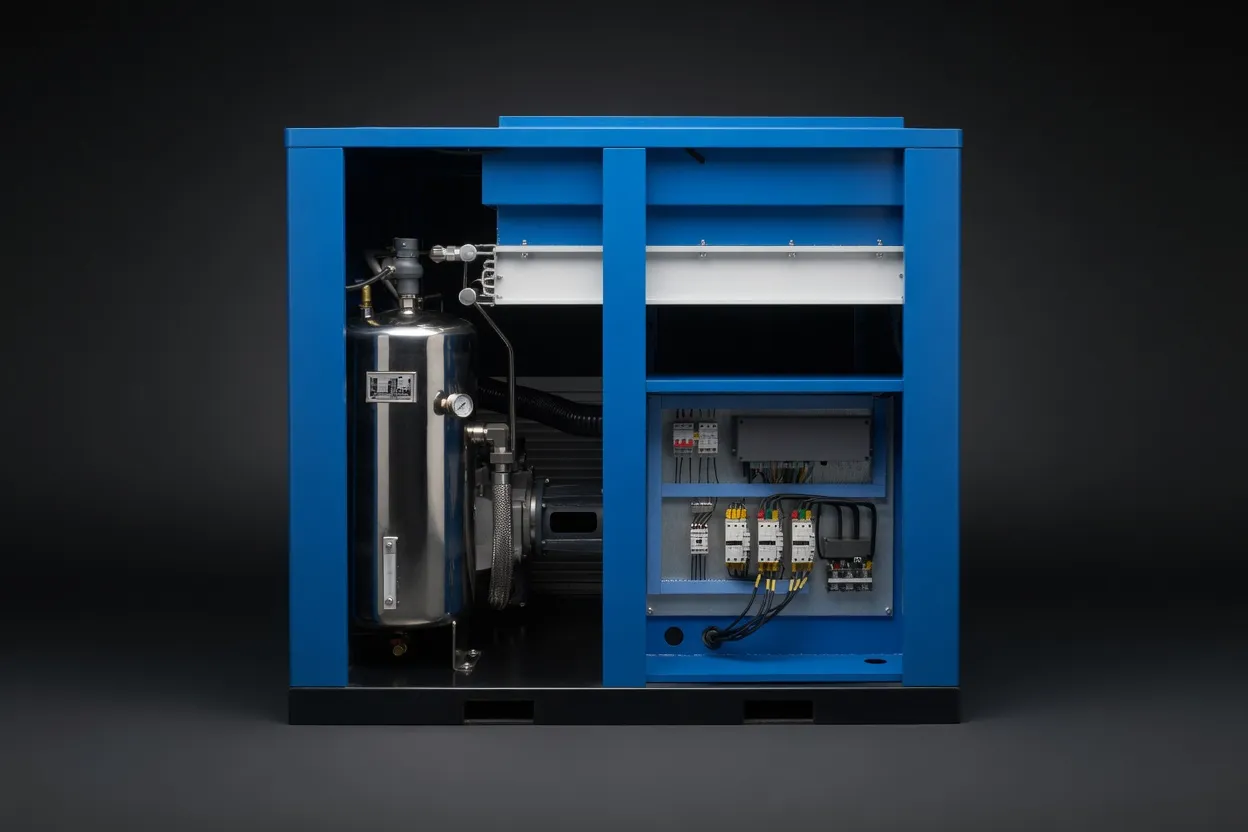
Enclosure and Canopy Design: Protecting the Machine Without Choking It
The most common mistake in outdoor compressor housing design is building a weatherproof structure that inadvertently traps heat — creating a sealed box that provides rain protection but prevents cooling airflow. An outdoor compressor enclosure must simultaneously exclude weather and allow the compressor’s cooling air to flow freely at its full rated volume. These two requirements are in direct tension and must be engineered together.
The airflow path is the starting constraint: the enclosure design must provide an inlet opening and an exhaust opening that allow the compressor’s rated cooling air volume to flow without restriction greater than the machine’s maximum allowable back-pressure (typically 30–80 Pa for packaged rotary screw units). Weather baffles on inlet and outlet openings must be designed to reduce water ingress while minimising air restriction.
Recommended Enclosure Design Elements
A canopy extending 600–800 mm beyond the compressor footprint on all sides provides rain and sun protection with maximum airflow freedom. Combine with louvred side panels open at bottom (intake) and top (exhaust) for natural convection assistance. Canopy material: Colorbond or polycarbonate with UV stabilisation. Install at minimum 600mm above compressor top.
Chevron-profile powder-coated aluminium louvres angled to deflect rain while passing airflow. Free area of louvre must be 1.5× the duct cross-section to account for louvre restriction. Position on the prevailing wind sheltered side (south or east-facing in most Australian locations) to reduce driving rain direct impact on the intake opening.
A low-wattage (100–250 W) thermostatic anti-condensation heater inside the control panel maintains panel interior temperature 3–5°C above ambient. This prevents moisture condensation on PCBs and terminal boards during overnight cool-down — one of the leading causes of outdoor electrical failure. Connect to a separate power circuit that remains active when the compressor is switched off.
A concrete plinth 150–200 mm above surrounding grade prevents rainwater runoff from flooding the compressor base. Conduit entry points below ground level must be sealed with rigid conduit and waterproof compound. Include a condensate drainage channel in the plinth to direct compressor drain water to a suitable discharge point clear of the base.
Australian Climate Zone Considerations for Outdoor Compressor Installation
Australia’s climate zones present fundamentally different challenges for outdoor compressor installation. What works in temperate Melbourne would fail within a year in tropical Darwin, and vice versa. The design specification must match the specific climate at the installation site.
How Outdoor Installation Affects Compressed Air Quality
The compressed air quality implications of outdoor installation are significant and often underestimated. An outdoor compressor is exposed to higher atmospheric humidity, greater temperature extremes, and higher ambient dust and particulate loading than its indoor equivalent — all of which affect the quality of compressed air produced and the sizing of downstream treatment equipment.
Outdoor air typically has higher relative humidity than air inside a ventilated building — often 10–20% RH higher. This increases the moisture content drawn into the compressor, increasing the load on the dryer and condensate drain systems. For refrigerated dryer systems, size the dryer for outdoor ambient humidity plus temperature correction. For desiccant systems, shorter desiccant cycles may be needed to maintain rated dew point.
Outdoor air carries significantly more particulate than indoor air — agricultural dust, road dust, pollen, and industrial emissions are all more concentrated in outdoor air. Intake filter service intervals must be reduced from the standard indoor recommendation — typically halved or more in high-dust environments. Install a pre-filter louvre on the intake opening to reduce coarse particulate entry before it reaches the main intake filter.
Outdoor sites near roads, loading docks, or fuel storage have variable but often elevated atmospheric hydrocarbon concentrations. For quality-critical applications (food, medical) requiring an activated carbon adsorber downstream, outdoor installation near vehicle exhaust sources may require more frequent carbon replacement due to higher inlet hydrocarbon loading. Position the compressor intake upwind of vehicle traffic and fuel storage.
For pharmaceutical, food direct-contact, or medical applications that require certified compressed air quality — ISO 8573-1 documentation and periodic air quality testing — outdoor installation introduces additional variability in inlet air quality that complicates quality system management. Indoor installation with controlled ventilation is strongly preferred for quality-critical compressed air applications.
Outdoor Compressed Air Piping: Special Requirements
Compressed air piping from an outdoor compressor to an indoor distribution point presents challenges that indoor pipework does not face: thermal expansion over a wide temperature range, UV degradation of any polymer components, and the risk of condensate freezing in sections exposed to below-zero temperatures in cold-climate sites.
The outdoor pipe section from the compressor to the building entry point should meet these requirements:
Standard aluminium modular pipe systems are not UV-stabilised and degrade with extended outdoor sun exposure (sealing O-rings). Carbon steel corrodes without protection. Stainless steel is the recommended material for the outdoor compressor-to-building pipe run — corrosion-free, UV-resistant, and rated for the full outdoor temperature range.
Steel pipe expands approximately 12 mm per 10 m per 10°C temperature change. In Australian inland environments with 30°C+ seasonal temperature swings, a 20m outdoor run can expand/contract 72mm. Expansion loops or compensators must be included in the pipe design to prevent joint fatigue cracking over the equipment’s service life.
For sites where overnight temperatures drop below the compressed air dew point (+3°C for refrigerated dryer systems), exposed outdoor pipework must be insulated and, where frost risk exists, heat-traced. A section of cold pipe downstream of a refrigerated dryer can form ice internally if air above +3°C dew point contacts a pipe wall below 3°C — blocking the line completely in extreme cases.
Any polymer component in the outdoor section — flexible hose connections, drain valve bodies, filter housings — must be UV-stabilised. Standard polymer grades used in indoor applications become brittle under sustained UV exposure in Australian conditions within 2–3 years. Replace flexible connectors every 3 years on outdoor compressor installations (versus 5 years for indoor).
Outdoor Installation Expertise from Australia Oil Free Air Compressor
Australia Oil Free Air Compressor Co., Ltd. has supported outdoor installation projects across Australian climate zones — from tropical North Queensland mining sites to temperate southern Victoria agricultural operations and coastal Western Australian industrial facilities. We understand that the specification appropriate for a sheltered Perth site is fundamentally different from what Darwin requires, and that getting this wrong shortens compressor service life in ways that are entirely avoidable with correct upfront specification.
For outdoor installation projects, we provide a site-specific specification covering: IP rating requirements for the proposed site; enclosure or canopy design guidance; inlet air quality correction factors for downstream dryer and filter sizing; cold-start protection requirements if applicable; and inspection frequency recommendations for the climate zone. For sites where we have concerns about outdoor installation feasibility, we will say so — and propose alternative solutions including containerised compressor units that are purpose-designed for outdoor permanent installation.
Contact us at [email protected] with your site location, climate zone, and proposed outdoor installation configuration for a suitability assessment.
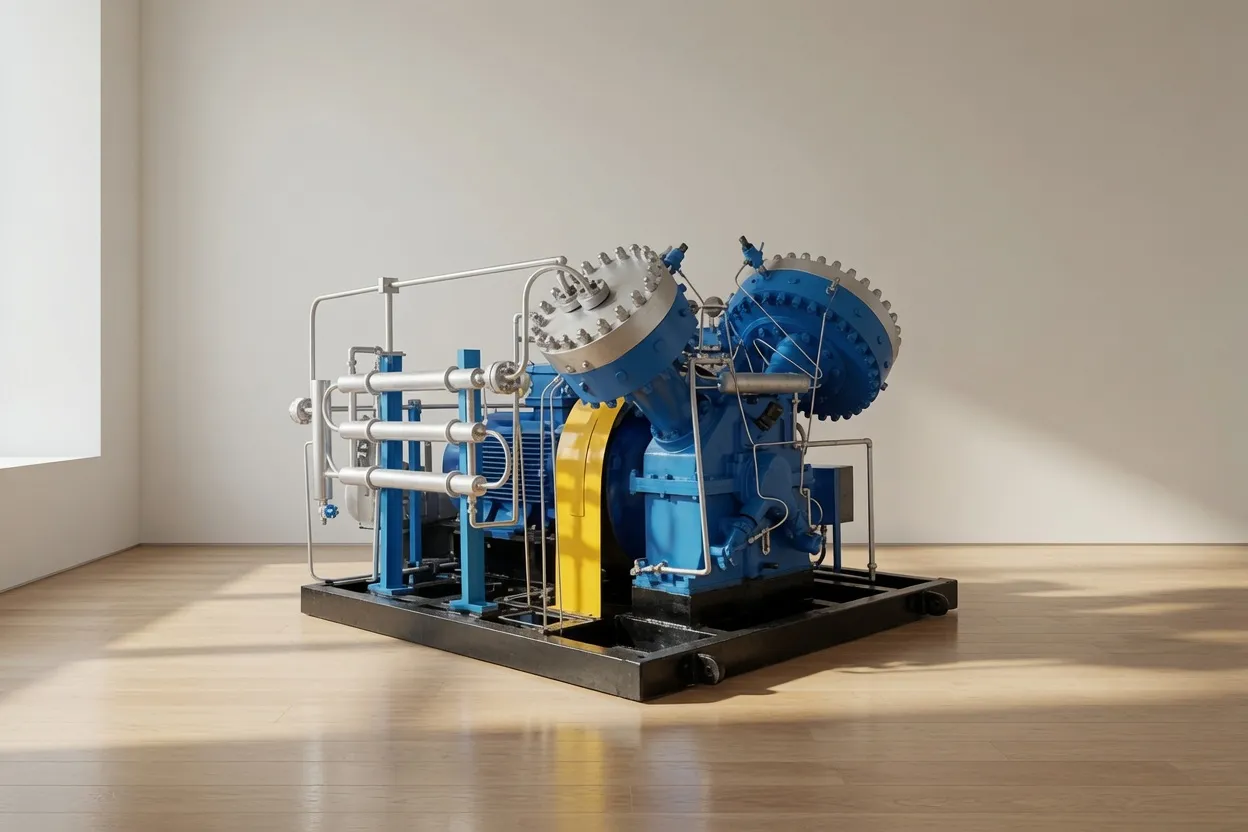
CM242GPV — Medium-Pressure Oil-Free Screw Compressor with Outdoor Enclosure Options
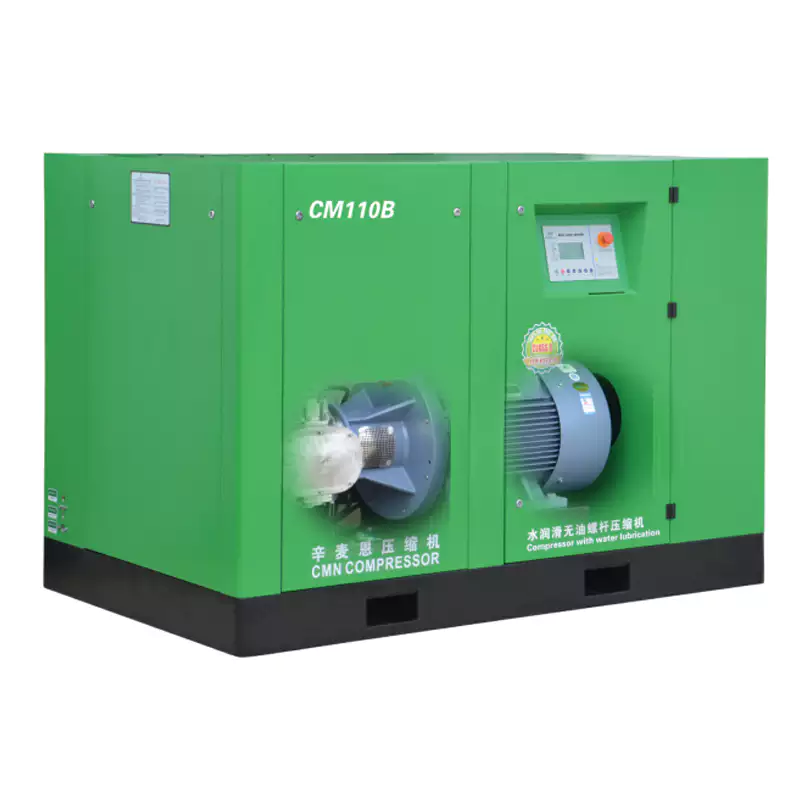
The CM242GPV is available with factory-configured options that facilitate outdoor installation — upgraded motor IP rating, weatherproof control panel, and anti-condensation heater as standard. For facilities that require medium-pressure oil-free output (up to 242 PSI) from an outdoor-located unit, the CM242GPV provides the pressure performance, continuous duty rating, and available weatherproofing that outdoor laser cutting or forming applications require. Contact our team for the available outdoor options and site-specific specification guidance for your climate zone and installation conditions.
Frequently Asked Questions
Australia Oil Free Air Compressor Co., Ltd.
Charlton Industrial Area, Australia | [email protected]