
How ISO 8573-1 Works: The Three-Dimensional Quality Framework
ISO 8573-1 is the international standard for compressed air quality. Its fundamental principle is that compressed air quality cannot be described by a single number — it requires three independent quality ratings covering the three primary contamination categories: solid particles, water content, and total oil content. A complete ISO 8573-1 quality specification always has the format X:Y:Z, where X is the particle class, Y is the water class, and Z is the oil class.
This three-dimensional structure reflects the physical reality that the equipment managing each contamination type is independent. A refrigerated dryer removes moisture but cannot remove particles or oil. A coalescing filter removes particles and oil aerosol but cannot remove vapour-phase oil or achieve desiccant-level dew points. An oil-free compressor eliminates oil at source but cannot remove atmospheric particles or moisture. Each dimension requires its own specification and its own control measure — and a facility can achieve Class 1 for oil while simultaneously having Class 4 for water. “ISO Class 1 air” without specifying all three dimensions is an incomplete quality statement.
The classes are numbered 1 through 5 (or higher, depending on the dimension) in order of increasing allowable contamination — Class 1 is the strictest, Class 5 the most lenient. Class 0 is a special case that sits above Class 1 in stringency, and its meaning differs fundamentally from all other classes. Understanding this distinction is the key to correctly interpreting compressed air quality claims.
The Complete ISO 8573-1:2010 Classification Table
The current edition of ISO 8573-1 is the 2010 revision. The tables below show the limits for each class across all three quality dimensions — the data that underpins every compressed air quality specification in pharmaceutical, food, aerospace, and semiconductor manufacturing worldwide:
Dimension 1 — Solid Particles
| Class | Particles/m³ at 0.1–0.5 µm | Particles/m³ at 0.5–1.0 µm | Particles/m³ at 1.0–5.0 µm | Mass concentration (mg/m³) ≥5 µm |
|---|---|---|---|---|
| Class 0 | Specified by user | Specified by user | Specified by user | Specified by user |
| Class 1 | ≤ 20,000 | ≤ 400 | ≤ 10 | — |
| Class 2 | ≤ 400,000 | ≤ 6,000 | ≤ 100 | — |
| Class 3 | — | ≤ 90,000 | ≤ 1,000 | — |
| Class 4 | — | — | ≤ 10,000 | — |
| Class 5 | — | — | — | ≤ 5 |
Dimension 2 — Water Content (Pressure Dew Point)
| Class | Pressure Dew Point (pdp) | Liquid water per m³ | Typical Dryer Technology |
|---|---|---|---|
| Class 0 | Specified by user (below Class 1) | — | Heated desiccant / specialised |
| Class 1 | ≤ −70°C | — | Heated desiccant (blower purge) |
| Class 2 | ≤ −40°C | — | Heatless or heated desiccant / HOC |
| Class 3 | ≤ −20°C | — | Heatless desiccant |
| Class 4 | ≤ +3°C | — | Refrigerated dryer |
| Class 5 | ≤ +7°C | — | Refrigerated dryer |
| Class 6 | ≤ +10°C | — | Refrigerated dryer (low-spec) |
Note: Water Class 1 in ISO 8573-1:2010 specifies ≤−70°C pdp — this is often incorrectly cited as −26°C or −40°C (the old 2001 edition limits). Always confirm which edition of the standard is being referenced in specifications.
Dimension 3 — Total Oil Content
| Class | Total oil (aerosol + vapour + liquid) mg/m³ | Achievable with |
|---|---|---|
| Class 0 | Specified by user (lower than Class 1) | Oil-free compressor + carbon adsorber (removes atmospheric oil vapour) |
| Class 1 | ≤ 0.01 mg/m³ | Oil-free compressor; or oil-injected + high-efficiency coalescing filter + carbon adsorber |
| Class 2 | ≤ 0.1 mg/m³ | Oil-free compressor; or oil-injected + coalescing filter |
| Class 3 | ≤ 1 mg/m³ | Oil-injected + standard coalescing filter |
| Class 4 | ≤ 5 mg/m³ | Oil-injected compressor (no filter) |
What ISO Class 0 Actually Means — and Why It’s Fundamentally Different from Class 1
This is the most important and most misunderstood point in ISO 8573-1. Class 0 is not “a stricter version of Class 1 with a lower number.” It is a structurally different category with a fundamentally different meaning in the standard.
ISO 8573-1:2010 defines Class 0 as follows (paraphrased from the standard): “Where air purity requirements are more stringent than Class 1 limits, the user and supplier shall agree on the requirements for these classes and designate them as ‘Class 0’.” This means:
- → A contractual agreement between user and supplier on limits more stringent than Class 1
- → Application-specific — the actual limits are defined by the user, not by the standard itself
- → For oil: typically defined as <0.001 mg/m³ or <0.003 mg/m³ by the specifying party
- → For particles: might specify <20,000 particles/m³ at 0.1–0.5 µm (same as Class 1) with an additional requirement for zero particles above 0.5 µm
- → A marketing claim by compressor manufacturers that their machine achieves oil levels below Class 1 limits
- → A single defined numerical limit in the standard itself — there is no ISO-mandated “Class 0 oil limit”
- → A complete quality specification — “ISO Class 0 air” without specifying what Class 0 limits were agreed is meaningless
- → Equivalent to “zero contamination” — Class 0 allows user-specified limits that may be very close to Class 1
- → Automatically achieved by any oil-free compressor — a water-lubricated compressor achieves Class 0 oil from the compression element; but atmospheric oil vapour must still be removed by carbon adsorber to achieve Class 0 total oil at the point of use
- → A single number — “Class 0” applies to one dimension only; full quality requires all three classes
When a compressor manufacturer states their machine produces “ISO 8573-1 Class 0 oil,” they mean the compressor outlet oil content is below the Class 1 limit (≤0.01 mg/m³) — typically by at least one order of magnitude. A water-lubricated oil-free compressor produces oil content effectively at or near zero at the outlet, since there is no oil in the compression element to carry over. The Class 0 claim is a statement about the compressor design, not a statement about the system performance at the point of use. Achieving Class 0 at the point of use requires also removing atmospheric oil vapour that entered with the intake air — which requires a carbon adsorber downstream.
The ISO 8573-1 Edition Confusion: 2001 vs 2010 Water Class Limits
One of the most persistent sources of specification error in compressed air is that ISO 8573-1 has been revised — and the water class limits changed between the 2001 and 2010 editions. Many facilities still have specifications, equipment data sheets, and air quality test reports referencing the 2001 edition limits. When a 2001 and 2010 specification are compared without noting which edition applies, the results appear contradictory.
| Water Class | ISO 8573-1:2001 Dew Point | ISO 8573-1:2010 Dew Point | Impact on Specification |
|---|---|---|---|
| Class 1 | ≤ −70°C | ≤ −70°C | No change — both editions match |
| Class 2 | ≤ −40°C | ≤ −40°C | No change — both editions match |
| Class 3 | ≤ −20°C | ≤ −20°C | No change — both editions match |
| Class 4 | ≤ +3°C | ≤ +3°C | No change |
| Old Class 1 (2001) → Now often misquoted |
≤ −26°C (vapour) | N/A — this was a 2001 sub-specification | ⚠️ The “−26°C Class 1” figure widely cited in pharma/food specs derives from the 2001 edition. In ISO 8573-1:2010, this dew point sits between Class 3 (−20°C) and Class 2 (−40°C), approximately Class 2-3. |
The practical consequence: when a pharmaceutical validation document written in 2005 specifies “ISO 8573-1 Class 1 water (−26°C pdp),” it is referencing the 2001 edition. Under ISO 8573-1:2010, −26°C pdp is not Class 1 water — it falls between Class 2 and Class 3. If new equipment is procured to ISO 8573-1:2010 Class 1 (≤−70°C pdp), it will actually exceed the 2001 specification requirement — but if the test report references 2010 Class 1 and the validation document references 2001 Class 1, the apparent class numbers differ even though the actual dew points achieved may be perfectly acceptable. Always reference the edition year when citing ISO 8573-1 class numbers.
Class 0 vs Class 1 Oil: The Practical Performance Gap
For the oil dimension — the most commercially significant distinction — the gap between Class 1 (≤0.01 mg/m³) and a typical Class 0 specification (<0.001 mg/m³) is a factor of 10. In practical terms, this is the difference between:
The critical insight is that for the oil dimension, the difference between Class 0 and Class 1 is not primarily about the filtration downstream — it is about the compressor design. A Class 0 claim from a water-lubricated compressor means there is no oil in the system to filter out. A Class 1 claim from a filtered oil-injected system means the filter is working. These are categorically different assurance levels despite being numerically adjacent.
How to Write a Correct ISO 8573-1 Compressed Air Quality Specification
Given the complexity and the common errors in ISO 8573-1 usage, here is the correct format and key elements of a complete compressed air quality specification:
“Compressed air quality shall conform to ISO 8573-1:2010, Class [particles]:[water]:[oil],
measured at the point of use under operating conditions.
Class 0 oil is defined as total oil content ≤ [user-defined limit, e.g., 0.003 mg/m³].”
“ISO 8573-1:2010, Class 1:2:0, with Class 0 oil defined as total oil ≤ 0.003 mg/m³,
measured at each direct-contact point of use using ISO 8573 test methods.”
- → “ISO Class 0 air” (no particles or water class; no Class 0 oil limit defined)
- → “ISO 8573 Class 1” (incomplete — which edition? one class or all three?)
- → “Oil-free compressed air to ISO standards” (no specific class, edition, or test method)
- → “Class 1:1:1 per ISO 8573-1” (oil Class 1 is achievable with filtered oil-injected — many applications require Class 0)
- → “ISO 8573-1:2010 Class 1:2:0 (Class 0 oil ≤ 0.003 mg/m³) at point of use”
- → “ISO 8573-1:2010 Class 2:4:1 at point of use (indirect food contact)”
- → “ISO 8573-1:2010 Class 1:1:0 (Class 0 oil = user-specified <0.001 mg/m³) for semiconductor tool air”
ISO 8573-1 Class Specification by Industry & Application
For reference, the industry-standard ISO 8573-1 class specifications used in quality-critical applications worldwide — all using the 2010 edition:
| Industry / Application | Particle Class | Water Class | Oil Class | Full Notation |
|---|---|---|---|---|
| Semiconductor / Electronics fab | 1 | 1 | 0 | 1:1:0 |
| Pharmaceutical aseptic / sterile | 1 | 2 | 0 | 1:2:0 |
| Food direct contact | 1 | 2 | 0 | 1:2:0 |
| Aerospace coating / bonding | 1 | 2 | 0 | 1:2:0 |
| Medical device manufacturing | 1 | 1 | 0 | 1:1:0 |
| Food indirect / food-contact surfaces | 2 | 3 | 1 | 2:3:1 |
| Automotive painting / spray finishing | 1 | 3 | 1 | 1:3:1 |
| Laser cutting assist gas | 1 | 3 | 1 | 1:3:1 |
| General precision manufacturing | 2 | 4 | 2 | 2:4:2 |
ISO 8573 System Design from Australia Oil Free Air Compressor
Australia Oil Free Air Compressor Co., Ltd. specifies every compressed air system proposal in full ISO 8573-1:2010 notation — not as a marketing claim but as a testable, documentable quality commitment. Our oil-free compressor range provides certified Class 0 oil at the compressor outlet, and our complete system designs address all three quality dimensions with the appropriate treatment technology for your specific application class requirement.
When we propose a system for a pharmaceutical or food client, we specify the full three-dimension class (e.g., 1:2:0), define the Class 0 oil limit numerically, and include the filter train and dryer configuration that achieves and maintains each class under your site conditions. Our commissioning documentation includes the initial air quality test report at all critical use points — not just at the compressor outlet — using ISO 8573 test methods.
Contact us at [email protected] with your application and required ISO 8573-1 class for a complete system specification with supporting quality documentation.
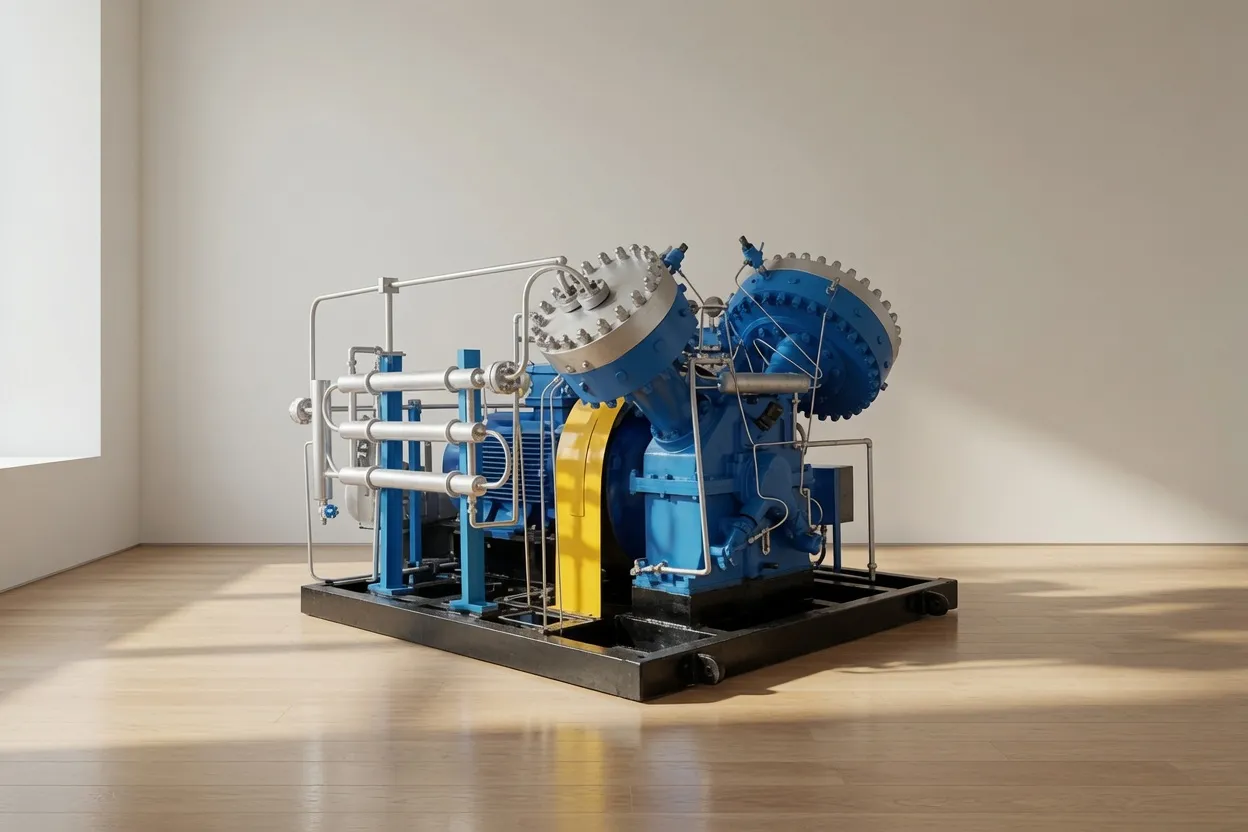
CM45D — Water-Lubricated Oil-Free Screw Compressor: The Structural Class 0 Foundation
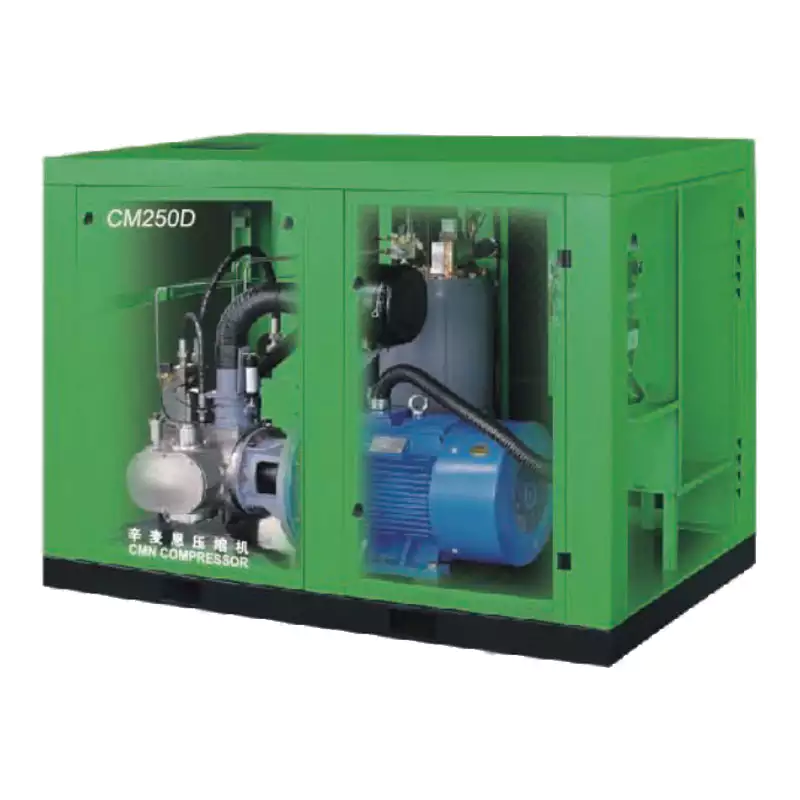
The CM45D water-lubricated oil-free screw compressor provides ISO 8573-1 Class 0 oil content by structural design — the absence of oil in the compression element, not the performance of a filter. In the context of this article, the CM45D represents the only compressor technology where the Class 0 oil claim is independent of any downstream filter performance. Combining the CM45D with a HOC desiccant dryer achieves Class 2 water (−40°C pdp) at zero energy cost, a coalescing filter achieves Class 1 particles, and a carbon adsorber removes atmospheric oil vapour to bring the system to full Class 1:2:0 compliance at the point of use — the complete specification for pharmaceutical, food direct contact, and aerospace applications.
Frequently Asked Questions
Australia Oil Free Air Compressor Co., Ltd.
Charlton Industrial Area, Australia | [email protected]