
Framing the Question: What Does “Sustainable” Actually Mean for Compressors?
The term “sustainable” is used casually in industrial equipment marketing in ways that can obscure more than they reveal. For a compressed air compressor, a meaningful sustainability assessment requires looking at the full lifecycle — from raw material extraction through manufacturing, operation, maintenance, and eventual disposal — and across multiple environmental dimensions, not just the one most favourable to the product being marketed.
For oil-free compressors, the genuinely strong sustainability credentials cluster in the operational phase: elimination of petroleum-derived lubricant consumption, reduction of hazardous waste generation, prevention of oil contamination in industrial condensate, and — in the case of water-injected designs — compatibility with water-based cooling that avoids refrigerant use in the compressor element itself.
This guide applies the GRI (Global Reporting Initiative) environmental standards framework as a structure for examining compressed air sustainability — the same framework used in formal ESG (Environmental, Social and Governance) reporting. For Australian manufacturers with sustainability reporting obligations under the ASX Corporate Governance Principles, the Climate-Related Financial Disclosures framework, or voluntary standards such as CDP, this structure aligns sustainability claims with reportable metrics.
Energy & Emissions: The Primary Sustainability Dimension
Operational energy consumption dominates the environmental impact of any industrial compressor over its service life. The sustainability case here is clear and quantifiable:
Modern oil-free screw compressors are routinely specified with VSD drives, reducing energy consumption by 20–35% compared to fixed-speed operation for variable-demand applications. While VSD technology is also available on oil-injected compressors, the market transition to oil-free has coincided with widespread VSD adoption — meaning oil-free selections typically arrive with better energy management as standard.
An oil-injected 37 kW compressor consumes approximately 200–400 litres of mineral oil annually. The full lifecycle emissions of this oil — extraction, refining, transport, consumption, and disposal — represent approximately 800–1,400 kg CO₂e per year that simply does not exist in an oil-free compressor’s footprint. Over a 15-year service life, this is 12–21 tonnes CO₂e of avoided emissions.
Oil-free compressors — particularly water-injected designs — produce a clean waste heat stream that can be recovered and used directly in facility heating or process applications without risk of oil contamination. Heat recovery from a 55 kW oil-free compressor can displace 25–35 MWh of natural gas heating annually, saving approximately 5–7 tonnes CO₂e per year from a Scope 1 (direct combustion) category.
Dry-screw oil-free compressors carry a 5–15% specific power penalty versus equivalent oil-injected units, meaning they consume more electricity per unit of compressed air produced. This partially offsets the lubricant lifecycle saving. Water-injected oil-free designs largely close this gap. The net energy position depends on specific technology, VSD specification, and operating conditions.
Waste & Pollution Prevention: Where Oil-Free Has a Clear Edge
The most unambiguous sustainability advantage of oil-free compressors lies in waste and pollution prevention. The downstream consequences of eliminating oil from the compression cycle touch multiple environmental pathways:
An oil-injected compressor produces condensate containing 50–200 mg/L of oil — classified as contaminated industrial wastewater under Australian water authorities’ trade waste regulations. This condensate cannot be discharged to stormwater (maximum 5 mg/L under Australian Runoff Water Quality standards) and requires oil-water separation before sewer disposal. A typical 37 kW compressor generates 30–60 litres of condensate per day in humid conditions — 10,000–20,000 litres annually — all requiring treatment. Oil-free compressor condensate contains no compressor oil and is typically dischargeable directly under standard trade waste agreements without requiring treatment infrastructure.
Oil-injected compressors generate three categories of scheduled waste in Australian states: used compressor oil (typically classified as Category C or equivalent scheduled waste requiring licensed disposal); oil-saturated filter elements from oil separator and coalescing filters; and oil-contaminated condensate requiring treatment. Annual hazardous waste disposal costs for a 37 kW oil-injected compressor commonly reach AUD $800–1,500 when properly managed. Oil-free compressors eliminate all three categories — reducing both environmental risk and compliance cost.
Compressor ventilation air from an oil-injected system carries trace oil mist that is exhausted to atmosphere through the compressor room ventilation system. While this emission is diffuse and difficult to measure, it represents a real release of petroleum hydrocarbons to air that does not occur with oil-free equipment. In facilities where EPA licence conditions address air emissions (common for larger manufacturing operations), eliminating this source of petroleum aerosol emission supports compliance with air quality conditions.
Water-lubricated oil-free screw compressors use water as the lubricant and coolant in the compression element. This does require a potable water supply — typically 3–8 litres per hour for a 45 kW unit — with the water recirculated through a cooling circuit. The water consumption is modest compared to other industrial water uses and eliminates the need for petroleum lubricant entirely. In facilities with water recycling infrastructure, compressor cooling water can be integrated into the facility water balance.
ESG Reporting: How Oil-Free Compressors Contribute to Sustainability Disclosures
Australian companies with ESG reporting obligations — whether under mandatory ASIC climate disclosure requirements, voluntary CDP reporting, or supply chain sustainability requirements from multinational customers — can reference oil-free compressor technology across multiple GRI standard disclosures.
| GRI Standard | Disclosure Topic | How Oil-Free Compressors Contribute |
|---|---|---|
| GRI 302: Energy | Energy consumption, intensity, reductions | VSD drive reduces energy consumption 20–35%; quantifiable energy reduction initiative |
| GRI 305: Emissions | Scope 1, 2, 3 GHG emissions | Reduces Scope 2 (electricity), eliminates lubricant Scope 3; heat recovery reduces Scope 1 |
| GRI 306: Waste | Waste generated, diverted, directed to disposal | Eliminates used oil (hazardous waste) and oil-contaminated filter waste streams |
| GRI 303: Water | Water withdrawal, consumption, discharge | Condensate discharge quality improves; no oil-water separation required for sewer discharge |
| GRI 307: Environmental Compliance | Non-compliance with environmental laws | Eliminates risk of trade waste non-compliance from untreated condensate discharge |
| GRI 416: Customer Health & Safety | Product safety incidents | ISO Class 0 air eliminates oil contamination risk in food, pharmaceutical, medical product manufacturing |
Lifecycle Analysis: Manufacturing and End-of-Life Considerations
A complete sustainability assessment requires looking beyond the operational phase to the embodied environmental impact of manufacturing and the end-of-life recyclability of the equipment. This is where honest analysis reveals some nuances that pure operational metrics miss.
Oil-free compressors typically use more precision-machined components (tighter rotor tolerances for dry-screw designs; precision water seals for water-injected designs) than equivalent oil-injected units. This may result in slightly higher embodied carbon in manufacture — estimated at 5–15% more total material processing energy. However, as discussed in Article 42, embodied carbon typically represents less than 0.5% of lifetime operational emissions, making this difference negligible at the system level.
Water-lubricated oil-free screw compressors benefit from the superior cooling properties of water compared to oil — discharge air temperatures are lower, rotor operating temperatures are lower, and thermal stress on seals and bearings is reduced. This typically results in longer bearing and rotor life compared to equivalent oil-injected units at comparable operating conditions. Longer service life means fewer replacement compressors required over a facility’s lifetime — a genuine circular economy benefit.
Oil-free compressors eliminate the oil separator element — the highest-volume consumable in an oil-injected rotary screw compressor, replaced annually and classified as hazardous waste due to oil impregnation. The remaining filter elements (air inlet, coalescing downstream) are standard waste. Across a 15-year service life, this equates to eliminating approximately 15 oil separator elements and 120+ litres of used oil from the facility’s waste stream.
Both oil-free and oil-injected compressors are primarily composed of recyclable metals (steel, aluminium, copper) that can be recovered through standard metal recycling pathways. The end-of-life advantage of oil-free equipment is the absence of oil-contaminated components — the air end, cooling system, and receiver of an oil-free unit do not require decontamination before metal recovery, reducing the processing burden at the recycler.
Honest Assessment: Where Oil-Free Claims Need Qualification
Intellectual honesty in sustainability reporting requires acknowledging where claims are qualified or where the evidence is more nuanced than marketing language suggests:
Water-injected compressors require water treatment chemicals to prevent scale, corrosion, and biological growth in the water circuit — typically biocides and corrosion inhibitors added to the water supply. The environmental footprint of these chemicals, while small, is not zero. The claim that water-lubricated compressors are entirely chemical-free is inaccurate; they are oil-free, which is the relevant claim for product contact applications.
Some dry-screw oil-free compressor designs use PTFE-coated rotor surfaces or timing gear lubricants that contain per- and polyfluoroalkyl substances (PFAS). PFAS are persistent environmental contaminants subject to increasing regulatory attention globally. Buyers concerned about PFAS in their supply chain should ask compressor manufacturers specifically about PTFE and PFAS content in dry-screw designs.
The single most impactful sustainability action for compressed air is reducing system leaks — not the choice of compressor type. A 25% leak rate in an existing oil-injected system wastes more energy than the efficiency difference between any oil-injected and oil-free compressor. Leak reduction, pressure optimisation, and heat recovery all deliver larger absolute sustainability improvements than lubrication type selection alone. Oil-free technology is a genuine sustainability improvement at equivalent efficiency — it is not a substitute for fundamental system efficiency measures.
Building a Credible Sustainability Narrative for Your Compressed Air System
For Australian manufacturers developing sustainability reports, responding to customer ESG questionnaires, or building a credible green manufacturing narrative, the compressed air system can be a meaningful contributing element — but only if the claims are grounded in verified data rather than unsubstantiated assertions.
Measure or calculate current compressor electricity consumption, lubricant volume, condensate volume, and waste disposal quantities. This baseline makes subsequent improvement claims credible and quantifiable.
When upgrading to oil-free equipment, quantify the actual changes: energy consumption before and after (ideally via submetering), lubricant purchases eliminated, hazardous waste disposal invoices before and after, and condensate treatment system cost savings.
Express improvements in terms that align with standard ESG reporting categories: kg CO₂e avoided (using NGERS emissions factors), cubic metres of contaminated wastewater eliminated, kilograms of hazardous waste avoided, and gigajoules of energy saved.
Third-party verification of energy savings and emissions calculations — available through NABERS energy auditors, ISO 50001 energy management certification, and NATA-accredited compressed air testing — gives sustainability claims the credibility required for formal ESG reporting and customer due diligence responses.
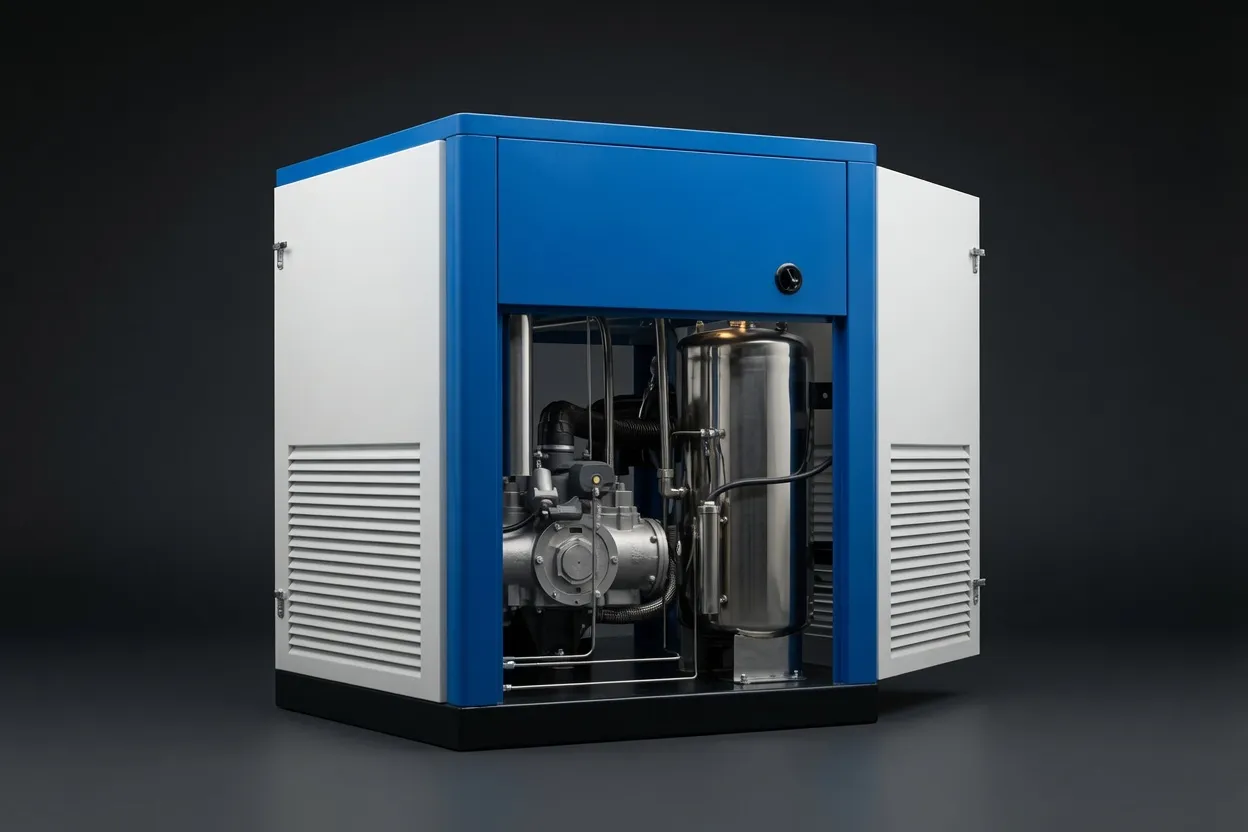
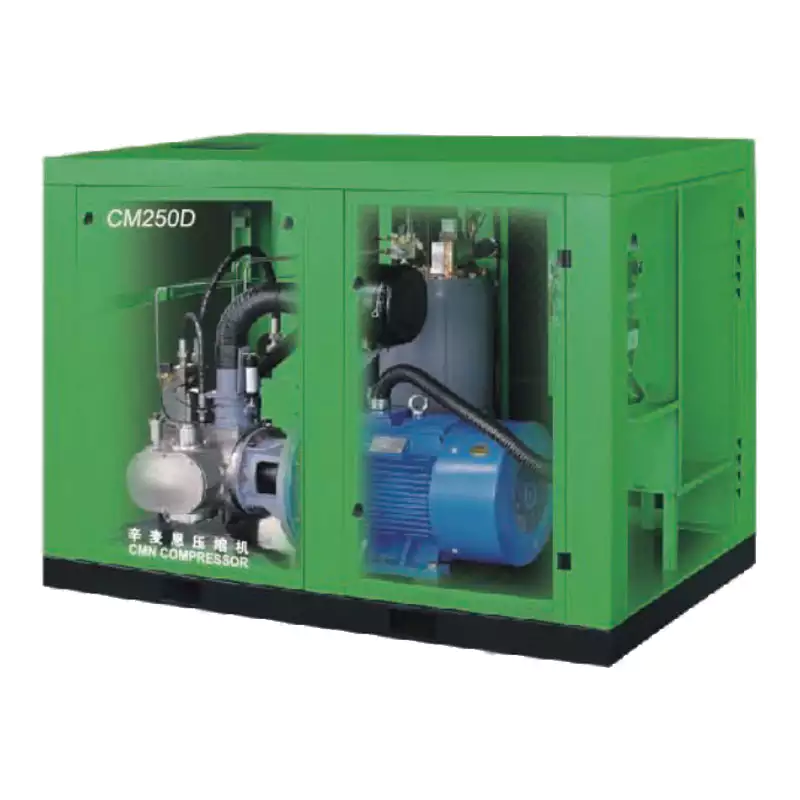
The CM45D delivers the broadest range of verified sustainability benefits in a single compressor package: zero petroleum lubricant use (eliminating oil lifecycle emissions and hazardous waste); clean condensate discharge (no oil-water separation required); VSD drive with permanent magnet motor (lowest specific power at all load points); low discharge temperature (extended rotor and bearing life, reduced cooling energy); and ISO Class 0 air certification (enabling product-contact air quality that eliminates rework and product waste in sensitive manufacturing). All of these benefits are documentable and reportable under standard ESG frameworks.
Frequently Asked Questions
Can I include oil-free compressor upgrades in our Scope 3 sustainability reporting?
Does ISO 14001 environmental management certification require oil-free compressors?
Is there an Australian standard for reporting compressed air environmental performance?
How do customers or auditors verify that our compressors are genuinely oil-free?
What sustainability claims can I legitimately make about switching to oil-free compressed air?
Australia Oil Free Air Compressor Co., Ltd. supplies oil-free compressor systems with documented sustainability credentials, supporting your ESG reporting, customer sustainability audits, and environmental compliance. Charlton Industrial Area.