
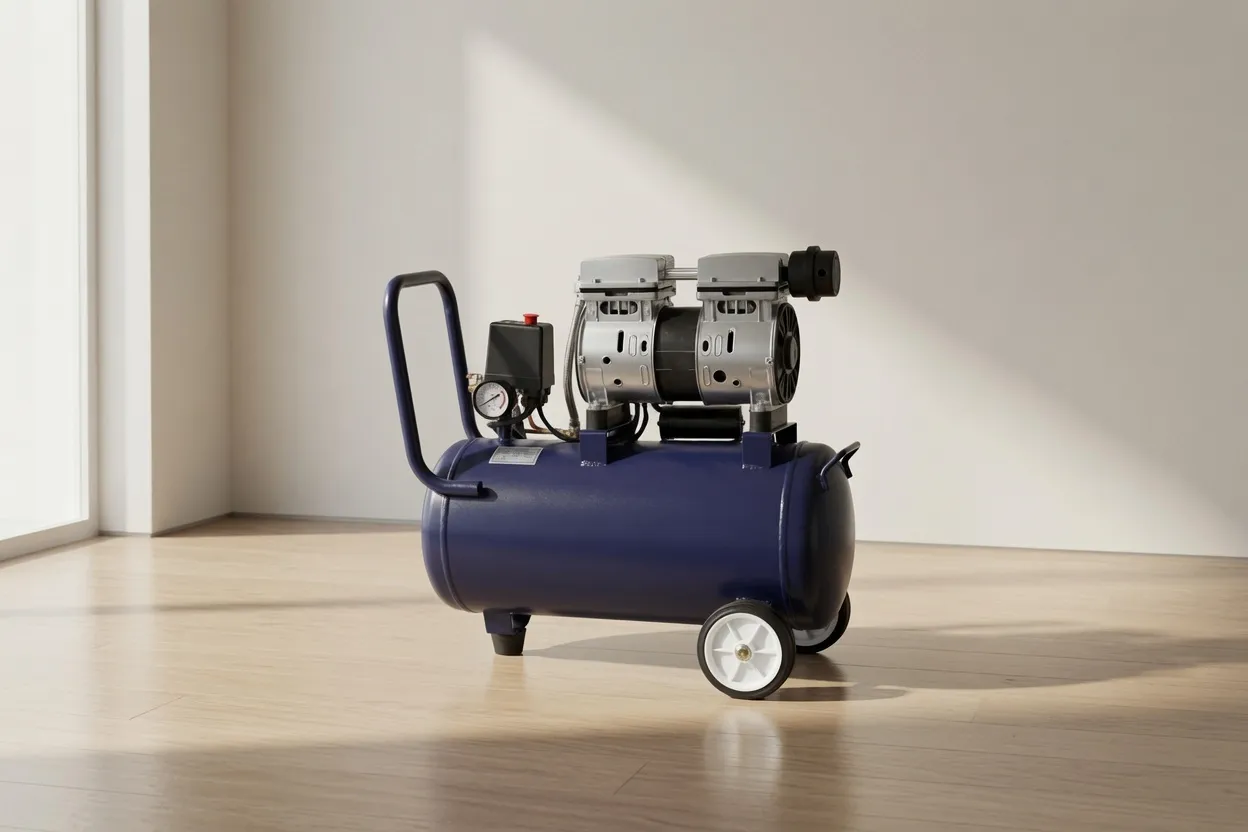
What Is Compressor Condensate and How Much Does Your System Produce?
Compressed air condensate forms because ambient air contains water vapour that concentrates dramatically during compression. When air is compressed to 7 bar, its volume reduces to roughly one-eighth of the original — and the water-holding capacity of that air at compressed conditions is far lower than the vapour it carried at atmospheric pressure. The excess moisture falls out as liquid condensate at every point in the system where temperature drops: in the aftercooler, in the air receiver, along the distribution pipework, and in the air dryer.
The quantity of condensate generated depends on three factors: compressor output flow (CFM), ambient air temperature, and ambient relative humidity. In a tropical or coastal Australian location during summer — Darwin, Cairns, Brisbane, Sydney — a single 37 kW compressor can easily generate 80–120 litres of condensate per day. In a dry inland location during winter, the same compressor might produce 20–30 litres per day. Annual condensate production for a medium-sized industrial compressor in a humid Australian climate commonly reaches 10,000–25,000 litres.
That volume — up to 25,000 litres per year — must be collected, managed, and disposed of in a manner that complies with Australian state EPA regulations and water authority trade waste requirements. Understanding what that condensate contains is the first step to understanding the applicable disposal rules.
What Is Actually in Oil-Free Compressor Condensate?
The composition of condensate from an oil-free compressor is significantly different from that produced by an oil-injected unit — but it is not simply clean water. Understanding the actual composition is essential for applying the correct disposal pathway.
- ▸ Water — the dominant component, 95–99% by volume. Condensed atmospheric moisture concentrated during compression.
- ▸ Atmospheric contaminants — particulate matter, dust, and aerosols drawn in with intake air. Concentration depends on intake air quality.
- ▸ Dissolved gases — trace carbon dioxide, nitrogen oxides, and sulphur compounds from ambient air, slightly acidifying the condensate (pH typically 5.5–7.0).
- ▸ Compressor component trace metals — very low levels of zinc, copper, or aluminium from compressor internals, depending on material of construction.
- ▸ Environment-specific contamination — salt in coastal or seafood processing facilities; solvents near painting or coating operations; biological material in food processing environments.
- ✓ Compressor oil — the defining difference. No petroleum-derived lubricant enters the compression element in an oil-free design, so none can appear in the condensate.
- ✓ Oil degradation products — oil-injected systems generate acidic breakdown compounds from heat-stressed lubricant that lower condensate pH to 3.5–5.0. Absent in oil-free condensate.
- ✓ Oil additive chemistry — anti-wear compounds, rust inhibitors, detergent packages in compressor oils contain metals and biocides. Not present in oil-free condensate.
- ✓ Emulsified oil droplets — the primary contaminant driving trade waste treatment requirements for oil-injected condensate. Eliminated at source with oil-free compression.
Water-lubricated oil-free screw compressors (such as the CM45D and CM132DV series) produce condensate that also contains the water treatment chemicals added to the compressor water circuit — typically corrosion inhibitors and biocides at low concentration. While these are not petroleum-derived contaminants and the condensate remains far simpler to manage than oil-injected condensate, the water treatment chemical content should be disclosed in trade waste agreement applications. The chemical supplier’s Safety Data Sheets provide the relevant composition data for this purpose.
Australian Trade Waste Regulations: State-by-State Requirements
In Australia, any wastewater discharged to the sewer from a business premises — including compressed air condensate — is classified as trade waste. Trade waste discharge requires a formal agreement (or permit) with the local water authority, specifying the permissible composition of the discharged liquid. Discharge to stormwater is prohibited under EPA legislation in all states and carries significant penalties.
The critical distinction for oil-free compressor condensate is that it does not contain oil — and oil is the primary contaminant that water authorities require facilities to manage through treatment infrastructure. The practical implications by state:
| State / Water Authority | Oil & Grease Sewer Limit | Oil-Injected Condensate | Oil-Free Condensate | Agreement Requirement |
|---|---|---|---|---|
| NSW (Sydney Water) | 50 mg/L | 50–200 mg/L — fails | <5 mg/L — passes | Standard agreement; no treatment required for oil-free |
| Victoria (Melbourne Water) | 50 mg/L | 50–200 mg/L — fails | <5 mg/L — passes | Standard agreement; PIW obligations for oil-injected only |
| Queensland (Urban Utilities) | 30 mg/L | 50–200 mg/L — fails | <5 mg/L — passes | Tightest oil limit in Australia; oil-free easily compliant |
| South Australia (SA Water) | 50 mg/L | 50–200 mg/L — fails | <5 mg/L — passes | Standard agreement; annual compliance declaration |
| WA (Water Corporation) | 100 mg/L | 50–200 mg/L — borderline | <5 mg/L — passes | Higher limit but oil-free still simplest path |
| NT (Power and Water) | 50 mg/L | 50–200 mg/L — fails | <5 mg/L — passes | High condensate volumes (tropical humidity) — oil-free critical |
A trade waste agreement for oil-free compressor condensate is a straightforward administrative process in most jurisdictions — the facility notifies the water authority of the condensate discharge (volume, frequency, composition), receives an agreement number, and discharges to the sewer under the agreement. No treatment infrastructure is required, no periodic analytical testing of the condensate is typically mandated, and no licensed waste contractor is needed.
By contrast, an oil-injected compressor requires: an oil-water separator (OWS) costing AUD $3,000–8,000 to install; periodic replacement of the OWS coalescing media; periodic analytical testing of the treated condensate to verify the separator is performing within the discharge limit; and the additional complexity of managing the recovered oil as a scheduled waste stream.
Prohibited Disposal Methods: What You Must Not Do
Even though oil-free compressor condensate is significantly cleaner than oil-injected condensate, certain disposal routes remain prohibited under Australian environmental law regardless of condensate composition. Understanding these prohibitions prevents well-intentioned but non-compliant disposal practices.
Discharging any trade waste — including condensate from an oil-free compressor — directly to a stormwater drain, gutter, kerb, or any drainage that leads to a waterway is prohibited under state EPA legislation throughout Australia. The prohibition applies regardless of condensate composition. Penalties under the Protection of the Environment Operations Act (NSW), Environment Protection Act (VIC), and equivalent state legislation can reach AUD $1 million for corporations for deliberate discharge, with lesser penalties for negligent or accidental discharge. Stormwater systems are not designed for trade waste and connect directly to waterways and coastal waters.
Discharging condensate onto soil, grass, or unpaved ground — even in remote areas or on large rural properties — is classified as unlawful disposal of trade waste in most jurisdictions. Even clean condensate can carry dissolved atmospheric contaminants and trace metals that accumulate in soil over time. In areas near waterways or aquifer recharge zones, ground disposal creates contamination pathways that EPA officers take seriously under the National Environment Protection Measure for the Assessment of Site Contamination.
Evaporation ponds or sumps used to dispose of condensate by allowing it to evaporate from an open container or lined pit are a form of waste disposal that typically requires EPA works approval in most Australian jurisdictions. Without formal approval, an evaporation pond is an unlicensed waste depot — carrying enforcement risk regardless of what the condensate contains. Remote mining and pastoral operations sometimes use this method under existing site licences; urban and industrial facilities should not rely on this pathway without specific approval.
Discharging condensate to the sewer without a formal trade waste agreement is technically non-compliant in all jurisdictions, even if the condensate itself would meet the applicable quality limits. The trade waste agreement requirement is procedural — it ensures the water authority has notified the discharge, assessed its impact on the sewer system, and issued approval conditions. Many small businesses unknowingly discharge condensate to the sewer without an agreement; while enforcement risk is lower than for stormwater discharge, it remains a compliance gap that a water authority audit could identify.
Compliant Disposal Methods for Oil-Free Compressor Condensate
For oil-free compressor condensate, the approved disposal pathways are simpler and cheaper than for oil-injected systems. The correct approach depends on facility type, location, and volume:
Recommended
The simplest and most commonly used disposal pathway for oil-free condensate in urban and industrial facilities. Contact your local water authority’s trade waste team, provide condensate volume estimates (litres per day, averaged over the year), and describe the compressor type and condensate composition. For oil-free condensate, trade waste agreements are typically straightforward to obtain — the authority will issue an agreement specifying the permissible discharge volume and any monitoring requirements. Most oil-free facilities are assessed as low-risk trade waste generators with minimal ongoing compliance obligations.
Common in Food & Beverage
Facilities with existing process wastewater treatment systems — food processing, beverage manufacturing, pharmaceutical production — can typically route oil-free compressor condensate into their existing wastewater collection system for co-treatment and discharge. The clean nature of oil-free condensate means it does not adversely affect downstream treatment systems, and the condensate volume is minor compared to typical process wastewater flows. This approach consolidates compliance under the existing trade waste agreement rather than requiring a separate condensate agreement.
Seafood, Chemicals, Mining
In environments where intake air quality is very poor — seafood processing (high salt and organic content), chemical manufacturing (solvent vapours in intake air), or mining (heavy metal dust) — the condensate composition may be elevated above standard trade waste limits even from an oil-free compressor. In these cases, collection by a licensed liquid waste contractor for off-site treatment and disposal is the appropriate pathway. The condensate is collected in a dedicated tank, scheduled for regular collection, and disposed of under a liquid waste transportation licence.
Water-Stressed Facilities
Oil-free compressor condensate is essentially distilled water — it is low in dissolved solids and free of oil. With basic pH adjustment (to neutralise the slight acidity from dissolved atmospheric CO₂) and microfiltration, oil-free condensate can be recovered for non-potable reuse applications such as cooling tower make-up, outdoor irrigation, toilet flushing, or cleaning water. This approach is appropriate for water-stressed facilities seeking to reduce mains water consumption and is eligible for water efficiency credits under NABERS Water and similar schemes. A water quality analysis of the condensate is required before implementing any reuse pathway.
Condensate Collection System Design for Oil-Free Compressors
A correctly designed condensate collection system ensures that condensate is captured completely, drains automatically without operator attention, and routes to the approved disposal pathway without risk of spillage or uncontrolled discharge.
All condensate collection points — the compressor aftercooler separator, the air receiver, the air dryer, and inline filter housings — must be fitted with automatic drain valves. Timed solenoid drains are the most common and economical type; zero-loss electronic level-sensing drains are more efficient (no compressed air wasted with each drain cycle) and are recommended for larger systems. All drains must be piped to a collection point — never left to discharge directly to floor or ground.
A dedicated condensate collection tank — typically 20–200 litres depending on compressor size and drain frequency — collects condensate from all drain points through a common manifold. The tank should be located in a bunded area to contain any spill, fitted with a high-level alarm if unmanned overnight, and connected via a fixed pipe or heavy-duty hose to the approved discharge point (sewer, process drain, or collection vessel for removal). Never use a portable container that staff manually empty — spillage risk is too high.
In facilities where condensate collection pipework passes through areas that fall below 0°C — blast freezers, cold stores, outdoor pipe runs in southern Australia during winter — condensate can freeze in drain lines and collection pipework. Insulate all condensate lines in cold zones, and consider heat-traced drain lines for critical cold-store installations. Frozen drain lines cause condensate back-up into the air system and potential carryover into the distribution pipework — the opposite of what the collection system is designed to achieve.
Even for compliant sewer discharge of oil-free condensate, maintaining basic disposal records is recommended — particularly for food, pharmaceutical, or environmentally certified facilities where auditors may request evidence of wastewater management. Records should include: trade waste agreement number, estimated daily condensate volume, drain valve service dates, and any anomalies observed (unusual colour, odour) that might indicate a contamination event upstream in the compressed air system.
Total Cost Comparison: Oil-Free vs Oil-Injected Condensate Management
The financial advantage of oil-free condensate management over oil-injected is substantial when all compliance costs are included across a 10-year operating period for a single 37 kW compressor:
| Cost Item | Oil-Injected (10 yr) | Oil-Free (10 yr) |
|---|---|---|
| Oil-water separator purchase & installation | AUD $5,000–8,000 | $0 |
| Oil-water separator media replacement (every 2 yr) | AUD $2,500–5,000 | $0 |
| Condensate analytical testing (annual, accredited lab) | AUD $3,000–6,000 | $0 – $1,500 |
| Recovered oil disposal (licensed contractor, annual) | AUD $2,000–5,000 | $0 |
| Oil separator element disposal (hazardous waste, annual) | AUD $1,500–3,000 | $0 |
| Trade waste agreement (admin, periodic renewal) | AUD $500–1,500 | AUD $200–600 |
| Total 10-year condensate compliance cost | AUD $14,500–28,500 | AUD $200–2,100 |
The 10-year condensate compliance cost saving alone — AUD $12,000–26,000 per compressor — contributes meaningfully to offsetting the capital cost premium of oil-free equipment. For facilities operating multiple compressors, the cumulative compliance saving is substantial.
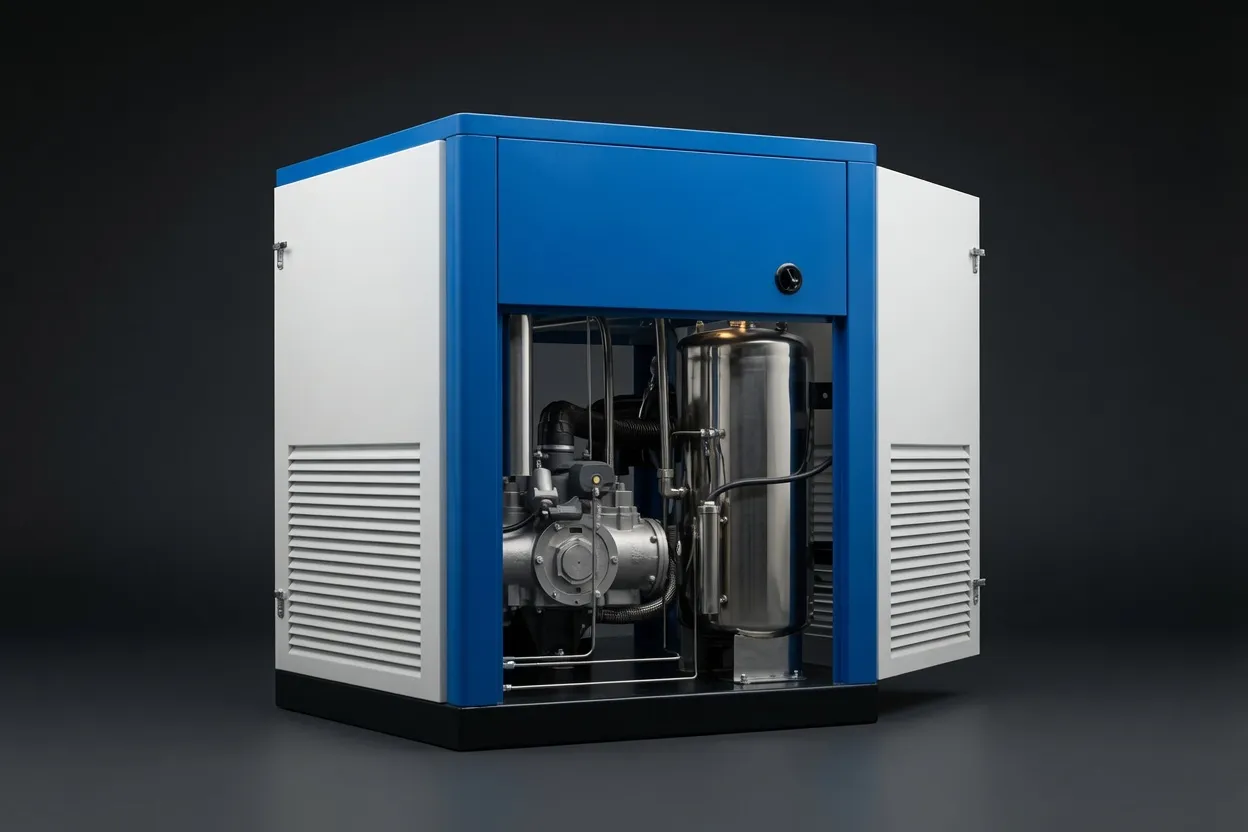
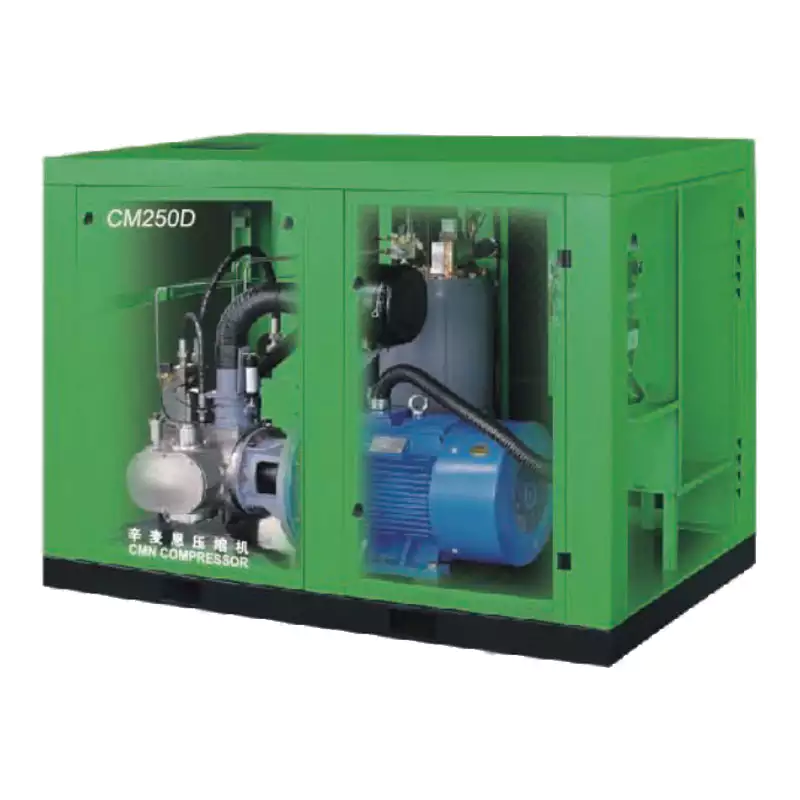
Because the CM45D uses water — not oil — as the sole lubricant and coolant in the compression element, its condensate is the cleanest of any compressor technology. No petroleum-derived lubricant, no oil additive chemistry, no emulsified oil droplets. The condensate consists primarily of water with atmospheric contaminants and trace amounts of the water treatment chemistry used in the compressor’s water circuit. This makes the CM45D’s condensate compliant with sewer discharge limits under standard trade waste agreements throughout Australia, with no oil-water separation infrastructure required. In food, pharmaceutical, and export-certified manufacturing environments where condensate management is part of the environmental compliance audit, the CM45D’s clean condensate profile is a genuine operational and documentary advantage.
Frequently Asked Questions
Do I need a trade waste agreement even if my oil-free condensate is clean enough for the sewer?
Can I dispose of oil-free condensate to the garden or on-site vegetation?
What does oil-free condensate smell like, and could an unusual smell indicate a problem?
How do I estimate condensate volume for a trade waste agreement application?
Our facility switched from oil-injected to oil-free. Do we need to update our trade waste agreement?
Australia Oil Free Air Compressor Co., Ltd. supplies oil-free compressor systems that eliminate oil-water separation infrastructure and simplify trade waste compliance across all Australian jurisdictions. Based in the Charlton Industrial Area.