
Where Does the Carbon in Compressed Air Come From?
The carbon footprint of an industrial compressed air system is dominated by a single factor: the electricity consumed to drive the compressor motor over its operating life. For a 37 kW compressor running two shifts per day in Australia, electricity consumption over a 15-year service life exceeds 14,000 MWh — at the current Australian national grid emissions intensity of approximately 0.51 kg CO₂e/kWh (2024–25 average, declining annually as renewable penetration increases), this equates to over 7,000 tonnes of CO₂e over the compressor’s working life.
Against this operational emissions figure, the embodied carbon of the compressor hardware — the steel, copper, and aluminium used in manufacture — is relatively minor, typically 2–5 tonnes CO₂e for a 37 kW unit. The carbon in the lubricating oil consumed by an oil-injected compressor (approximately 200–400 litres per year) adds a further 0.5–1 tonne CO₂e annually, plus the upstream extraction and refining emissions of the petroleum-derived lubricant. For an oil-free compressor, this oil-cycle emissions component is eliminated entirely.
This analysis establishes the fundamental principle: the biggest lever for reducing compressed air carbon footprint is reducing electricity consumption. Every other factor — lubricant type, refrigerant choice, manufacturing location — is secondary. The question of how oil-free compressors affect carbon footprint is therefore primarily a question of how they affect energy efficiency.
Energy Efficiency: Oil-Free vs Oil-Injected — The Real Comparison
The claim that oil-free compressors are inherently less energy efficient than oil-injected units is a persistent industry myth that deserves careful examination. The efficiency gap, where it exists, has narrowed substantially over the past decade and is now largely a function of compressor configuration rather than lubrication type.
| Compressor Type | Specific Power (kW/100 CFM) | Relative Efficiency | Notes |
|---|---|---|---|
| Oil-injected screw (fixed speed) | 16–19 | Baseline | Poor at part load — runs fully loaded or unloaded |
| Oil-injected screw (VSD) | 15–18 | 5–15% better | Good part-load efficiency; common reference point |
| Oil-free dry screw (fixed speed) | 18–22 | 5–15% worse | No oil film sealing — tighter rotor tolerances required |
| Oil-free water-injected screw (VSD) | 15–18 | Equivalent to oil-injected VSD | Water film sealing recovers efficiency vs dry screw |
| Oil-free two-stage screw (VSD) | 13–16 | Up to 15% better | Intercooling between stages reduces compression work |
| Oil-free centrifugal (large, >200 kW) | 13–15 | Best at full load | Poor turndown; requires inlet guide vanes for part load |
The data shows that a modern oil-free water-injected screw compressor with VSD drive achieves essentially the same specific power as an equivalent oil-injected VSD unit — eliminating the efficiency penalty of earlier dry-screw oil-free designs. A two-stage oil-free screw configuration actually outperforms most oil-injected single-stage units on specific power, delivering a genuine energy and carbon advantage.
The key insight is that VSD drive technology — not lubrication type — is the dominant energy efficiency variable in modern compressor selection. A fixed-speed oil-injected compressor and a fixed-speed oil-free compressor both waste significant energy in unloaded running. The efficiency advantage of VSD drive (20–35% energy reduction for variable-demand applications) dwarfs any lubrication-related efficiency difference.
Calculating the Carbon Footprint of Your Compressed Air System
A meaningful carbon footprint calculation for a compressed air system covers four components. Here is the methodology with worked examples based on Australian conditions:
Formula: Motor kW × Operating hours/year × Load factor × Grid emissions intensity (kg CO₂e/kWh)
37 × 4,000 × 0.70 × 0.51 = 52,668 kg CO₂e/year (52.7 tonnes)
Oil-injected compressors consume approximately 200–400 L of mineral oil annually. The lifecycle emissions of mineral compressor oil (extraction, refining, transport, disposal) are approximately 3.0–3.5 kg CO₂e per litre.
300 × 3.2 = 960 kg CO₂e/year — eliminated with oil-free compressor
Refrigerated air dryers use HFC refrigerants with high global warming potential (GWP). R134a has a GWP of 1,430; R410A has a GWP of 2,088. Typical refrigerant charge for an industrial dryer is 0.5–2 kg. Annual leakage rate is assumed at 2–5% per Australian NGERS methodology.
1.0 × 0.03 × 2,088 = 62.6 kg CO₂e/year — minor but reportable under NGERS
Manufacturing a 37 kW industrial compressor requires approximately 500–800 kg of steel, 50–100 kg of copper, and 30–60 kg of aluminium. Total embodied carbon including manufacturing energy is approximately 2–4 tonnes CO₂e per unit, amortised over a 15-year life.
3,000 ÷ 15 = 200 kg CO₂e/year — less than 0.4% of operational emissions
For the example 37 kW compressor, switching from a fixed-speed oil-injected unit to an oil-free VSD model eliminates the lubricant emissions (960 kg CO₂e/year) and reduces operational emissions by approximately 25% through VSD efficiency (13,167 kg CO₂e/year saved). Total annual carbon saving: approximately 14,127 kg CO₂e — or 14 tonnes per compressor per year. Over a 15-year life at current Australian grid intensity, this represents a reduction of approximately 210 tonnes CO₂e.
The Australian Grid Emissions Factor: A Moving Target
The Australian electricity grid emissions intensity is declining steadily as renewable energy capacity increases. The national grid emissions factor published by the Clean Energy Regulator under NGERS has fallen from approximately 0.84 kg CO₂e/kWh in 2010 to around 0.51 kg CO₂e/kWh in 2024–25, and is projected to continue declining toward 0.3 kg CO₂e/kWh by 2030 as large-scale solar and wind projects come online.
This declining grid factor has an important implication for compressed air carbon footprint projections: the absolute operational emissions from a given compressor will decrease over time even without any equipment changes, simply because the electricity it consumes becomes progressively lower carbon. Facilities that have already invested in energy-efficient VSD oil-free compressors are well positioned to benefit from this trend — their energy consumption is fixed at a lower level, so their carbon footprint falls faster than a less efficient competitor as the grid decarbonises.
- Victoria0.93 kg CO₂e/kWh
- New South Wales0.70 kg CO₂e/kWh
- Queensland0.73 kg CO₂e/kWh
- South Australia0.31 kg CO₂e/kWh
- Western Australia (SWIS)0.61 kg CO₂e/kWh
Source: Clean Energy Regulator, NGERS Technical Guidelines. State factors reflect different renewable penetration and fuel mix. Use state factor for Scope 2 emissions reporting.
Every 10% improvement in compressor efficiency translates directly to a 10% reduction in carbon emissions. For a 75 kW compressor running 6,000 hours/year in NSW (0.70 kg CO₂e/kWh):
Heat Recovery: The Largest Carbon Reduction Opportunity in Compressed Air
Of all the ways to reduce the carbon footprint of a compressed air system, heat recovery offers the highest potential return with zero impact on compression efficiency. Approximately 94% of the electrical energy used to drive a compressor is converted to heat in the compressed air and cooling system — and in most facilities, this heat is simply dissipated to atmosphere through the compressor cooling system.
Recovering this waste heat and using it to displace natural gas or LPG heating in the facility can reduce total facility carbon emissions substantially. For an oil-free compressor system, heat recovery is particularly clean — there is no risk of oil contamination in the recovered heat stream, which enables direct use in applications including space heating, process hot water, and in some cases low-temperature drying processes.
- Compressor: 55 kW oil-free screw
- Operating hours: 4,500 hr/year
- Average load: 80%
- Heat recovery efficiency: 70% of input power
- Displaced fuel: Natural gas
- Natural gas emissions: 0.053 kg CO₂e/MJ
- Heat available: 55 × 0.80 × 0.70 = 30.8 kW
- Annual heat recovered: 30.8 × 4,500 = 138,600 kWh
- In MJ: 138,600 × 3.6 = 499,000 MJ
- Gas displaced: 499,000 MJ
- CO₂e saved: 499,000 × 0.053 = 26.4 tonnes/year
This 26.4 tonne annual saving from heat recovery alone represents approximately 50% of the compressor’s operational electricity emissions — making heat recovery the most impactful single action most facilities can take to reduce their compressed air carbon footprint, regardless of whether they run oil-free or oil-injected equipment.
NGERS Reporting: How to Account for Compressed Air in Scope 1 and Scope 2
Australian facilities that trigger NGERS (National Greenhouse and Energy Reporting) thresholds — currently 200 TJ of energy consumption or 25,000 tonnes CO₂e of emissions per year at facility level — must report greenhouse gas emissions from all significant energy uses, including compressed air systems.
Under NGERS methodology, compressed air system emissions are reported as follows. Electricity consumed by compressor motors is reported as Scope 2 (purchased electricity) emissions using the relevant state or national grid emissions factor. Refrigerant leakage from dryers is reported as Scope 1 (direct) emissions using the refrigerant’s GWP value from the NGERS Technical Guidelines. Lubricant consumption (for oil-injected compressors) is not typically reported as a direct emission under NGERS — it is treated as a purchased material — but the indirect emissions from lubricant lifecycle may be reportable under voluntary Scope 3 frameworks such as the GHG Protocol Corporate Standard.
For NGERS-reporting facilities, switching to an oil-free VSD compressor reduces Scope 2 emissions (through lower energy consumption) and eliminates any Scope 1 refrigerant reporting associated with the compressor oil cooling circuit if the new unit uses a different cooling configuration. It also supports Scope 3 reporting by eliminating the lubricant supply chain emissions from the compressed air system’s value chain.
Five Actions That Reduce Compressed Air Carbon Footprint Today
The average industrial compressed air system loses 20–30% of production through leaks. Each 1% of compressed air production wasted to leaks in a 55 kW system wastes approximately 550 kWh/year — about 280–640 kg CO₂e/year per 1% leak rate. A systematic leak detection and repair programme using ultrasonic detection equipment is the highest-ROI carbon reduction action available in most facilities, with payback periods under 6 months.
Every 1 bar of unnecessary system pressure increases compressor energy consumption by approximately 7%. Running a system at 8.5 bar when the highest-demand application only requires 7 bar wastes approximately 10.5% of compression energy — a pure efficiency and carbon loss. A systematic pressure audit, identifying the true pressure requirements at each use point and setting the compressor to the minimum effective system pressure, typically recovers 5–15% of compression energy with no capital cost.
A fixed-speed compressor running at part load wastes energy through unloaded running — the compressor motor continues to consume 20–40% of its rated power while producing no useful compressed air. A VSD compressor reduces motor speed precisely to match demand, eliminating this waste. For a variable-demand application (most production environments), VSD drives typically save 20–35% of annual energy consumption compared to fixed-speed operation.
As demonstrated in Section 5, recovering compressor waste heat to displace fossil fuel heating can save 20–30 tonnes CO₂e per year for a mid-sized compressor system. Heat recovery payback periods are typically 2–4 years when displacing natural gas at current Australian prices.
When existing oil-injected compressors reach end of service life, replacing them with oil-free VSD units eliminates lubricant lifecycle emissions, reduces maintenance waste (filter elements, oil disposal), and positions the facility for the cleanest possible carbon accounting as sustainability reporting requirements increase. The capital cost premium of oil-free technology has narrowed significantly over the past decade and is increasingly offset by lower total cost of ownership.
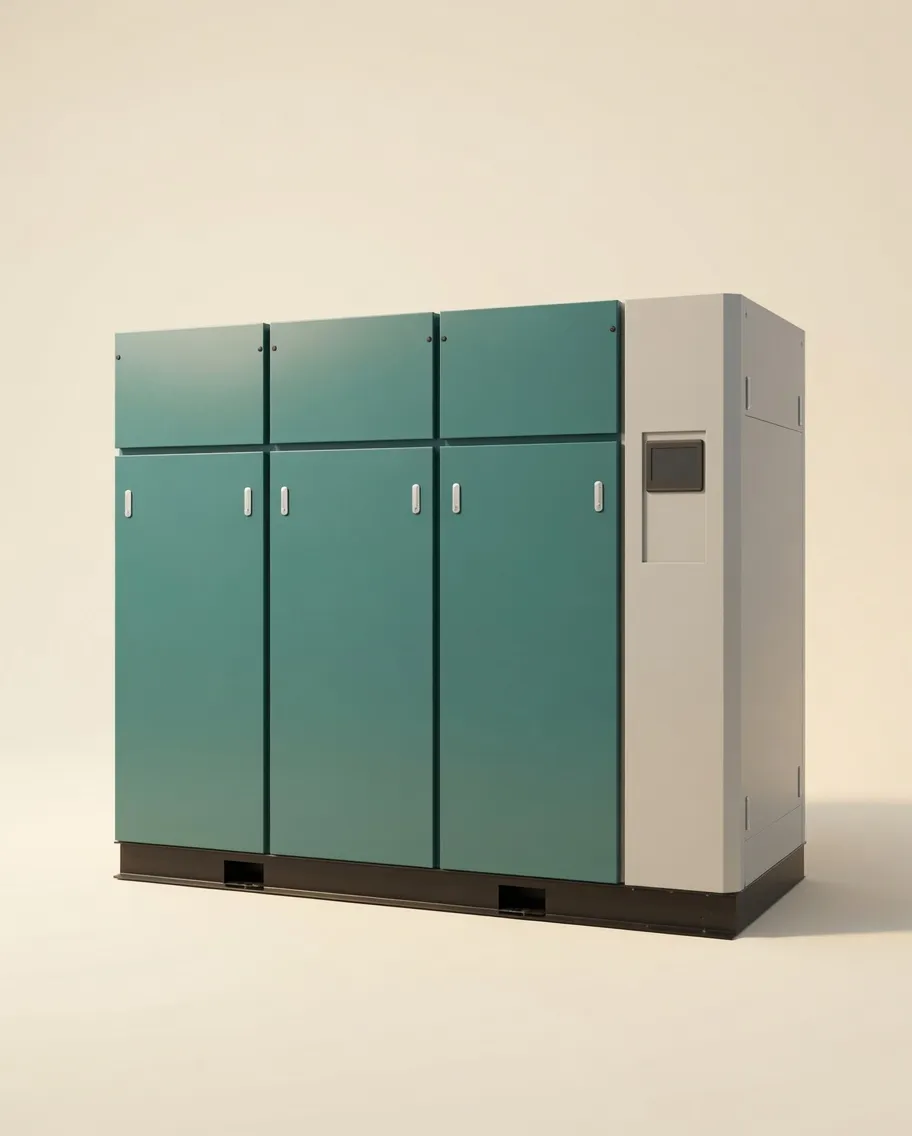
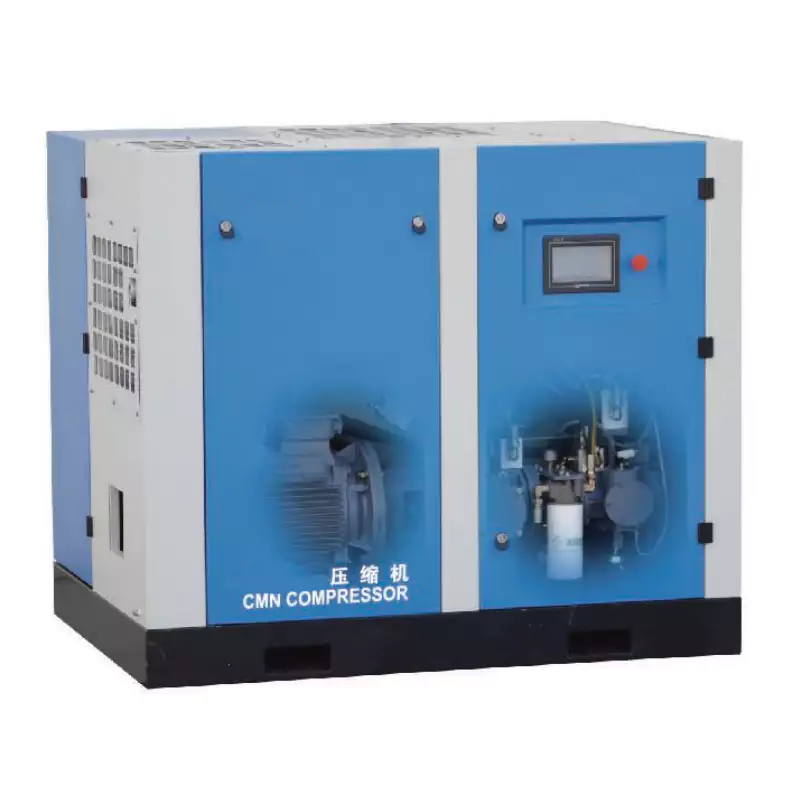
The CM132DV combines water lubrication (eliminating oil-cycle emissions entirely), permanent magnet VSD drive (achieving the lowest specific power across the operating load range), and integrated heat recovery capability. For sustainability reporting purposes, it offers the simplest possible carbon accounting for compressed air: no lubricant lifecycle emissions, no oil-contaminated condensate waste stream, and documented energy performance data for Scope 2 emissions reporting. The water-injection technology matches the efficiency of premium oil-injected VSD units while delivering genuine ISO Class 0 air.
Frequently Asked Questions
Are oil-free compressors actually more energy efficient than oil-injected?
How do I calculate my compressed air system’s carbon footprint for NGERS reporting?
What is the payback period on replacing a fixed-speed compressor with an oil-free VSD?
Can I claim carbon credits for installing an energy-efficient oil-free compressor?
Does the source of electricity matter for compressed air carbon footprint?
Australia Oil Free Air Compressor Co., Ltd. helps Australian manufacturers reduce energy consumption and carbon emissions through oil-free VSD compressor technology and heat recovery systems. Charlton Industrial Area.