
Where Compressed Air Contacts Cosmetic Products
Compressed air is a fundamental process utility in cosmetics and personal care manufacturing, involved at more points in the production process than most manufacturing managers initially recognise. A comprehensive air quality management strategy must account for all contact points — not just the most obvious ones.
Compressed air is used to agitate or sparge product in mixing tanks, and to pressurise vessels during homogenisation. Direct contact between air and product occurs during sparging applications. Even vessel pressurisation (where air contacts the headspace above the product) carries contamination risk — oil aerosols condense on vessel surfaces and product contact surfaces, subsequently migrating into the formulation.
Many cosmetics facilities use air pressure to transfer product between vessels, through pipelines, and into filling equipment. Compressed air that contacts product during transfer directly contaminates the formulation. Aerosol propellant systems, pump actuation for viscous products, and airless dispensing systems all use compressed air in ways that risk product contamination if the air is not oil-free.
Automated filling lines for creams, lotions, serums, lipsticks, and powder products are extensively pneumatic — actuators, indexing mechanisms, nozzle controls, cap applicators, and label apply systems all use compressed air. While much of this is indirect contact, any actuator near a product-open container or filling station creates contamination risk through turbulent air displacement and aerosol carry.
Compressed air jets are widely used to purge containers, bottles, jars, and tubes before filling — removing manufacturing debris, dust, and particles from inside packaging before product contact. If this purge air is contaminated with oil aerosol, the cleaning step actively introduces contamination into the container rather than removing it. This is one of the most commonly overlooked contamination pathways in cosmetics facilities switching from oil-lubricated compressors.
Compressed air is used in QC laboratories for instrument operation, sample preparation, and analytical equipment. Contamination in laboratory air can introduce false positives in microbial testing, interfere with HPLC sample preparation, and corrupt stability testing results. Laboratory compressed air is often overlooked in facility air quality assessments but deserves the same specification as production area air.
ISO 22716: The GMP Standard for Cosmetics Manufacturing
ISO 22716:2007 — Good Manufacturing Practices (GMP) for Cosmetics — is the primary international standard for cosmetics manufacturing quality management and the framework referenced by major retailers, certification bodies, and regulatory authorities (including the Australian Therapeutic Goods Administration for listed cosmetic products).
ISO 22716 does not specify a numerical compressed air purity class. Instead, it requires that manufacturing operations be conducted in ways that prevent contamination of the finished product — and that utilities including compressed air be demonstrated to be fit for purpose for their intended use. This “fit for purpose” requirement, interpreted through the lens of GMP, means that any compressed air contacting product or product-contact surfaces must demonstrably not contribute to product contamination.
Section 5
Section 7
Section 9
Section 10
The practical interpretation of ISO 22716 by auditors from major certification bodies (SGS, Bureau Veritas, Intertek) and by cosmetics retailers conducting supplier audits (Sephora, MECCA, Chemist Warehouse supply chain programs) consistently identifies oil-free compressed air as the expected standard for product-contact applications. Facilities using oil-lubricated compressors with downstream filtration for product-contact air face increased scrutiny and may require additional documentation to demonstrate equivalent protection.
What Oil Contamination Does to Cosmetic Formulations
The effects of oil contamination from compressed air on cosmetic formulations vary by product type, but in every case they represent a quality failure that may not be immediately detectable — making contamination events particularly dangerous in cosmetics manufacturing where shelf life, stability, and consumer safety are all at stake.
- • Foreign oil disrupts emulsifier chemistry, causing phase separation
- • Changes to rheology — product texture different from specification
- • Accelerated oxidation of active ingredients
- • Rancidity development during shelf life
- • Potential allergen introduction (compressor lubricant additives)
- • Oil-in-water contamination creates visible droplets or cloudiness
- • Interference with active ingredient delivery (hyaluronic acid, peptides)
- • Reduced preservative efficacy — increases microbial risk
- • Changes to surface tension — affects spreading and absorption
- • Incompatibility with water-sensitive actives (vitamin C)
- • Oil contamination causes powder agglomeration and caking
- • Changes to payoff and blendability — visible quality defect
- • Skin adhesion properties altered
- • Mould growth substrate in pressed powder products
- • Container purge air introducing oil into open product
- • Oil in propellant air alters spray particle size distribution
- • Nozzle contamination causing clog and inconsistent spray pattern
- • Deodorant/antiperspirant effectiveness compromised
- • Potential lung exposure from inhaled aerosol contamination
- • Regulatory classification implications for contaminated aerosols
The detection problem: Unlike physical contamination (a visible foreign object), oil aerosol contamination from compressed air is often invisible in the finished product until stability testing reveals formulation breakdown weeks or months into shelf life. By this time, the batch may already be in retail — making the potential recall scope and cost substantially larger than the initial production value.
Air Purity Classification for Cosmetics Applications
While ISO 22716 does not mandate specific ISO 8573-1 classes, the cosmetics industry has developed a practical consensus on appropriate air quality by application, drawing on pharmaceutical GMP parallels and retailer audit expectations.
| Application | Particulate Class | Moisture Class | Oil Class | Notes |
|---|---|---|---|---|
| Direct product contact (sparging, transfer) | Class 1 | Class 2 | Class 0 | Highest purity — formulation integrity critical |
| Container purge & filling line | Class 1 | Class 2 | Class 0 | Purge air contacts interior of primary packaging |
| Near-product pneumatic actuation | Class 2 | Class 3 | Class 0 | Exhaust air near product zone — turbulence risk |
| QC laboratory instruments | Class 1 | Class 2 | Class 0 | Analytical result integrity |
| Secondary packaging & general plant | Class 2 | Class 4 | Class 1 | No direct product contact — general industrial standard |
Most cosmetics facilities standardise on Class 0 oil-free air throughout the production environment for simplicity and to avoid quality zone management complexity. A single oil-free compressor system serving the entire facility is cleaner and more auditable than a zoned approach.
Microbial Contamination: The Moisture Connection
Cosmetics manufacturers focused on oil contamination sometimes overlook the parallel risk from moisture in compressed air — a risk that is particularly acute in microbial contamination terms. Wet compressed air does not merely cause corrosion in pipework; it creates the ideal growth environment for bacteria and mould that can contaminate cosmetic formulations with serious consequences for consumer safety.
Water condensation inside compressed air pipelines creates biofilm — a persistent colony of microorganisms attached to pipe surfaces that releases cells into the air stream continuously. Even fully formulated cosmetics with preservative systems can be overwhelmed by high microbial loading from contaminated compressed air, particularly when the contamination occurs at fill — before the preservative system has had time to act on any incoming organisms.
Water-injected oil-free air compressors produce cooler discharge air than dry-screw alternatives, reducing the absolute humidity of compressed air entering the dryer system. This lower initial moisture load makes refrigeration dryer performance more consistent — the dryer achieves the target dew point more reliably across varying ambient conditions, reducing moisture-related microbial risk at the point of use.
Retailer Audit Programs: What Cosmetics Suppliers Are Asked
Australian cosmetics manufacturers supplying to major retail chains — Chemist Warehouse, Priceline, David Jones, MECCA, Woolworths Beauty, and international export markets — face increasingly rigorous supplier audit programs that include compressed air system assessment as a standard element of GMP audits.
Audit questions relating to compressed air typically cover:
Expected answer: Oil-free (type, model, and technology specified). Oil-lubricated answers trigger further scrutiny and require filtration documentation.
Expected answer: Periodic testing against ISO 8573-1 with laboratory records on file; annual minimum frequency documented in the quality system.
Expected answer: Yes — service records, filter change logs, and calibration records for instrumentation available in the quality management system.
Expected answer: Specified in the facility’s compressed air quality standard with measurement evidence. ISO 8573-1 Class 2 or better for product contact.
Facilities with an oil-free air compressor, documented periodic air quality testing, and a written compressed air quality specification in their GMP manual consistently pass these audit elements without difficulty. Facilities using filtration-dependent systems face additional questions that require more complex documentation to answer satisfactorily.
Building a Compressed Air Quality Program for Cosmetics GMP
A defensible compressed air quality program for ISO 22716 and retailer audit compliance requires more than specifying an oil-free compressor. It requires a documented system that demonstrates ongoing control of compressed air quality across the production environment.
A written specification defining the required ISO 8573-1 class at each use point in the facility. Signed by QA manager, version-controlled, and included in the GMP manual. This document is the foundation that auditors check first.
Documentation of the compressor type, dryer type, filtration installed, and initial qualification testing demonstrating the system meets specification. Includes equipment model numbers, serial numbers, and installation date.
Annual (minimum) laboratory testing of compressed air quality against the specification. Records of test results with laboratory certificate of analysis. Trending of results over time to identify any deterioration trends before they become failures.
Documented service records for the compressor and all downstream equipment. Change control procedure for any modifications to the compressed air system — changes require re-qualification testing before returning to product use.
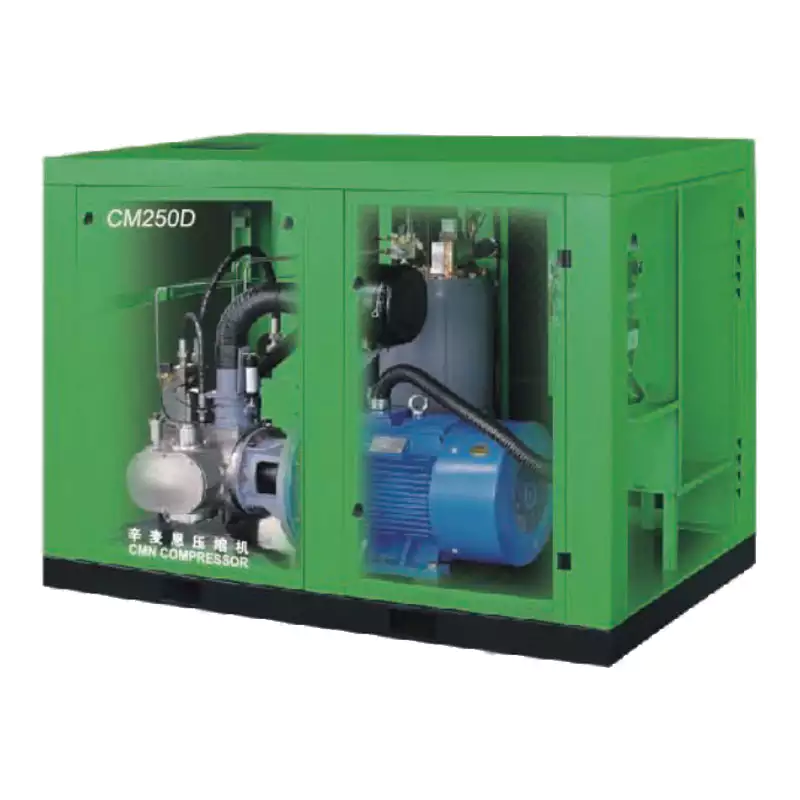
CM45D Water-Lubricated Oil-Free Screw Compressor
The CM45D’s water-lubrication technology delivers certified ISO Class 0 oil-free air with lower discharge temperatures than dry-screw alternatives — reducing moisture load on dryers and improving microbial control in the compressed air system. Its quiet operation is appropriate for cosmetics manufacturing environments where clean-room adjacent operation is required.
- ✓ ISO Class 0 — strongest available oil-free certification for auditor documentation
- ✓ Cooler discharge air — lower moisture load, better dryer performance
- ✓ No oil in process — simplifies GMP documentation and audit responses
- ✓ Low noise — suitable for production-adjacent installation
- ✓ Technical documentation available for quality system inclusion
Frequently Asked Questions
Does ISO 22716 specify a numerical compressed air purity class?
Can I use the same compressed air for product-contact and non-product-contact applications?
How do I document compressed air quality for a retailer GMP audit?
How does compressed air quality affect cosmetic product microbial testing results?
What frequency of compressed air quality testing is appropriate for cosmetics GMP?
GMP-Ready Oil-Free Compressor Systems for Cosmetics Manufacturers
Australia Oil Free Air Compressor Co., Ltd. supplies oil-free compressed air systems to cosmetics and personal care manufacturers across Australia. We can specify systems that support your ISO 22716 and retailer GMP audit requirements.
📧 [email protected] | Charlton Industrial Area, Australia