
What Compressed Air Actually Does Inside a Laser Cutting Head
Most laser cutting operators understand that compressed air is the cutting assist gas for thin non-ferrous materials and for general-purpose cutting where nitrogen purity is not required. What is less widely understood is that compressed air plays a second, equally critical role — continuously purging the optical path inside the cutting head to keep the lens, collimator, and beam delivery components free of contamination.
In a fibre laser cutting head, the compressed air purge flows continuously through the optical chamber during operation, creating a slight positive pressure that prevents cutting fumes, particulates, and spatter from migrating back up the nozzle and depositing on the focusing optics. This purge function is active even when a different assist gas (nitrogen, oxygen) is being used for cutting — the optics purge and the cutting gas circuits are separate.
When the purge air contains oil aerosol, those oil molecules enter the optical chamber and deposit on the lens surface over time. The deposition is gradual and initially invisible — but it creates a layer with significantly different optical absorption characteristics to clean glass. Once oil contamination reaches a threshold, the lens absorbs beam energy at the contaminated areas instead of transmitting it, causing localised heating. The lens then reaches a thermal runaway condition — the contamination absorbs more heat, heats the surrounding glass, reduces transmission further, and ultimately fractures the lens under thermal stress. This failure mode is called “lens damage by thermal lensing” and is the leading cause of premature lens replacement in laser cutting operations worldwide.
A quality focusing lens for a 6 kW fibre laser costs AUD $2,000–8,000 depending on the machine brand. A premium oil-free compressor system that prevents a single lens damage event typically pays for itself within the first year of operation.
Oil Contamination: The Chain Reaction That Destroys Optics
The mechanism by which oil contamination destroys laser optics follows a predictable, accelerating sequence. Understanding each stage helps explain why contamination prevention is far more cost-effective than attempting to clean contaminated optics:
Oil aerosol particles in the 0.01–1 µm range deposit on the lens surface and form a thin film that is visually undetectable. Cutting quality is unaffected. The lens appears clean. Without air quality testing or precise power meter measurement, this stage goes unnoticed.
The oil film thickens and begins absorbing beam energy. Transmission through the lens drops — initially by 1–3%, which may not be noticeable to the operator. Cutting speed must be reduced or power increased to maintain the same kerf quality. The operator may attribute this to material batch variation or beam alignment drift.
The contaminated areas of the lens heat significantly during beam delivery. The heated glass expands, changing the focal length and causing beam aberration — cut quality deteriorates noticeably, with increased dross, wider kerf, and reduced edge quality. The lens is now operating in a stressed thermal state every time the laser fires.
The thermal stress exceeds the lens material’s tolerance. The lens fractures — typically during a high-power cutting cycle on thick material. Fragments may be expelled into the cutting head, damaging the collimator, beam delivery fibre, and cutting head body. Total repair cost including component replacement and machine downtime can reach AUD $15,000–30,000 or more.
Air Quality Requirements for Laser Cutting by Machine Type
The specific air quality requirement varies between laser types because of differences in wavelength, optical materials, and power density. Fibre lasers are generally more sensitive to contamination than CO₂ lasers because the shorter 1,064 nm wavelength experiences different absorption characteristics with common contaminants.
Moisture: ISO Class 2 (≤−20°C pdp)
Particles: ISO Class 1
Moisture: ISO Class 3 (≤−10°C pdp)
Particles: ISO Class 2
Moisture: ISO Class 3 (≤−10°C pdp)
Particles: ISO Class 2
A refrigerated dryer delivers +3°C pdp — adequate for many industrial applications but insufficient for fibre laser cutting at high power. When the machine cutting head or ambient piping runs below the dew point (possible during Australian winters in southern states or in air-conditioned buildings), condensation can form in the assist gas circuit and enter the cutting head. For fibre laser operations requiring ISO Class 2 moisture (−20°C pdp), a desiccant dryer is the correct specification — not a refrigerated dryer alone.
Pressure & Flow Requirements for Laser Cutting Assist Gas
When compressed air is used as the cutting assist gas (rather than nitrogen or oxygen), the pressure and flow requirements are determined by the material type, thickness, and cutting speed. Getting the assist gas specification right is as important as getting the air quality right — incorrect pressure causes dross, incomplete cutting, and oxidation on cut edges.
| Material & Thickness | Assist Gas | Pressure (bar) | Flow (CFM) | Notes |
|---|---|---|---|---|
| Mild Steel 1–3 mm | Air or O₂ | 0.6–1.2 bar | 2–5 CFM | Air gives clean edge on thin gauge |
| Aluminium 1–4 mm | Air or N₂ | 8–16 bar | 10–25 CFM | High pressure air; oxidation acceptable |
| Stainless Steel 1–3 mm | N₂ preferred / Air | 10–20 bar | 15–35 CFM | Air acceptable if oxidised edge permitted |
| Acrylic / Plastics | Air | 2–6 bar | 3–8 CFM | Moisture-free air critical for clear edge |
| Copper / Brass 1–2 mm | N₂ or Air | 12–20 bar | 15–30 CFM | High reflectivity; back reflection protection needed |
| Carbon Fibre Composite | Air (high flow) | 4–8 bar | 8–20 CFM | Smoke extraction critical; HEPA filtration required |
The key sizing insight for aluminium and stainless applications using air as the assist gas is the high pressure requirement — 8–20 bar is well above what a standard workshop compressor running at 8 bar delivers to the machine. Laser cutting machines using compressed air for high-pressure assist gas typically require a dedicated high-pressure compressor or booster, or a compressor rated for 1.6 MPa (16 bar) or 3.0 MPa (30 bar) output.
The optics purge circuit runs at much lower pressure (typically 0.5–1 bar) but requires extremely clean, dry air continuously throughout the cutting cycle regardless of which assist gas is used for cutting.
High-Pressure vs Standard-Pressure Compressors for Laser Cutting
The choice between a standard 0.8–1.0 MPa compressor and a high-pressure 1.6–3.0 MPa unit is one of the most important decisions when specifying compressed air for a laser cutting operation. The machine manufacturer’s specification — which defines the required assist gas pressure at the machine inlet — is the determining factor.
- ✓ Lower capital cost
- ✓ Standard maintenance requirements
- ✓ Can supply multiple machines and workshop tools
- ✗ Insufficient for aluminium or stainless with air assist
- ✗ Cannot replace nitrogen for bright-edge cutting
- ✓ Enables air cutting of non-ferrous metals
- ✓ Eliminates nitrogen gas costs for applicable materials
- ✓ Faster cutting speeds on aluminium vs N₂
- ✗ Higher capital cost than standard units
- ✗ Requires high-pressure rated pipework throughout
Many laser cutting operations spend AUD $3,000–8,000 per month on nitrogen gas for stainless steel and aluminium cutting. A high-pressure oil-free compressor at 1.6 MPa can eliminate nitrogen consumption for stainless up to 3 mm and aluminium up to 4 mm in most applications — with cut quality equivalent to nitrogen at reduced speed, or slightly oxidised edges at higher speed. The payback period on a high-pressure oil-free compressor vs continued nitrogen consumption is typically 18–36 months for operations running two or more shifts per day.
The calculation must account for the total cost of the compressed air system (compressor, dryer, filtration, pipework) vs the nitrogen supply cost reduction. We can assist with this analysis as part of the system specification process.
Complete System Design for Laser Cutting Compressed Air
A correctly designed compressed air system for laser cutting must address the optics purge circuit and the cutting assist gas circuit as separate requirements with a common supply source. The system design follows this architecture:
The compressor must be a genuine oil-free design — water-lubricated screw, dry-screw, or scroll. Oil-injected units with downstream filtration are not appropriate for laser cutting regardless of the filtration specification. The compressor output pressure must match the assist gas requirement; for high-pressure cutting applications, a 1.6 MPa or 3.0 MPa rated unit is required.
Integrated on all modern oil-free screw compressors. Removes the bulk of condensate generated during compression before it reaches the dryer. Critical for dryer efficiency — without effective aftercooling, the dryer is overloaded and dew point performance degrades. Ensure the separator automatic drain valve is functioning correctly on every service visit.
For fibre laser cutting, a desiccant dryer is the correct specification. A refrigerated dryer delivering +3°C pdp may allow moisture to form in the cutting head circuit under adverse conditions. A heatless desiccant dryer provides −40°C pdp at low capital cost; a heated or blower-purge desiccant dryer is more energy efficient for larger compressor installations. The dryer must be correctly sized for the compressor flow rate and ambient conditions.
A two-stage filtration train downstream of the dryer removes any residual aerosol and fine particles. The pre-filter (typically 1 µm) protects the high-efficiency coalescing filter (0.01 µm) and extends its service life. Filter elements must be changed on schedule — an overloaded element passes more contamination than a new element and causes a pressure drop penalty of 0.3–0.5 bar, reducing effective assist gas pressure at the cutting head.
A receiver tank sized to buffer the peak demand during cutting cycles reduces pressure fluctuations at the machine. Stable pressure at the nozzle is critical for consistent cut quality — pressure dips during high-demand cutting cycles cause kerf width variation and dross formation. The receiver should be sized for a minimum of 3–5 minutes of continuous cutting demand.
Maintenance Schedule for Laser Cutting Compressed Air Systems
Laser cutting compressed air systems require a more rigorous maintenance schedule than standard industrial air systems because the consequences of contamination are immediate and expensive. The following schedule represents best practice for a single-shift operation; two-shift and three-shift operations should reduce all intervals by 30–50%.
| Task | Interval |
|---|---|
| Check separator auto-drain is functioning (listen for discharge on compressor stop) | Daily |
| Verify dew point indicator on dryer (confirm within spec) | Weekly |
| Check pressure differential across filter elements (replace if ΔP > 0.35 bar) | Monthly |
| Inspect and clean compressor intake filter | Monthly |
| Replace coalescing filter elements (regardless of ΔP) | 6 months |
| Full compressor service per manufacturer schedule | Annual |
| Desiccant bed inspection and replacement if required | Annual |
| Compressed air quality test (oil, moisture, particles) by accredited lab | Annual |
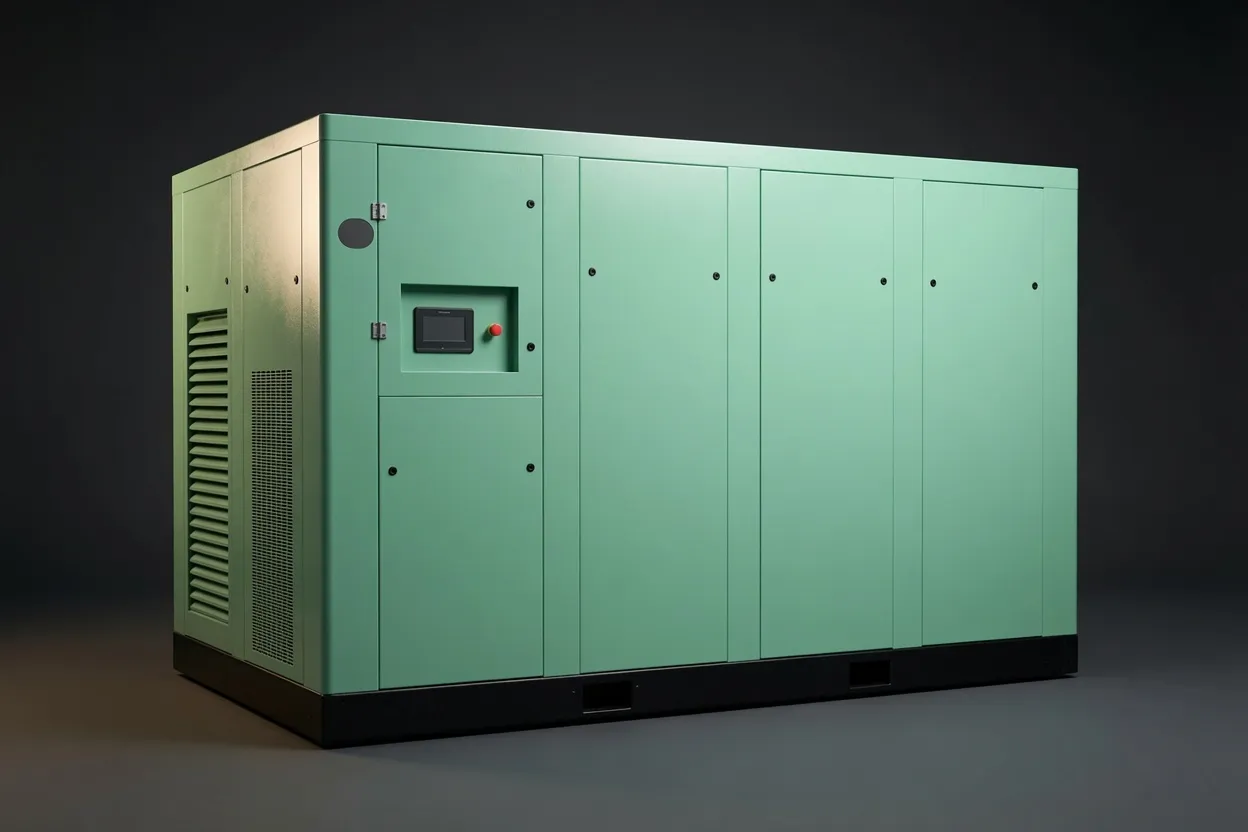
Designed specifically for laser cutting assist gas applications. 1.6 MPa (16 bar) output pressure enables compressed air cutting of aluminium and stainless steel, replacing nitrogen for many common thicknesses. Genuine oil-free compression element — ISO Class 0 air at the source. Integrated VSD for energy efficiency. Micro-oil specification where ultimate purity is required.
For high-power fibre laser cutting systems (6 kW+) requiring 20–30 bar assist gas pressure for thick aluminium and stainless steel cutting. Two-stage compression delivers higher pressure with better efficiency than single-stage boosted systems. Enables full nitrogen replacement across the widest range of materials and thicknesses.
Frequently Asked Questions
Can I use a standard workshop compressor for a fibre laser cutter?
How do I know if my compressed air is damaging my laser lens?
What is the difference between the 1.6 MPa and 3.0 MPa laser cutting compressors?
How much can I save by replacing nitrogen with compressed air?
Does using compressed air instead of nitrogen affect cut quality?
Australia Oil Free Air Compressor Co., Ltd. specialises in high-pressure and standard oil-free compressor systems for laser cutting operations. Serving fabricators, manufacturers, and job shops across Australia. Charlton Industrial Area.