
Why Seafood Processing Is a High-Risk Environment for Compressed Air
Compressed air in a seafood processing facility comes into direct or close contact with product at multiple points in the processing line — from initial de-shelling and filleting through to glazing, IQF freezing, and packaging. Unlike dry food manufacturing, where contamination risks are primarily chemical, seafood processing adds a significant microbiological dimension: the combination of high moisture, cold temperatures, and nutrient-rich product residues creates an environment where contamination introduced by the compressed air system can rapidly multiply to dangerous levels.
Oil contamination in seafood processing compressed air creates two distinct problems. The first is direct chemical contamination of the product — compressor oil aerosol deposited on fish, prawns, or shellfish is a food safety hazard that is detectable by sensitive consumers, affects product flavour, and may trigger allergen concerns in certain lubricant formulations. The second problem is less obvious: oil aerosol in the air supply acts as a growth medium for Listeria monocytogenes and other cold-tolerant pathogens that are the primary microbiological concern in chilled seafood environments. A contaminated compressed air system in a seafood processing plant can act as a continuous source of Listeria aerosol distributed throughout the processing zone.
Australian seafood processors supplying domestic retail chains or exporting to the EU, Japan, the USA, or China face mandatory certification requirements that specifically address compressed air quality. Understanding these requirements — and how an oil-free compressor system supports compliance — is essential for export market access.
Compressed Air Applications in Seafood Processing
Understanding which compressed air applications involve product contact — and which are indirect or utility uses — is essential for applying the correct quality specification to each part of the system.
- ▸ Pneumatic scaling, gutting, and filleting equipment — air ejects product waste directly adjacent to flesh
- ▸ Air-knife product drying before weighing and packaging
- ▸ Pneumatic shucking of oysters and mussels — high-pressure air jets contact shellfish meat directly
- ▸ Prawn de-veining and peeling equipment — air-assisted product separation
- ▸ MAP (modified atmosphere packaging) gas flush assist — air used to position or transport product during gas flush
- ▸ IQF glazing line air conveyance — air jets used to separate frozen product pieces
- ▸ Conveyor belt pneumatic drives and tensioners in processing zones
- ▸ Pneumatic actuators on grading and sorting lines above open product
- ▸ Food-contact surface cleaning (air blowdown before wet wash)
- ▸ Packaging machinery — form-fill-seal, tray sealers, vacuum chambers
- ▸ Cold store door actuators and blast freezer controls
- ▸ Air-operated pumps for chilled water and brine circulation
While it is technically possible to designate separate quality zones and run different air quality specifications to different areas, most seafood processing plants find it impractical to maintain truly separate compressed air circuits. Cross-connections, hose extensions, and the mobile nature of processing equipment mean that air from the “utility” circuit routinely ends up in product-contact positions. The industry best practice — and the position taken by most certification bodies — is to run a single compressed air specification throughout the facility that meets the direct product contact requirement. This simplifies both system design and compliance documentation.
Australian Regulatory Framework for Seafood Compressed Air
Australian seafood processing is regulated under a layered framework that includes federal food safety standards, state-level primary industry legislation, export certification requirements, and third-party audit schemes accepted by major retail chains. Compressed air quality is addressed across multiple levels of this framework.
Australia and New Zealand’s primary food safety standard for seafood requires processors to implement food safety management systems that identify and control all hazards, including those introduced by process inputs such as compressed air. Standard 4.2.1 requires that compressed air used in seafood processing “does not adversely affect the safety of seafood.” This language is interpreted by regulators as requiring processors to demonstrate that compressed air is free from oil, excessive moisture, and microbial contamination — all achievable with an oil-free compressor and appropriate downstream treatment.
Australia’s Department of Agriculture, Fisheries and Forestry (DAFF) certifies seafood processing establishments for export. EU-certified establishments must comply with EC 852/2004 and 853/2004, which require compressed air used in food processing to be “suitable for food use and free from contamination.” USDA FSIS-certified establishments for US export must meet HACCP requirements that specifically address compressed air as a potential physical, chemical, and biological hazard. Japan’s Ministry of Health, Labour and Welfare export requirements similarly address compressed air quality as part of facility approval.
Major Australian retailers including Woolworths, Coles, and Aldi require their seafood suppliers to hold BRC Issue 9 certification. Clause 4.7.5 of BRC Issue 9 requires that compressed air or other gases used in contact with food or food-contact surfaces are clean and do not present a contamination risk. The standard specifically requires monitoring of compressed air quality and documentation of the treatment system. BRC auditors assess compressed air as a critical control during facility audits.
SQF Module 11.7 addresses compressed gases in food manufacturing, requiring that compressed air and other gases used in food processing, packaging, or as an ingredient be clean and pose no contamination risk. SQF auditors require documented compressed air specifications, evidence of oil-free compressor design or validated filtration, and periodic analytical test records. SQF certification is widely required by US food service customers and increasingly by Australian foodservice distributors.
Recommended Air Quality Specification for Seafood Processing
Based on FSANZ requirements, export certification standards, and the specific hazard profile of seafood processing, the following ISO 8573-1 specification is recommended for compressed air used in direct or indirect product contact in Australian seafood facilities:
The moisture requirement of Class 2 (−20°C pdp) is stricter than what a refrigerated dryer alone can deliver (+3°C pdp). This requirement exists because seafood processing environments often operate at or below 0°C in the processing zone and well below freezing in blast-freezing and cold storage areas. A +3°C dew point means moisture will condense wherever the pipework or equipment falls below +3°C — which is throughout most of a chilled seafood facility. A desiccant dryer delivering −20°C or lower pdp ensures the air remains dry at all points in the distribution system, including in cold store environments.
The oil Class 1 requirement (≤0.01 mg/m³) is not reliably achievable with an oil-injected compressor relying on downstream filtration. An oil-free compressor design — water-lubricated screw, dry screw, or scroll — is the correct specification, with coalescing filtration as a verification layer rather than the primary contamination barrier.
Special Challenges: Cold, Wet Environments and Condensate in Seafood Plants
Seafood processing facilities present installation and maintenance challenges that do not arise in standard factory environments. The combination of wash-down procedures, cold temperatures, high humidity, and corrosive salt contamination from product processing requires specific design choices for the compressed air system.
All compressed air equipment installed within processing zones must be rated for wash-down environments (minimum IP65, IP69K preferred for high-pressure wash areas). Standard compressor control panels, pressure switches, and solenoid valves are not wash-down rated and will fail within months in a seafood processing environment. Point-of-use regulators, filter units, and lubricators (where used in non-product-contact circuits) must be stainless steel or food-grade materials, not zinc or aluminium die-cast components that corrode under daily chemical wash-down.
Compressed air pipework running through cold stores operating at −18°C to −25°C presents specific challenges. Standard refrigerated dryer condensate drain valves can freeze if the air entering the cold store is above the cold store temperature — causing blocked drains, condensate carryover, and ice formation in distribution lines. All auto-drain valves in cold areas should be zero-loss electronic type rated for low ambient temperatures. Pipework in cold stores should be insulated to prevent condensation forming on the outside of the pipe, which can then drip onto product below.
Salt aerosol from seafood processing — particularly in crustacean and shellfish processing — deposits on compressed air equipment and accelerates corrosion. Carbon steel distribution pipework in seafood facilities typically requires replacement within 5–7 years due to accelerated internal and external corrosion. Aluminium alloy ring main systems (e.g. Parker Transair, Aignep, or equivalent) are strongly recommended — corrosion-resistant, smooth bore, and modular for easy reconfiguration when processing lines change.
Condensate from an oil-free compressor system in a seafood processing facility contains sea salt, seafood processing residues carried in the intake air, and microbiological contamination. This condensate is classified as trade waste in all Australian states and requires trade waste agreement for sewer disposal. Direct discharge to stormwater is prohibited. In facilities with existing trade waste agreements for process water, the additional condensate volume should be disclosed to the water authority — typically a minor variation to the existing agreement.
HACCP Analysis: Compressed Air as a CCP in Seafood Processing
Under FSANZ Standard 4.2.1 and HACCP-based food safety management systems, compressed air used in direct product contact applications in seafood processing is typically identified as a Critical Control Point (CCP) or, under newer process control frameworks, a Critical Quality Point (CQP). This designation requires that specific critical limits be set, monitoring procedures be defined, and corrective actions be documented.
| HACCP Element | Detail |
|---|---|
| Hazard Identified | Chemical: Oil aerosol contamination of product. Biological: Listeria monocytogenes aerosol via contaminated moisture in air supply. Physical: Particulate contamination from corroded pipework. |
| Critical Limits | Total oil ≤ 0.01 mg/m³ (ISO Class 1). Pressure dew point ≤ −20°C at point of use. Particle count: ISO Class 2 or better. |
| Monitoring Procedure | Continuous dew point monitoring at compressor outlet (alarm at −15°C). Annual NATA-accredited laboratory analysis for oil and particles at point of use. Visual inspection of filter indicators monthly. |
| Corrective Action | If dew point alarm: suspend production on affected lines, investigate dryer function, test air quality before resuming. If oil test exceeds limit: stop direct-contact air use, identify source, replace filter elements, retest before resuming. |
| Records Required | Compressor and dryer service records. Filter element change log. Annual laboratory test certificates. Dew point monitoring log. Corrective action log. |
Sizing Compressed Air for Seafood Processing Lines
Seafood processing lines have characteristically high peak demand during shucking, de-heading, and IQF operations, with lower continuous demand during sorting and packaging phases. Correctly sizing the compressor system requires capturing both the peak and average demand.
| Processing Equipment | Typical CFM | Operating Pressure | Demand Profile |
|---|---|---|---|
| Oyster / mussel shucking line (6 stations) | 25–40 CFM | 7–8 bar | Pulsed, high peak |
| Prawn peeling / de-veining line | 15–25 CFM | 5–6 bar | Continuous moderate |
| Fish filleting and pin-bone removal | 10–20 CFM | 6–7 bar | Intermittent |
| Air knife drying before packaging | 20–45 CFM | 4–6 bar | Continuous during production |
| IQF product separation and conveyance | 15–30 CFM | 5–7 bar | Continuous during freeze cycle |
| Packaging machinery (tray seal, vacuum, MAP) | 10–20 CFM | 6–7 bar | Continuous during packaging run |
For a medium-scale seafood processing facility running shucking, filleting, air-knife drying, and packaging in parallel, total compressed air demand commonly falls in the 80–140 CFM range at 7 bar. A 30–55 kW oil-free screw compressor with VSD drive, desiccant dryer, and coalescing filtration is the standard configuration for this scale of operation.
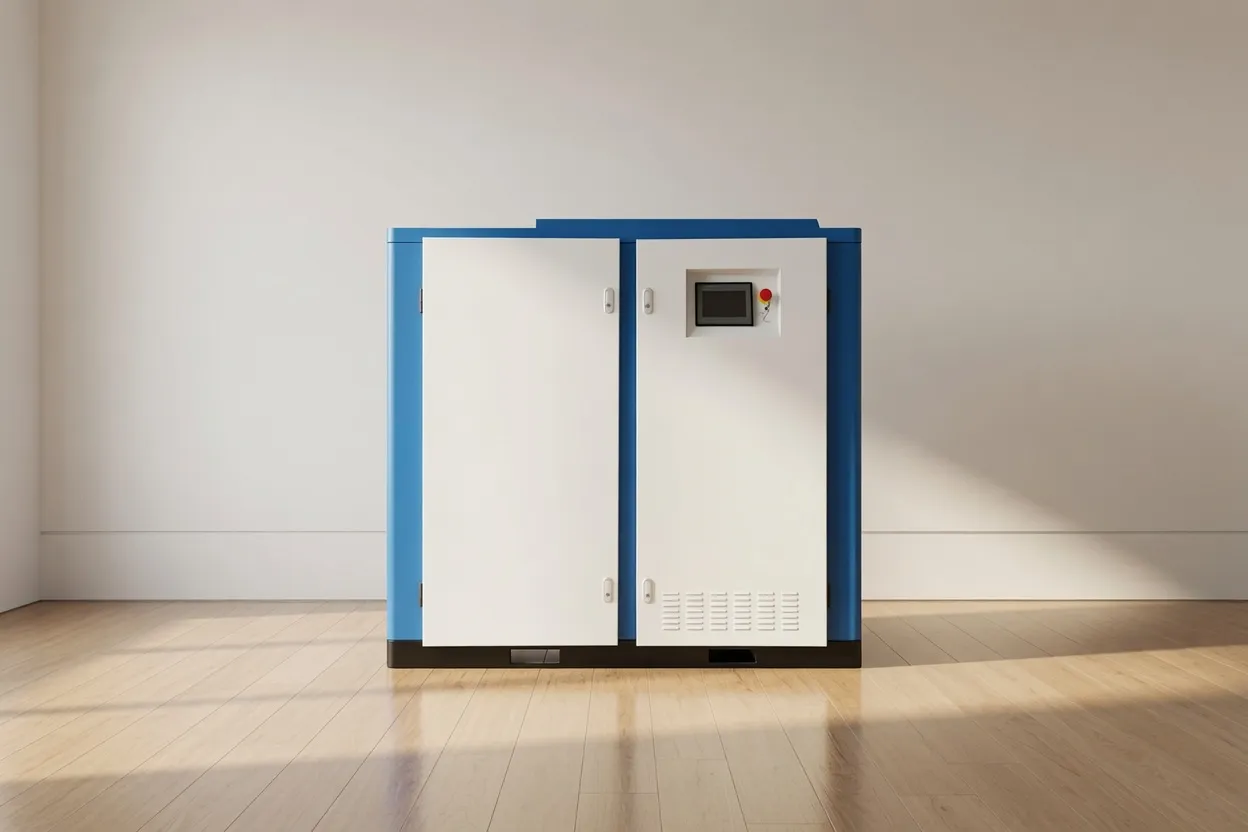
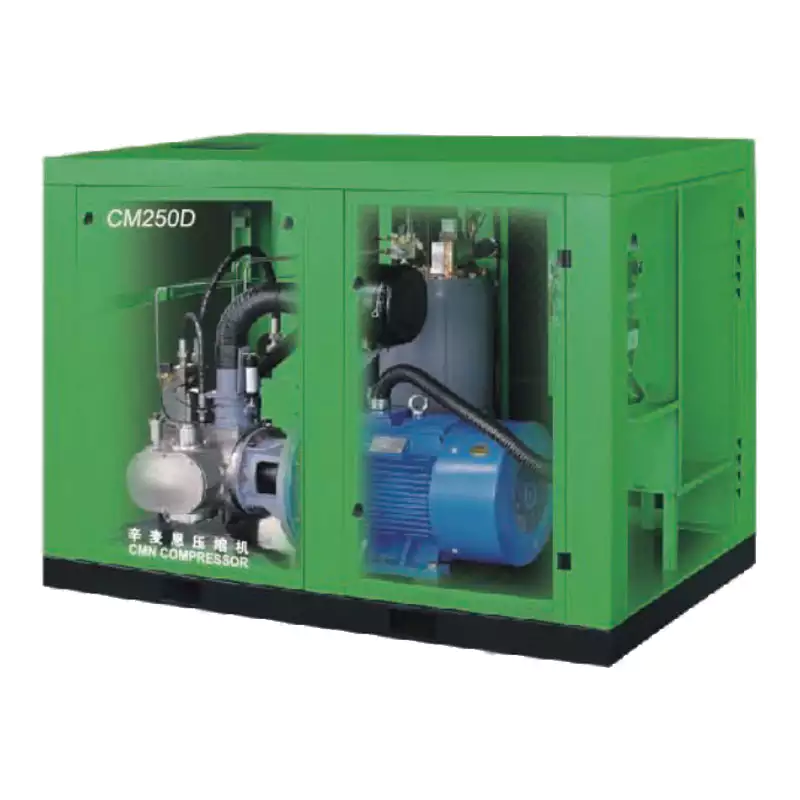
The CM45D uses water — not oil — as the sole lubricant and coolant in the compression element. For seafood processing, this has a specific advantage beyond ISO Class 0 air: the condensate produced is free of compressor oil, containing only water and any atmospheric contamination drawn in with the intake air. This simplifies trade waste management and reduces the risk of oil contamination in the event of any system fault. The VSD drive matches energy consumption precisely to production line demand across the processing shift. Compact footprint suitable for machinery rooms adjacent to cold processing areas.
Frequently Asked Questions
Does DAFF require oil-free compressors for export-certified seafood facilities?
Can I use a refrigerated dryer instead of a desiccant dryer in a seafood plant?
How often should I test compressed air quality in a seafood processing facility?
What happens if our compressed air quality test fails during a BRC audit?
Is the condensate from an oil-free compressor in a seafood facility safe to discharge to sewer?
Australia Oil Free Air Compressor Co., Ltd. works with seafood processors across Australia to specify, supply, and support oil-free compressor systems that meet FSANZ, BRC, SQF, and DAFF export certification requirements. Charlton Industrial Area.