
Understanding the Overtemperature Protection System
Every modern oil-free rotary screw compressor has a thermal protection system — a temperature sensor in the compression element or discharge port that monitors operating temperature and triggers a controlled shutdown when a set point is exceeded. This is not a fault in itself; it is the machine working correctly to prevent damage to the compression element, motor windings, or drive electronics that would result from sustained operation above rated temperature.
The typical overtemperature shutdown setpoint for oil-free screw compressors is 105–120°C at the compression element discharge, depending on the manufacturer and model. For water-lubricated oil-free units, this threshold is typically lower (85–100°C) because the water injection keeps discharge temperatures considerably cooler than dry oil-free designs. An alarm warning typically appears 5–10°C below the trip setpoint, giving a brief window to reduce load or investigate before shutdown occurs.
Critically, the overtemperature event is a symptom, not the problem. The machine is hot because something in the thermal environment has changed — either the machine is generating more heat than usual, or the heat removal pathway has been compromised. Resetting the fault and restarting without identifying and fixing the underlying cause will result in repeated overtemperature shutdowns and, eventually, actual damage to the components the protection system was designed to save.
This guide addresses all nine primary causes of overtemperature in oil-free compressors, from the most common (inadequate room ventilation) to the less obvious (VSD drive fault causing excessive current draw). Work through the diagnostic checklist in order — the causes are arranged from most likely to least likely for a machine that was previously operating normally.
First Response: What to Check Before Calling for Service
Before assuming a component failure, spend 10 minutes on these immediate checks. These catch the majority of overtemperature causes and can often be resolved in minutes without any service call:
The 9 Root Causes of Oil-Free Compressor Overheating
Systematic Diagnosis: Match Symptoms to Cause
Use the discharge temperature reading and timing of the overtemperature event to narrow down the cause before working through the full checklist:
| When overtemperature occurs | Most likely cause(s) | Check first |
|---|---|---|
| Only during summer afternoons / hot days | Room ventilation insufficient for summer ambient (Cause 1) | Room temperature thermometer |
| After gradual temperature rise over weeks/months | Blocked aftercooler (Cause 2) or loaded intake filter (Cause 3) | Visual cooler inspection; filter ΔP indicator |
| Shortly after start-up (within 15–30 min) | Fan failure (Cause 5); water cooling fault (Cause 6) | Fan operation check; cooling water flow/temp |
| Only when production demand is high | Undersized for current demand (Cause 7) | Controller load factor display; recent demand changes |
| Always at same temperature regardless of ambient | Faulty temperature sensor; VSD fault (Cause 8) | Compare sensor reading to contact thermometer; motor current check |
| Combined with reduced output pressure or flow | Worn compression element (Cause 9); major intake restriction | FAD output measurement vs commissioning baseline; running hours |
| After machine relocation | Hot air recirculation (Cause 4); inadequate clearances to walls | Intake temperature measurement; clearance verification |
Preventing Overheating: The Maintenance Schedule That Keeps Temperatures Under Control
Most overtemperature events in oil-free compressors are preventable through consistent maintenance. The following schedule addresses the primary causes before they develop into a shutdown event:
- → Visual inspection of aftercooler fins
- → Record discharge temperature and compare to baseline
- → Verify room temperature at midday (summer) or peak production
- → Check all ventilation openings clear
- → Log controller discharge temperature reading
- → Check intake filter ΔP indicator
- → Replace intake air filter element (or by hours — whichever first)
- → Clean aftercooler fins with compressed air
- → Check cooling fan blade condition and bearing
- → For water-cooled: measure cooling water flow and inlet temperature
- → Check VSD cooling fan condition (VSD models)
- → Clean VSD enclosure ventilation filters
- → Full service by certified technician
- → Motor current measurement at rated load
- → FAD output test vs commissioning baseline
- → Temperature sensor calibration check
- → Review trending data — identify gradually rising discharge temperature
- → Review ventilation capacity against summer peak room temperature data
When to Stop Diagnosing and Call a Certified Technician
Many overtemperature causes — blocked coolers, dirty filters, ventilation problems — can be diagnosed and fixed by a competent maintenance person with no specialised compressor training. Others require a qualified compressor technician with diagnostic tools, calibration equipment, and replacement parts. Do not attempt field repair of the following:
- → Discharge temperature is elevated even after cleaning cooler and replacing filter and ventilation is adequate
- → Motor body feels excessively hot to touch (above 60°C) independent of ambient temperature
- → You can smell burning or hot plastic inside the enclosure
- → The controller shows an error code alongside the overtemperature alarm
- → Output FAD has dropped noticeably alongside the overtemperature condition
- → VSD current readings are abnormally high at normal speed
- → Machine has more than 20,000 hours and has never had an element overhaul
- → Cleaning blocked aftercooler fins
- → Replacing intake filter element
- → Opening ventilation paths; removing obstructions
- → Identifying and removing hot air recirculation pathway
- → Checking and restoring cooling water supply (temperature and flow)
- → Cleaning external ventilation fan blades of debris
- → Checking and clearing condensate drain
Service & Support from Australia Oil Free Air Compressor
Australia Oil Free Air Compressor Co., Ltd. provides technical support for overtemperature faults on all oil-free compressor models we supply — including remote diagnosis assistance for maintenance teams who can access the controller display and perform basic checks. Our service network covers major Australian cities and regional industrial areas.
For units approaching major service milestones (element overhaul, rotor replacement), we provide planned service quotes that include a discharge temperature trend analysis — identifying whether the machine is operating efficiently or showing early wear signs. Preventive major service before a temperature-related breakdown is considerably cheaper than emergency call-out with parts on back-order.
Contact us at [email protected] with your compressor model, running hours, and the overtemperature symptoms for remote diagnostic assistance.
CM45D — Water-Lubricated Oil-Free Screw Compressor: Lower Discharge Temperatures by Design
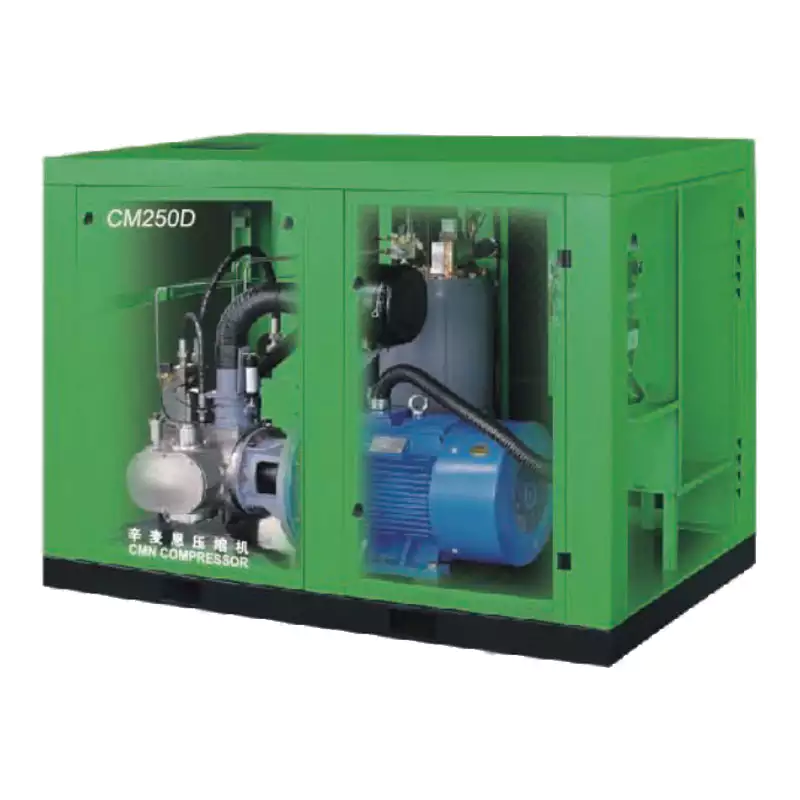
If your current dry oil-free compressor has a chronic overtemperature problem that cannot be resolved through maintenance improvements, the underlying physics may be the issue — dry oil-free screw machines discharge air at 150–200°C, close to the temperature trip setpoint in an already-warm environment. Water-lubricated compressors like the CM45D inject water into the compression chamber, cooling discharged air to 40–60°C — 100°C lower than a dry design. This dramatically increases the thermal margin between operating discharge temperature and the overtemperature trip point, eliminating the sensitivity to ambient temperature that causes dry machines to trip on hot Australian summer afternoons while operating perfectly in winter.
Frequently Asked Questions
Australia Oil Free Air Compressor Co., Ltd.
Charlton Industrial Area, Australia | [email protected]