FDA & Regulatory Compliance
The FDA does not publish a single compressed air standard — but it holds food and pharmaceutical manufacturers accountable for air quality through the lens of contamination control. Oil-free air compressors are the industry consensus starting point for FDA compressed air compliance, but they are the beginning of the story, not the end. This guide explains what FDA regulations actually require, where compressed air fits, and how to build a defensible compliance position.
✦ FDA Regulatory Framework
✦ Food vs Pharma Requirements
✦ Documentation & Audit Trail
How the FDA Regulates Compressed Air — Without a Dedicated Standard
The FDA does not publish a specific compressed air quality standard equivalent to ISO 8573-1. Instead, compressed air compliance for food and pharmaceutical facilities is governed through three interconnected regulatory frameworks: the Food Safety Modernization Act (FSMA) for human food, Current Good Manufacturing Practice (cGMP) regulations under 21 CFR Part 211 for pharmaceuticals, and 21 CFR Part 117 for food facilities. Each framework requires manufacturers to identify and control all potential contamination sources — and compressed air that contacts product or product-contact surfaces is unambiguously a potential contamination source.
The absence of a specific compressed air number in FDA regulations is not permission to ignore compressed air quality — it is a responsibility to determine what “adequate” means for your specific application and to demonstrate that your system achieves it. FDA inspectors evaluate compressed air systems as part of facility inspections under the general contamination control and equipment design provisions of the applicable regulations. Warning letters have been issued to facilities where compressed air systems were found to be inadequate for their use — insufficient documentation, unvalidated systems, and the use of oil-lubricated compressors for direct-contact applications are all documented inspection findings.
The practical consequence is that food and pharmaceutical manufacturers must develop a written compressed air policy that: identifies all compressed air use points and their contact with product or product-contact surfaces; specifies the quality requirements for each use point; documents the system design that achieves those requirements; and maintains records of system performance and maintenance. An oil-free air compressor is the foundation of this policy — but the policy must extend to the complete system, not just the compressor choice.
FDA Food Compressed Air Requirements: 21 CFR Part 117 and FSMA
For food manufacturing facilities, compressed air quality requirements are governed primarily by 21 CFR Part 117 (Current Good Manufacturing Practice, Hazard Analysis, and Risk-Based Preventive Controls for Human Food) — the regulation implementing FSMA’s preventive controls framework. Under this framework, compressed air that contacts food or food-contact surfaces must be treated as a potential contamination hazard and controlled accordingly.
📋 21 CFR Part 117 Compressed Air Requirements (Key Provisions)
§117.40(a): Equipment and utensils used for manufacturing, processing, packing, or holding food shall be so designed and of such material and workmanship as to be adequately cleanable — compressed air systems that contact food or food-contact surfaces fall under this provision.
§117.35(d): Compressed air or other gases mechanically introduced into food or used to clean food-contact surfaces shall be treated so as not to contaminate food — the “treated” requirement means filtration, drying, and documentation.
§117.93: Hazard analysis must consider chemical hazards including lubricants, cleaning compounds, and other chemicals — oil-contaminated compressed air is classified as a chemical hazard.
§117.135: Preventive controls must include process controls for any hazard requiring a preventive control — compressed air hazard analysis results drive the required control documentation.
In practical terms, the FDA food framework requires manufacturers to categorise each compressed air use point by contact type and specify controls accordingly. The industry-recognised framework for this categorisation uses three contact tiers:
Tier 1 — Direct Food Contact
Air that directly contacts the food product — blown into food during mixing or filling, used as a conveyance medium, or propelling product in pneumatic systems.
Requires: ISO Class 0 oil · Class 1 particles · Class 1 water (−26°C or better) · Zero microbiological
Tier 2 — Food-Contact Surface Contact
Air that contacts surfaces that in turn contact food — blowing out packaging, actuating valves on filling lines, cleaning conveyor surfaces.
Requires: ISO Class 0 oil · Class 1–2 particles · Class 2–3 water · Microbiological controls where applicable
Tier 3 — Non-Contact (Indirect)
Air used for machine actuation, non-contact cleaning, and general plant services where no pathway to food or food-contact surfaces exists.
Requires: Oil-free preferred · ISO Class 2–3 particles · Class 3–4 water · No specific microbiological requirement
The tiered approach allows facilities to specify appropriate — not excessive — air quality for each use point. Applying direct-contact quality specifications to non-contact applications wastes capital and operating cost; applying insufficient quality to direct-contact applications is an FDA compliance failure.
FDA Pharmaceutical Compressed Air: 21 CFR Part 211 cGMP Requirements
For pharmaceutical manufacturers, compressed air compliance is governed by 21 CFR Part 211 — the cGMP regulations for finished pharmaceuticals. Part 211 is more prescriptive than the food regulations, with specific provisions addressing equipment design, cleanroom air quality, and documentation requirements that directly affect compressed air system specification.
📋 21 CFR Part 211 Key Compressed Air Provisions
§211.65 — Equipment Construction: Equipment shall be constructed so that surfaces that contact components, in-process materials, or drug products shall not be reactive, additive, or absorptive — compressed air contacting API or drug product must not introduce reactive contaminants, including oil.
§211.68 — Automatic, Mechanical, Electronic Equipment: Equipment used in pharmaceutical manufacturing shall be calibrated, inspected, or checked routinely — compressed air systems used in manufacturing are subject to calibration and qualification requirements.
§211.113 — Control of Microbiological Contamination: Written procedures shall be established and followed for preventing objectionable microorganisms in drug products — compressed air used in aseptic manufacturing must be included in microbiological control procedures.
§211.68(b) — Input/Output Control: Inputs to and outputs from computer-controlled systems in production shall be checked — process control air (pneumatic valve actuators in automated systems) must be qualified as part of computer system validation.
Beyond the specific Part 211 provisions, FDA’s guidance documents and Warning Letters establish clear expectations for pharmaceutical compressed air. The FDA expects that pharmaceutical manufacturers:
Use oil-free compressors for any compressed air that contacts drug product, drug product containers, closures, or in-process materials — oil-lubricated compressors with filtration are not accepted by FDA for direct-contact pharmaceutical air.
Qualify the compressed air system through Installation Qualification (IQ), Operational Qualification (OQ), and Performance Qualification (PQ) — applying the same validation framework required for other critical manufacturing utilities.
Perform periodic testing of compressed air quality at points of use — dew point, particle count, total oil, and microbiological tests at defined intervals documented in a Compressed Air Testing SOP.
Maintain a system map documenting all compressed air generation points, treatment stages, distribution routes, and points of use with contact classification for each use point.
ISO 8573 as the Practical FDA Compliance Framework
Because the FDA does not specify compressed air quality limits numerically, industry has converged on ISO 8573-1 (Compressed Air Quality Standards) as the de facto framework for specifying and verifying FDA-compliant compressed air. ISO 8573-1 provides numerical limits for all three contamination dimensions — particles, water, and oil — that can be tested, documented, and referenced in FDA audit responses.
The ISO 8573 classes most commonly specified for FDA-regulated compressed air applications are:
| FDA Application |
ISO 8573-1 Particles |
ISO 8573-1 Water |
ISO 8573-1 Oil |
Full Class Notation |
| Food direct contact / filling |
Class 1 |
Class 1 (−26°C pdp) |
Class 0 |
1:1:0 |
| Food packaging (direct) |
Class 1 |
Class 2 (−40°C pdp) |
Class 0 |
1:2:0 |
| Food indirect contact |
Class 2 |
Class 3 (+3°C pdp) |
Class 1 |
2:3:1 |
| Pharmaceutical non-sterile mfg |
Class 1 |
Class 1 (−26°C pdp) |
Class 0 |
1:1:0 |
| Pharmaceutical aseptic / sterile |
Class 1 |
Class 1 (−40°C pdp) |
Class 0 |
1:1:0 + sterile filter |
| Pharma packaging / non-contact |
Class 2 |
Class 3 (+3°C pdp) |
Class 1 |
2:3:1 |
Using ISO 8573 class notation in compressed air quality documentation gives FDA inspectors a recognised, testable framework for evaluating compliance — far more defensible than a narrative description of system design without measurable quality limits. Most FDA Warning Letters related to compressed air cite the absence of documented quality specifications and testing, not necessarily the specific quality levels achieved.
The Complete FDA-Compliant Compressed Air System: Beyond the Compressor
An oil-free air compressor is necessary but not sufficient for FDA compressed air compliance. The complete system must address all three ISO 8573 contamination dimensions plus microbiological control (for direct-contact pharmaceutical and food applications). Here is the complete equipment specification for a pharmaceutical direct-contact compressed air system:
1
Oil-free rotary screw compressor: Water-lubricated or dry-running oil-free design providing certified ISO 8573-1 Class 0 oil content at the outlet. All wetted materials in contact with compressed air must be FDA-acceptable (stainless steel for water-injected types; PTFE, aluminium, or stainless for dry oil-free). Compressor qualification documentation must be available for IQ.
2
316L stainless steel receiver tank: Internal surface 316L SS with electropolished finish for pharmaceutical applications — eliminates rust contamination and allows CIP cleaning if required. Must have automatic condensate drain, pressure gauge, safety relief valve, and ASME/AS 1210 design certification. Tank must be included in IQ documentation.
3
Pre-filter (particulate + coalescing): 316SS housing, FDA-compliant filter media (borosilicate glass microfibre, PTFE membrane). Coalescing filter achieving 0.01 µm / 0.01 mg/m³ oil aerosol removal. Filter housings must be cleanable; drain valves of 316SS. Element replacement documented in maintenance records.
4
Activated carbon adsorber: Removes vapour-phase hydrocarbons (atmospheric contamination) and odours — essential for food-contact applications and for achieving ISO 8573-1 Class 0 total oil at the point of use. 316SS housing, food-grade activated carbon. Change on fixed schedule (typically every 6 months) with replacement documented.
5
Desiccant dryer (HOC or heated): Achieves −26°C to −40°C pressure dew point (ISO 8573-1 Class 1 water) for pharmaceutical and food direct-contact. HOC desiccant dryer preferred for 24/7 oil-free screw systems — zero additional energy, zero purge loss, continuous dry air output. 316SS desiccant vessel for pharma applications.
6
Afterfilter + sterile membrane (pharmaceutical): Afterfilter captures desiccant fines. 0.2 µm sterilising-grade membrane filter at each critical use point for aseptic pharmaceutical applications — must be integrity-tested post-installation per ASTM F316 or equivalent. Filter validation data required for FDA submission.
7
316SS distribution piping (orbital welded): All pharmaceutical direct-contact compressed air distribution must use 316L SS pipework with orbital welded joints — no threaded connections in direct-contact distribution. Electropolished internal surfaces. Piping map with weld log for IQ documentation. Slope to drain points for condensate removal.
FDA Documentation Requirements: What Inspectors Look For
FDA inspections of compressed air systems focus heavily on documentation — not just system design. A well-designed system with poor documentation fails an FDA inspection just as surely as a poorly designed system. The following documentation package should be maintained for any FDA-regulated compressed air system:
System Documentation
- → Process and Instrumentation Diagram (P&ID) of complete system
- → Use-point map with contact classification for each point
- → System design rationale document
- → Equipment specifications and certifications
- → IQ/OQ/PQ validation protocol and report (pharma)
- → Compressed air quality specification (ISO 8573 class by use point)
Ongoing Records
- → Compressed air testing results (dew point, particles, total oil, microbiological) with date and sampler ID
- → Filter element replacement records (date, element lot number, person)
- → Desiccant replacement records
- → Drain maintenance and inspection logs
- → Preventive maintenance schedule and completion records
- → Corrective action records for any out-of-specification results
⚠️ Most Common FDA Compressed Air Inspection Findings
No written compressed air quality specification documenting required quality limits per use point
No periodic testing of compressed air quality at points of use — system design assumed adequate without verification
Filter replacement records missing or incomplete — elements not replaced on schedule, no lot number recorded
Oil-lubricated compressors used for direct-contact applications with only filtration as control measure
FDA-Ready Compressed Air Systems from Australia Oil Free Air Compressor
Australia Oil Free Air Compressor Co., Ltd. supplies complete FDA-ready compressed air systems for food and pharmaceutical manufacturers in Australia — from compressor selection through to the complete documentation package required for FDA audit readiness. Our engineering team at the Charlton Industrial Area facility understands that a compressor certificate alone does not constitute compliance; the complete system design, material selection, and documentation framework must all be addressed together.
We provide: ISO 8573-certified oil-free compressors with manufacturer quality declarations; 316SS filter housings and dryer vessels; complete system P&ID drawings; use-point contact classification worksheets; and a compressed air quality testing schedule matched to your facility’s inspection cycle. For pharmaceutical clients, we work with qualified validation service providers to develop the IQ/OQ/PQ protocol for your compressed air system.
Contact us at [email protected] with your FDA application and current compressed air quality specification for a compliance gap assessment.
Recommended Product
CM45D — Water-Lubricated Oil-Free Screw Compressor for FDA-Regulated Applications
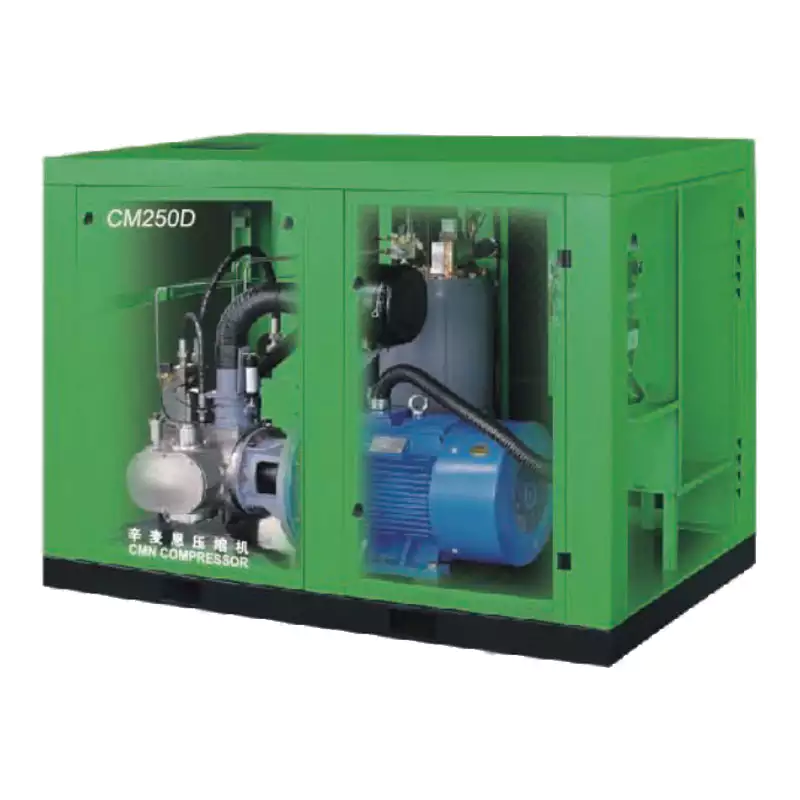
The CM45D water-lubricated oil-free screw compressor is the cleanest starting point for an FDA-regulated compressed air system. Water lubrication means the compression element contains no oil whatsoever — not even bearing lubricant that could migrate into the airstream in some dry oil-free designs. The CM45D’s discharge air is certified to ISO 8573-1 Class 0 for oil, providing the foundational compliance claim required for FDA food and pharmaceutical direct-contact compressed air. All wetted air-path materials are food-compatible. The unit’s continuous-duty rating makes it suitable for HOC desiccant dryer integration, delivering Class 1 water (−40°C dew point) at zero additional energy cost for the drying stage.
View CM45D Specifications
Frequently Asked Questions
Can a filtered oil-lubricated compressor be used for FDA-regulated food or pharma air?
+
For food indirect-contact applications, a filtered oil-lubricated compressor achieving ISO 8573-1 Class 1 oil (≤0.01 mg/m³) may be defensible — but it requires a rigorous filter maintenance programme and is generally considered a higher-risk compliance approach than an oil-free compressor. For pharmaceutical direct-contact applications and food direct-contact applications, FDA’s de facto position — reflected in Warning Letters and inspection findings — is that oil-free compressors are required. An oil-lubricated compressor with filtration is not accepted as adequate for direct-contact pharmaceutical air regardless of achieved oil level.
How often must compressed air be tested for FDA compliance?
+
FDA does not specify testing frequency — the manufacturer’s quality system determines the appropriate frequency based on risk. Industry practice for pharmaceutical compressed air is: dew point monitoring continuously or weekly at each use zone; total oil testing at least annually at each critical use point; particle count annually; microbiological testing quarterly at direct-contact points. For food facilities under FSMA, testing frequency should be documented in the food safety plan’s compressed air monitoring procedure — typically at minimum annually for all quality parameters, with more frequent dew point monitoring.
Does “ISO Class 0” on the compressor specification satisfy FDA requirements?
+
ISO Class 0 on the compressor specification addresses only the oil dimension at the compressor outlet. It does not satisfy FDA requirements by itself for three reasons: (1) ISO Class 0 does not specify particle count or water content, which FDA also requires to be controlled; (2) the Class 0 rating applies at the compressor outlet, not at the point of use — downstream treatment and distribution system integrity must also be verified; (3) FDA requires ongoing monitoring and documentation of performance, not just design specification. The compressor’s ISO Class 0 certification is the starting point for FDA compliance, not the conclusion.
What happens if an FDA inspector finds a compressed air deficiency?
+
FDA compressed air deficiencies are documented as observations in a Form 483 (inspectional observations). Depending on severity, they may also appear in a Warning Letter. Responses to Form 483 observations must include a corrective action plan with timelines. For serious deficiencies — oil-lubricated compressors on direct-contact pharmaceutical applications, or no documented quality monitoring — FDA may place the facility on import alert or initiate consent decree proceedings. The reputational and commercial consequences of a Warning Letter for compressed air deficiency are significant; proactive compliance is far less costly than remediation.
Are there Australian-specific food and pharmaceutical compressed air standards?
+
For food facilities in Australia, FSANZ (Food Standards Australia New Zealand) Standard 3.2.2 (Food Safety Practices and General Requirements) requires that food businesses take all practicable measures to ensure food is not contaminated — compressed air used in food contact is subject to this requirement. For pharmaceutical manufacturers supplying the Australian market, the Therapeutic Goods Administration (TGA) applies the PIC/S Guide to GMP (equivalent to EU GMP), which explicitly requires validated compressed air systems for direct-contact pharmaceutical manufacturing. Facilities supplying both Australian and US markets must comply with both TGA/PIC/S and FDA requirements — in practice, a system meeting the more stringent FDA pharmaceutical requirements also satisfies Australian TGA requirements.
