
Compressed air touches food and beverage products at more points in a modern processing facility than most quality managers initially realise. It conveys ingredients through pneumatic pipelines, actuates the valves that control filling lines, purges packaging materials before product contact, drives the forming nozzles that shape containers, and provides the inert blanketing gas that extends packaged product shelf life. When that compressed air contains oil — even at concentrations measured in parts per million — the contamination pathway is direct and the consequences are severe: FSANZ enforcement action, product recalls costing hundreds of thousands of dollars, retailer delisting, and lasting brand damage. This guide explains why oil-free air compressors for food and beverage manufacturing are not a premium specification choice but a fundamental requirement of responsible food safety practice, and exactly what a compliant, cost-effective oil-free compressed air system looks like for Australian food and beverage producers.
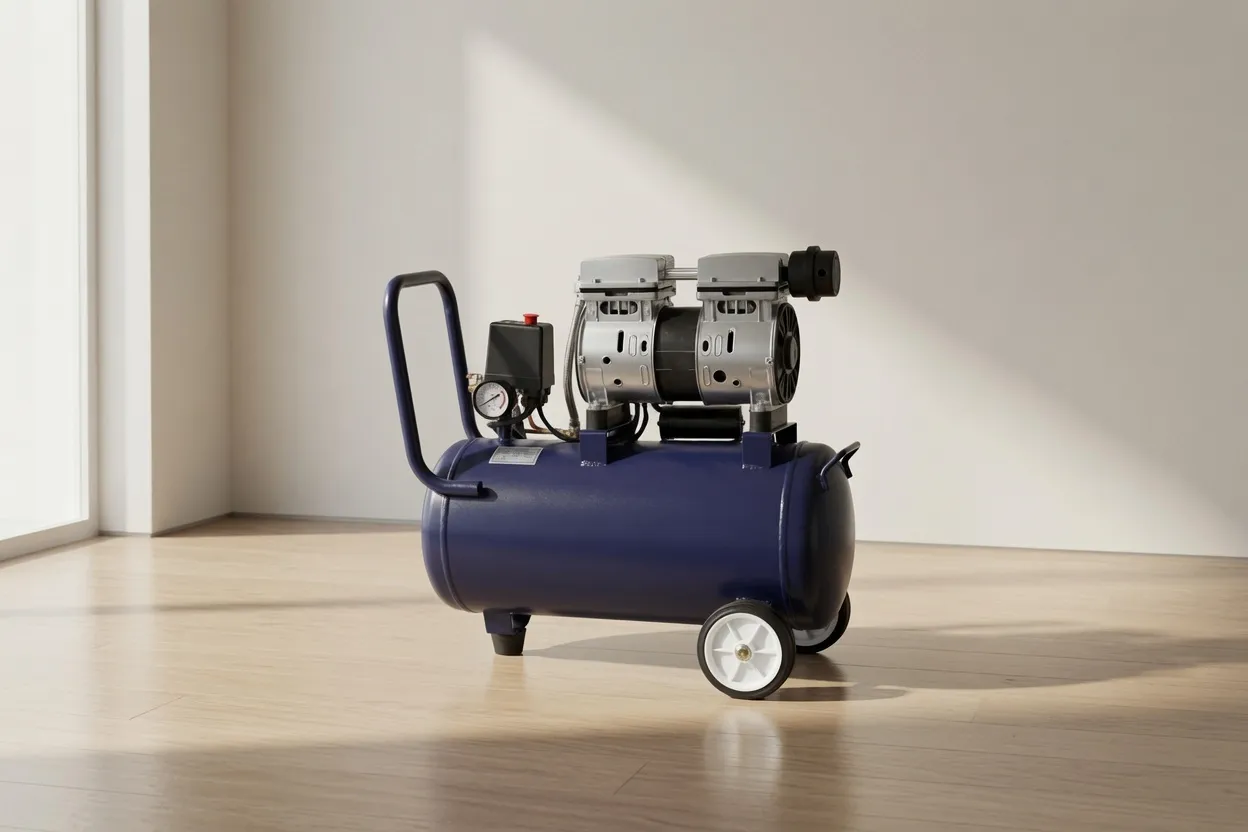
Where Compressed Air Contacts Food: The Full Map
The first step in building a robust food safety case for oil-free technology is understanding the complete inventory of compressed air uses in your facility. Many compressed air audits in food plants reveal contact and near-contact points that were not formally identified in the HACCP plan — creating unmanaged contamination risks that are invisible to the quality system.
Product-Touching Applications
- Pneumatic ingredient conveying (flour, sugar, powders)
- Filling nozzle purge air (beverage bottling)
- Aeration in brewing fermentation
- Air-knife product drying after washing
- Modified atmosphere packaging (MAP) gas blending
- Can / bottle blow-out before filling
Near-Product Applications
- Packaging machine actuators on filling lines
- Control valve operation in product zone
- Label applicator pneumatics
- Conveyor diverter gates in production area
- Sealing jaws on thermoform / vacuum pack machines
- CIP system valve actuation
Production Support Applications
- Pneumatic tools in maintenance areas
- Refrigeration system controls
- Boiler control actuation
- Structural cleaning (blowdown)
- Building pressurisation systems
- Utility instrument air (non-food zone)
Only the third category — non-contact applications isolated from the food production zone — can theoretically tolerate oil-lubricated compressed air without direct food safety risk. In practice, most Australian food manufacturing facilities find it operationally simpler, safer, and commercially more defensible to maintain a single oil-free compressed air supply system plant-wide, rather than managing zone segregation between oil-contaminated and oil-free circuits that share common headers.
The Regulatory Framework: FSANZ, HACCP & Industry Codes
Australian food manufacturers operate under a regulatory framework that increasingly treats compressed air as a food safety-critical utility requiring documented control — not simply a mechanical utility managed outside the HACCP system.
FSANZ Food Standards Code — Standard 3.2.2
FSANZ Standard 3.2.2 (Food Safety Practices and General Requirements) requires that food businesses take all practicable measures to ensure food does not become contaminated. The standard does not enumerate compressed air specifically but the principle — “all practicable measures” — applies directly. When a food business is aware that compressed air contacts or may contact food, and when the food safety risk of oil contamination from a non-oil-free system is documented, continuing to operate with oil-lubricated compressed air in product contact applications cannot be characterised as having taken “all practicable measures.” In enforcement contexts, this interpretation has been applied in FSANZ investigations following oil contamination incidents.
HACCP — Codex Alimentarius & Australian Implementation
HACCP (Hazard Analysis and Critical Control Points) methodology requires food businesses to identify, assess, and control all significant food safety hazards. Compressed air that contacts food is a potential vehicle for chemical contamination (oil aerosols) and microbiological contamination (moisture-borne bacteria from poorly dried compressed air). An effective HACCP plan for a facility using compressed air in product contact must identify oil contamination as a chemical hazard and document the control measure — which, for chemical hazard control, must be a preventative control rather than a detective one. The industry-standard preventative control is oil-free compressed air supply with ISO 8573-1 Class 0 certification. Downstream filter systems applied to oil-lubricated machines are detective controls (they remove contamination after it is introduced) and are not equivalent to preventative controls under HACCP principles.
GFSI Benchmarked Standards: BRCGS, SQF, IFS
Major supermarket retailers in Australia — Woolworths, Coles, and IGA-independent distributors — require their food manufacturing suppliers to hold certification under a GFSI (Global Food Safety Initiative) benchmarked standard such as BRCGS Food Safety, SQF Level 2/3, or IFS Food. All three of these standards contain explicit requirements for compressed air quality control in food contact applications. BRCGS Issue 9 Clause 4.9.3 specifically requires that compressed air used in direct food contact be free from oil, moisture, and contaminants. SQF Edition 9 Module 11 contains parallel requirements. Certification against any of these standards without an oil-free compressed air system in food contact applications is, at minimum, a minor non-conformance — and in direct product contact applications, a major non-conformance that risks certificate suspension.
The True Cost of Oil Contamination in Food Production
The financial exposure from an oil contamination event in a food manufacturing facility is sufficiently large that it fundamentally changes the economics of the oil-free vs. oil-lubricated compressor decision. The premium for oil-free technology — AUD 5,000–20,000 on a typical industrial compressor — is an insurance payment against the following itemised cost categories.
Product Recall Costs
Retail retrieval, consumer notifications, regulatory liaison, waste disposal, and product destruction costs for a single SKU recall event in a major Australian supermarket chain. Multi-SKU contamination events exceed AUD 2M in documented cases.
Production Shutdown & Investigation
Line shutdown, root cause investigation, equipment decontamination, validation testing, and re-qualification before production resumes following a contamination incident — typically 3–10 days of lost production at AUD 15,000–30,000/day for a mid-scale facility.
GFSI Certification Suspension
Loss of BRCGS, SQF, or IFS certificate following a major non-conformance triggers retailer supply suspension. Re-certification following suspension involves emergency audit fees, consultant support, remediation costs, and a mandatory suspension period — during which affected customer contracts may be terminated.
Brand & Reputational Damage
Consumer trust, once damaged by a publicised food safety incident, takes 3–7 years to recover according to consumer research. For own-brand products, brand erosion can reduce long-term revenue by 5–15%. For contract manufacturers, a single major incident can permanently end customer relationships built over decades.
Compressed Air Quality Standards for Food: ISO 8573-1 Applied
BRCGS and SQF reference ISO 8573-1 as the basis for compressed air purity specification in food manufacturing. Understanding how the classification system maps to your specific production process enables you to specify the right air treatment equipment without over- or under-investing in purity control.
Food Sub-Industry Applications: Specific Requirements
The food and beverage sector is not monolithic — different processing categories have specific compressed air requirements driven by the nature of the product, the regulatory environment for that category, and the operational characteristics of the production process. The following sub-industry profiles highlight the most important distinctions.
Beverage Manufacturing & Bottling
Beverage production uses compressed air at every critical stage of the production line. PET bottle blow-moulding requires high-pressure oil-free air (2.5–4.0 MPa) that enters the preform interior as the bottle forms — any oil contamination at this stage deposits on the internal bottle surface in direct contact with the beverage. Filling machines use compressed air to actuate filling valves and product-transfer systems. CIP (Clean-in-Place) systems use compressed air to actuate valves in the cleaning circuit — and contaminated CIP air can recontaminate freshly cleaned vessels. Carbonation systems use CO₂ blended with air in some applications. For breweries specifically, compressed air used in fermentation vessel purging, bright beer tank blanketing, and filtration press operations must be oil-free to avoid flavour contamination that produces characteristic off-notes detectable by trained tasting panels at concentrations as low as 0.1 ppm in the finished beer.
Dairy Processing
Dairy processing is among the most demanding food industry compressed air applications. Spray-drying towers for milk powder and infant formula use large volumes of compressed air both as the process air for atomisation and as the purge air for nozzle systems — direct product contact at temperatures that can aerosolise oil vapours. Cheese cutting and portioning uses pneumatic knife actuators above open product. Yoghurt and cultured product filling lines use compressed air in direct contact with sterile product surfaces. BRCGS and IFS auditors consistently flag dairy facilities with oil-lubricated compressed air systems as having major non-conformances — the product category’s vulnerability to contamination and the premium retail pricing at risk make compliance enforcement rigorous in this sector.
Bakery & Confectionery
Pneumatic ingredient conveying is the most significant compressed air use in large bakery and confectionery operations. Flour, sugar, cocoa powder, and dried fruit are conveyed in dilute-phase or dense-phase pneumatic systems that move tonnes of material per hour through pipelines using compressed air as the transport medium. Any oil aerosol in the conveying air is absorbed by the ingredient particle surfaces — introducing hydrocarbon contamination at the process input stage, before any HACCP control point can detect it. Oil-free conveying air is non-negotiable in large bakery operations and is a standard specification in all modern pneumatic conveying system designs for food applications.
Building a Compliant Food-Grade Compressed Air System
A compliant food-grade compressed air system is a complete engineered package — not simply a compressor swap. The following design and documentation requirements apply to Australian food manufacturers seeking BRCGS Issue 9, SQF Edition 9, or IFS Food Version 8 certification with compressed air in product contact applications.
ISO 8573-1 Class 0 Oil-Free Compressor
Select a compressor independently certified to ISO 8573-1 Class 0 — third-party analytical test data, not manufacturer specification alone. Water-lubricated oil-free screw compressors provide the lowest contamination risk profile for direct food contact air and the most robust audit evidence. Supply the certification documentation to your GFSI auditor as objective evidence of Clause 4.9.3 compliance.
Refrigerant Dryer to −20°C PDP for Direct Contact Air
Direct food contact air should be dried to a minimum pressure dewpoint of −20°C. A refrigerant dryer achieving +3°C PDP is adequate for non-contact zones; a desiccant dryer delivering −20°C to −40°C PDP provides the additional moisture reduction required at direct product contact points, and eliminates the risk of condensation inside product-zone pneumatic pipelines that would create microbiological growth conditions.
0.01 μm Sterile-Grade Filtration at Point of Use
For direct food contact applications, a 0.01 μm sterile-grade final filter installed at the terminal outlet ensures that even the very low residual particulate levels from pipeline surfaces and central treatment filters are removed before air contacts product. These filters require annual replacement on a time-based schedule and the replacement event must be documented in the food safety system maintenance records.
Annual Air Purity Validation & Documentation
BRCGS Clause 4.9.3 and SQF Module 11 require documented evidence of compressed air quality monitoring. An annual third-party test measuring oil content (ISO 8573-1 Class 0 verification), total particulate, and dewpoint, with results retained in the food safety management system, provides the audit evidence required. Some GFSI certified facilities perform quarterly spot tests at high-risk direct contact points to provide more frequent verification between annual full tests.
HACCP Plan Integration & Risk Register Update
The compressed air system must be formally integrated into the facility’s HACCP plan as a utility with identified hazards (oil, moisture, particulate, microbial) and documented control measures. The HACCP hazard analysis should record the oil contamination hazard as “controlled — eliminated at source” via oil-free compressor technology, rather than “controlled — reduced” via downstream filtration. This framing directly addresses the HACCP requirement for preventative controls at significant chemical hazard points.
Why Food & Beverage Manufacturers Choose Australia Oil Free Air Compressor Co., Ltd.
Australian food and beverage manufacturers need a compressed air partner who understands food safety compliance requirements, delivers equipment that supports GFSI certification, and provides the maintenance and documentation services that keep compliance evidence current. Here is what differentiates our service for food industry clients.
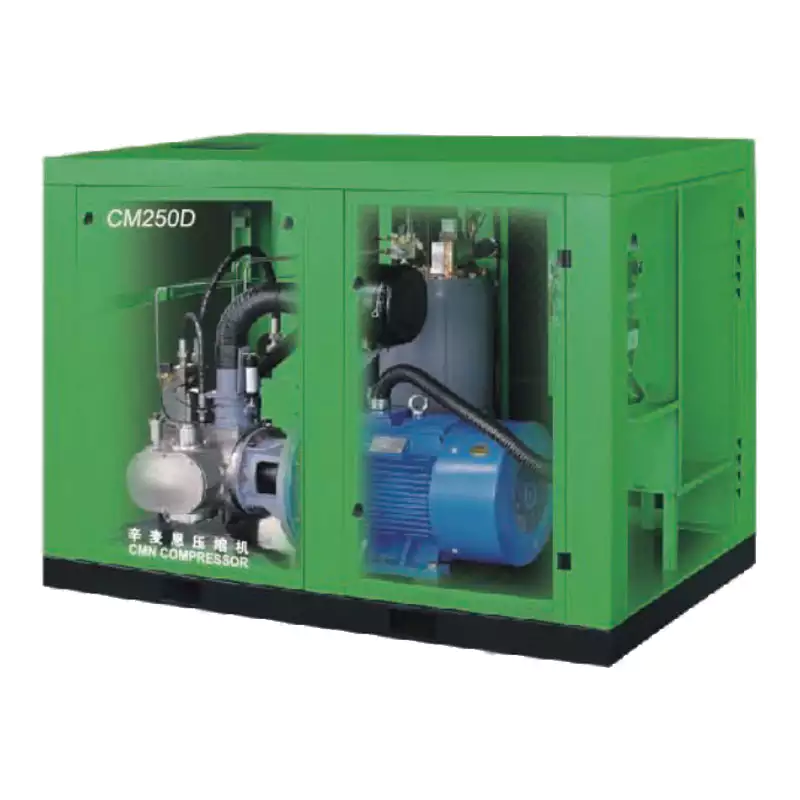
CM132DV Water-Lubricated Oil-Free Screw Compressor
Zero contamination risk through water-lubrication design. ISO 8573-1 Class 0 independently certified. Variable speed drive delivers 20–35% energy reduction in food manufacturing’s variable demand profile. Discharge temperature below 50°C reduces dryer loading and extends downstream filter life. Complete HACCP documentation support package available at purchase.
Frequently Asked Questions
Protect Your GFSI Certificate with Compliant Oil-Free Air
Australia Oil Free Air Compressor Co., Ltd. supplies ISO 8573-1 Class 0 certified oil-free compressed air systems to food and beverage manufacturers across Australia — with full BRCGS/SQF audit documentation support and annual validation contracts.
Request a Food Safety Air Assessment
Email: [email protected]
|
Contact Us Online
|
About Us