
ISO 8573 is one of the most widely cited standards in compressed air specification — and one of the most superficially understood. Engineers who have spent years working with compressed air systems frequently conflate its parts, misquote its class definitions, or apply it only to oil content while neglecting the equally important moisture and particulate axes. Procurement teams specify “ISO 8573-1 Class 1” without confirming which of the three parameters they mean. Regulatory auditors ask for ISO 8573-1 compliance records without specifying which test methods (from the companion parts of the series) were used to generate those records. This comprehensive guide clarifies every dimension of ISO 8573 as it applies to oil-free compressed air systems: the structure of the standard family, the precise meaning of each purity class, the relationship between compressor design and achievable purity, and the practical specification language that engineers and quality professionals need to correctly define and verify compressed air quality in regulated and industrial facilities.
The ISO 8573 Standard Family: Nine Parts, One System
ISO 8573 is not a single document — it is a family of nine interrelated standards, each covering a distinct aspect of compressed air quality measurement, specification, or testing. Understanding which part does what is the prerequisite for using the standard correctly.
The practical implication: when a supplier says “our compressor meets ISO 8573-1 Class 0,” they are referencing Part 1 (the classification) but the test that generated the result used Part 2 (aerosol oil) and Part 5 (vapour oil). A complete air quality certification for oil content must reference all three parts: 8573-1 (the class), 8573-2 (aerosol test method), and 8573-5 (vapour test method). Any certification that does not specify the test method used to generate the total oil result is incomplete and should not be accepted for regulated industry procurement.
How to Read a Full ISO 8573-1 Purity Class Designation
A complete ISO 8573-1 purity class specification is expressed as a three-number code separated by full stops or colons, giving the class for each of the three primary contamination axes in order: Particulate : Moisture (dewpoint) : Oil. Specifying only one axis — e.g., “Class 1 oil” — defines only one-third of the air quality requirement. Properly specified compressed air systems define all three axes, matched to the application’s risk level.
@ 0.1–0.5 μm
refrigerant dryer
total oil
ISO 8573-1 Class 1.4.1 means: Particulate Class 1 (≤20,000 particles/m³ in the 0.1–0.5 μm range) + Moisture Class 4 (PDP ≤+3°C, achievable with a refrigerant dryer) + Oil Class 1 (≤0.01 mg/m³ total oil). This specification is appropriate for hospital instrument air, dental practice supply, and food incidental contact applications. Note: Class 1.4.0 (with Oil Class 0 replacing Oil Class 1) would be required for pharmaceutical product contact and food direct contact applications.
Deep Dive: What Each Contamination Axis Measures
Axis 1: Solid Particulate — Sizing and Counting
The ISO 8573-1 particulate axis measures the concentration of solid particles in the compressed air stream across three size ranges: 0.1–0.5 μm, 0.5–1.0 μm, and 1–5 μm. Particles below 0.1 μm are not measured (below the resolution of most particle counters) and particles above 5 μm are typically removed by even basic filtration. The three size bands matter because particles in different size ranges have different penetration depths in the human respiratory tract when air is administered to patients — a consideration that drives the stringent Class 1 particulate requirement in medical air applications.
Sources of particulate contamination in oil-free compressed air systems include: atmospheric dust drawn in at the inlet (the primary source, managed by inlet filtration); pipe scale and internal corrosion products (managed by specifying appropriate pipework material); wear particles from filter media and compressor components; and biological particles (managed by downstream filtration and, for sterile applications, 0.22 μm terminal sterilising filters).
Axis 2: Moisture — Why Dewpoint Matters More Than Humidity
Moisture in compressed air is expressed as pressure dewpoint (PDP) — the temperature at which moisture begins to condense out of the compressed air at the line pressure. This is distinct from the atmospheric dewpoint because compressing air concentrates its moisture content proportionally. Air at atmospheric dewpoint of +10°C, when compressed to 0.7 MPa (8 bar absolute), has an effective moisture concentration approximately 8× higher — meaning condensation will occur inside the distribution pipework at ambient temperatures that would not cause any condensation in atmospheric air.
The practical consequence of inadequate drying (high PDP) in compressed air distribution is threefold: corrosion inside carbon steel or copper pipework that generates particulate contamination; microbial growth on pipeline internal surfaces wherever liquid water accumulates — creating a biofilm source that compromises air microbiological quality; and liquid water carryover into pneumatic instruments and actuators that causes damage and malfunction. For applications using water-lubricated oil-free compressors, the dryer performs a dual function: removing compression moisture and ensuring that the water used for lubrication does not carry over into the distribution system.
Axis 3: Total Oil Content — The Three Components
The ISO 8573-1 oil content class measures total oil content — the sum of three distinct forms of oil contamination that must be measured separately and added together. Understanding this three-component structure is essential because a compressor test that only measures one component (e.g., only aerosol oil) cannot yield a valid total oil content result for Class 0 certification purposes.
Component 1: Liquid Oil
Bulk liquid oil droplets larger than approximately 1 μm diameter that can be collected on a filter membrane. In oil-lubricated systems, liquid oil is the primary contamination form from separator element bypass events. In true oil-free systems, liquid oil should be absent — its presence indicates system cross-contamination or component failure.
Component 2: Oil Aerosol
Sub-micron oil droplets (0.01–1 μm diameter) that remain suspended in the air stream and pass through standard particulate filters. Oil aerosols are the predominant form of contamination from oil-lubricated compressors operating through a coalescing separator — and the form that causes the most significant product contamination in food and pharmaceutical manufacturing.
Component 3: Oil Vapour
Hydrocarbon molecules in the gas phase — fully vaporised, invisible, and undetectable by taste or smell at low concentrations. Oil vapour passes through all particulate and coalescing filters and can only be removed by activated carbon adsorption or desiccant adsorption. In true oil-free systems, oil vapour originates from atmospheric hydrocarbons drawn in at the inlet — not from the compressor itself.
Selecting the Right Purity Class for Your Application
The ISO 8573-1 purity class you select should reflect the contamination risk each application presents — not a blanket over-specification or under-specification. The following matrix maps the most common Australian industrial and regulated compressed air applications to their appropriate ISO 8573-1 class designation across all three axes, with the corresponding treatment equipment required to achieve it.
Five Common Misunderstandings About ISO 8573 in Practice
Misconception 1: “Class 1 is more stringent than Class 0”
Incorrect. In ISO 8573-1, lower numbers mean cleaner air. Class 0 is the most stringent (best) purity — it sits above Class 1 in the hierarchy. Class X is the least stringent (most contamination allowed). The counter-intuitive “zero is better” naming is a legacy of the 2010 revision that added Class 0 above the existing Class 1; the committee chose not to renumber the existing classes. When referencing the standard, always clarify the direction: “Class 0 = highest purity, Class X = lowest tracked purity.”
Misconception 2: “Specifying ‘Class 1’ is a complete air quality specification”
Incomplete. “Class 1” without specifying which axis — particulate, moisture, or oil — is ambiguous. A complete specification must state all three axes: e.g., “ISO 8573-1:2010 Class 1.4.0” (Particulate 1, Moisture 4, Oil 0). Many compressed air system failures in audited facilities trace back to a specification that defined only the oil class and left moisture and particulate uncontrolled — with resulting corrosion, biofilm, and instrument damage that the audit then penalises as a separate non-conformance.
Misconception 3: “ISO 8573-1 Class 0 means zero oil — literally nothing”
Technically imprecise. ISO 8573-1 Class 0 does not mean “zero” in an absolute mathematical sense — it means “less than 0.01 mg/m³ total oil content, with the exact agreed limit documented between supplier and user.” The standard recognises that absolute zero cannot be meaningfully verified by any analytical method. What Class 0 does mean in practice is: the oil contamination level is below the detection threshold of the test methods used, from a source that has no internal oil in the compression pathway. For regulated industries, this distinction is academic — 0.01 mg/m³ or below is functionally indistinguishable from zero at any level that affects product quality or patient safety.
Misconception 4: “The compressor’s Class 0 certificate covers the whole system”
Incomplete at site level. The manufacturer’s Class 0 certificate confirms the compressor’s performance at the factory outlet. Once the compressor is installed in your facility, the air quality at your process outlets depends on the entire system: compressor → receiver → dryer → filters → pipework → terminal points. Corrosion in pipework, a saturated filter element, a faulty dryer, or a leaking manual bypass valve can all degrade air quality downstream of a Class 0 compressor. Annual site air quality testing at your process outlets is required to demonstrate that the installed system — not just the compressor — delivers Class 0 at the point of use.
Misconception 5: “All ISO 8573 test methods measure the same thing”
Not equivalent. ISO 8573-2 measures oil aerosol and liquid oil (sub-micron through to bulk droplets, collected on a filter membrane or in an impinger). ISO 8573-5 measures oil vapour (gas-phase hydrocarbons, adsorbed on activated carbon and analysed by GC-FID). These are chemically and physically distinct analytical methods that measure different forms of oil. A Class 0 total oil content certificate that cites only Part 2 (aerosol measurement) but not Part 5 (vapour measurement) is not a complete total oil result — it is missing the vapour component. Both methods are required, and their results must be summed to yield total oil content for a valid Class 0 claim.
Building a Complete ISO 8573-Compliant Air Quality Specification
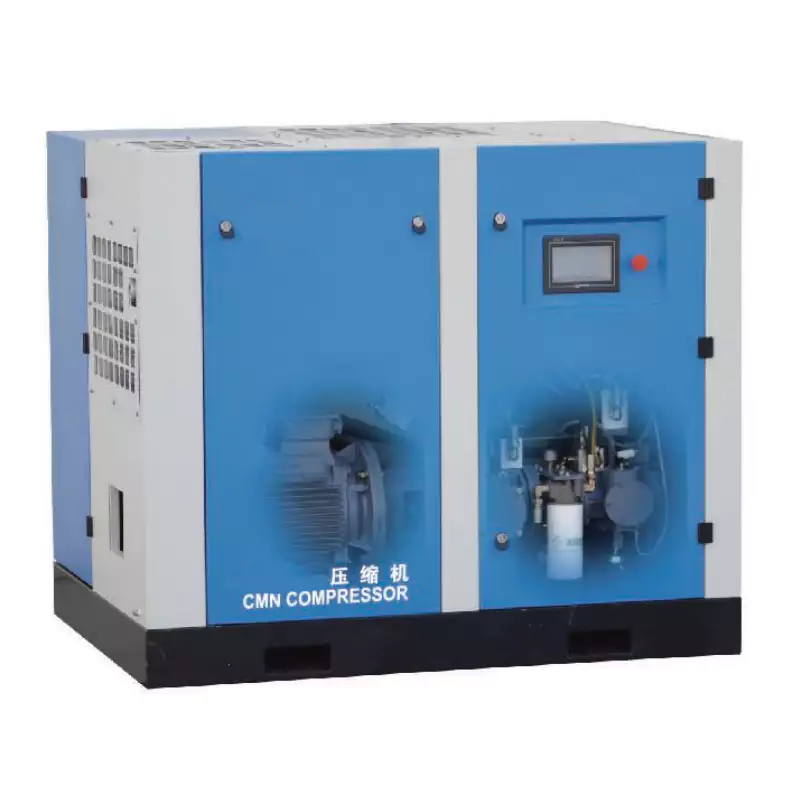
A complete, audit-ready compressed air quality specification for a regulated industry facility covers six elements. Our range — from the compact CM45D to the high-capacity CM242GPV — can be specified against any of these requirements with supporting documentation.
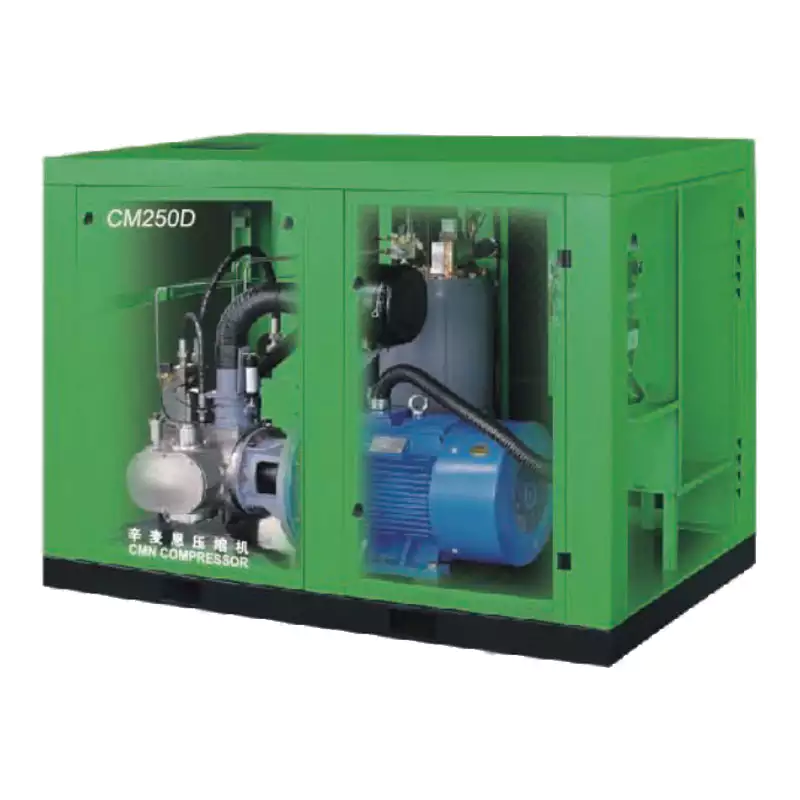
CM132DV Water-Lubricated Oil-Free Screw Compressor
Full ISO 8573-1 Class 0 certification documentation provided at delivery — covering all three axes, tested by an accredited laboratory at rated operating conditions using ISO 8573-2 and ISO 8573-5 test methods. Variable speed drive, integrated treatment train, and IQ/OQ/PQ documentation templates for pharmaceutical purchasers. Annual site validation service available.
Frequently Asked Questions
Specify With Confidence — Get ISO 8573 Documentation
Australia Oil Free Air Compressor Co., Ltd. supplies ISO 8573-1 certified compressors with complete three-axis test documentation, annual validation contracts, and technical specification support for pharmaceutical, food, medical, and industrial customers across Australia.
Request ISO 8573 Certification Documents
Email: [email protected] | Contact Us | About Us