Full Cost Breakdown
A rigorous, line-by-line TCO analysis for oil-free compressed air systems in Australian industrial and regulated environments — with real cost data, worked calculations, and the financial case for every major investment decision.
The purchase price of an oil-free air compressor is the figure that appears on the quotation. The total cost of ownership is the figure that determines whether the purchase was a good decision. For a 75 kW oil-free screw compressor running in an Australian manufacturing facility, the gap between purchase price (typically AUD 35,000–65,000) and 10-year TCO (typically AUD 650,000–950,000) is a factor of 12–18. Purchasing decisions made purely on capital cost systematically undervalue energy efficiency, maintenance interval, service life, downtime risk, and compliance cost — and systematically lead to choices that cost more over the operating life of the asset. This article provides a complete, component-by-component TCO breakdown for oil-free air compressors in the Australian context: detailed cost data for each of the seven major TCO components, worked calculations with current Australian pricing, the factors that make the largest difference to lifetime cost, and the investment decisions that consistently deliver the best long-term financial outcome.
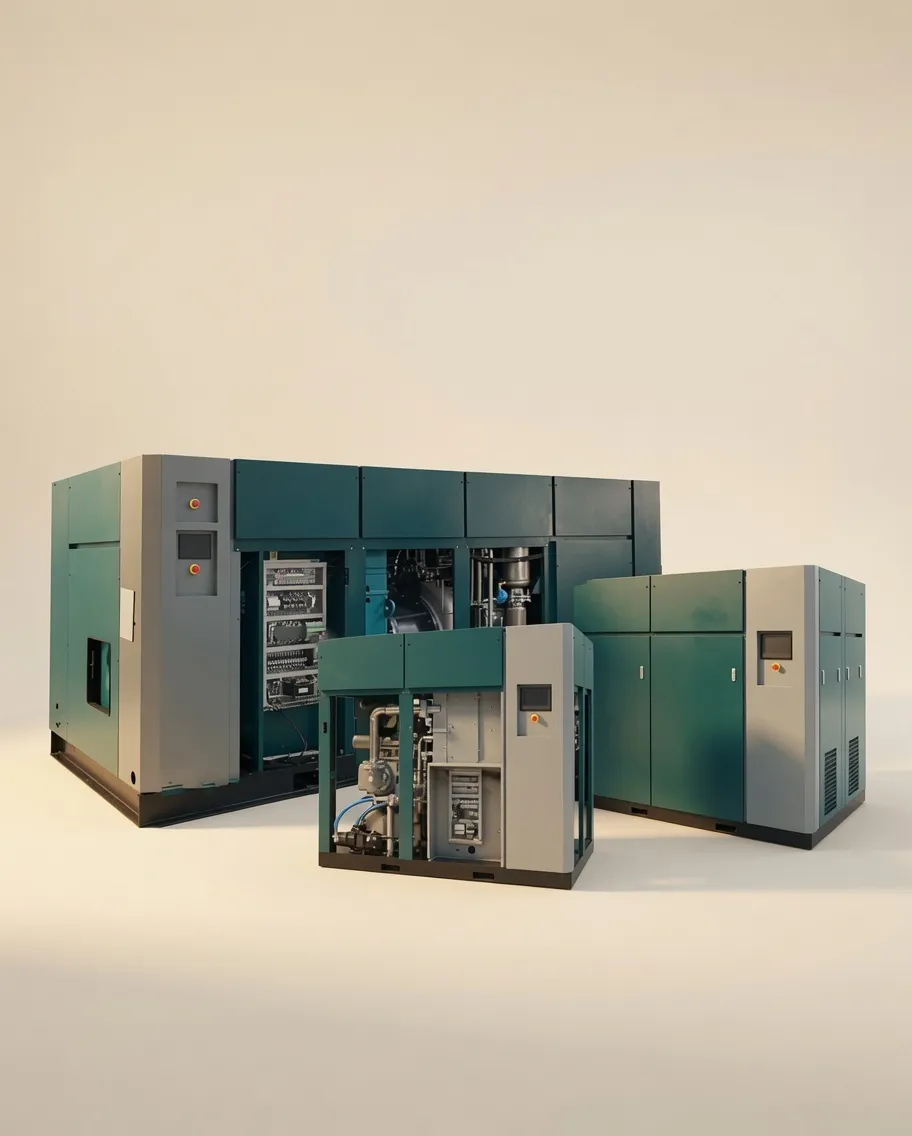
The purchase price of an oil-free compressor represents 8–12% of its 10-year total cost of ownership. The remaining 88–92% accumulates through energy, maintenance, repairs, downtime, compliance, and disposal costs over its operating life.
The TCO Composition: Where the Money Actually Goes
For a 75 kW oil-free screw compressor operating at typical Australian industrial conditions (6,000 hours/year, 65% average load, Victoria electricity at $0.19/kWh), the 10-year TCO breaks down as follows. These percentages shift modestly with operating hours, electricity rate, and application type — but the energy dominance is consistent across virtually all scenarios.
10-Year TCO Component Breakdown — 75 kW Oil-Free Screw Compressor (Victoria, 6,000 hrs/yr)
Downtime / lost production
10-YEAR TOTAL:
AUD 738,600
Component 1: Energy — 76% of TCO
Energy is the overwhelming dominant cost in any compressed air system TCO. At Australian industrial electricity rates of $0.14–$0.23/kWh, a 75 kW compressor running 6,000 hours/year generates $47,000–$104,000 in electricity costs annually. Over 10 years: $470,000–$1,040,000. Every 1% improvement in specific power (kW per m³/min FAD) saves approximately $4,700–$10,400 over the 10-year period for a compressor of this size. This is why specific power — not purchase price — is the single most financially significant parameter in the procurement decision.
Specific Power: The Energy Efficiency Benchmark
Specific power is expressed in kW per m³/min FAD at rated operating pressure. Lower is better. It is the only meaningful way to compare energy efficiency across compressors of different sizes or technologies. When comparing quotations, always request the ISO 1217 FAD and the full-load power at that FAD — calculate specific power yourself rather than relying on manufacturer “efficiency” claims.
| Technology |
Specific Power (kW/m³/min) |
Annual Energy (75 kW, 6,000 hrs) |
10-yr Energy Cost ($0.19/kWh) |
| VSD water-lubricated screw |
5.5–6.2 |
294,000 kWh |
AUD 558,600 |
| Fixed-speed dry screw |
6.5–7.5 |
342,000 kWh |
AUD 649,800 |
| Fixed-speed oil-lubricated screw |
7.0–8.0 |
370,000 kWh |
AUD 703,000 |
| Oil-free piston (comparable capacity) |
9.0–12.0 |
456,000 kWh |
AUD 866,400 |
VSD vs. fixed-speed energy saving: At 65% average load, VSD eliminates unloaded running losses. A VSD water-lubricated design saves approximately AUD 91,200 in energy over 10 years compared to a fixed-speed oil-free screw at the same size — recovering the VSD premium (typically AUD 8,000–18,000) within 12–24 months from energy savings alone. The CM132DV integrates VSD with water-lubricated oil-free technology for the lowest 10-year energy cost in the class.
Component 2: Planned Maintenance — 6.5% of TCO
Planned maintenance represents the scheduled labour and consumables costs across the compressor’s operating life. For oil-free designs, this is 40–55% lower than oil-lubricated equivalents primarily because it eliminates: lube oil changes (3 × per year for most industrial units), oil separator element replacement (annual), oil analysis programme, and controlled waste oil disposal levy. The remaining oil-free maintenance tasks — inlet filter, downstream filter cartridges, bearing grease, gear oil (dry screw), dryer service, safety valve certification — are common to both oil-free and oil-lubricated designs.
| Task |
Frequency |
Oil-Free Cost (AUD) |
Oil-Lubricated Cost (AUD) |
| Inlet air filter element |
3× per year |
$480–$600 |
$480–$600 |
| Downstream filter cartridges |
Annual |
$280–$480 |
$180–$320 |
| Lube oil change + analysis |
3× per year |
$0 — none |
$840–$1,440 |
| Oil separator element |
Annual |
$0 — none |
$320–$600 |
| Timing gear oil (dry screw) |
Annual |
$80–$140 |
N/A |
| Air-end bearing grease |
Every 4,000 hrs |
$60–$120 |
$60–$120 |
| Dryer service |
Annual |
$180–$280 |
$180–$280 |
| Oil disposal (controlled waste levy) |
3× per year |
$0 — none |
$240–$600 |
| Annual air quality test (ISO 8573-1) |
Annual |
$800–$2,500 |
Not available |
| ANNUAL TOTAL (mid-range estimate) |
|
AUD ~4,800 |
AUD ~7,200 |
Component 3: Purchase & Installation — 7.5% of TCO
The capital cost includes the compressor unit, downstream treatment train, installation materials, commissioning, and — for regulated industries — initial qualification. Despite representing only 7.5% of TCO, it typically receives 80% of the procurement team’s attention. The components of a complete installation capital cost:
Compressor Unit
AUD 35,000–65,000
75 kW VSD water-lubricated oil-free screw; includes integrated controls, cabinet, dryer, and filtration in packaged designs
Receiver Tank
AUD 1,500–5,000
200–1,000 L pressure vessel; cost includes supply, installation, and pressure vessel certification (mandatory in most Australian states)
Distribution Pipework
AUD 3,000–25,000
Dependent on run length, material (copper, 316L SS, aluminium), number of drops, and fitting complexity. Pharmaceutical SS systems at the upper end
Electrical Installation
AUD 1,500–6,000
Dedicated circuit, main isolator, cable to motor control panel; varies by distance to switchboard and cable specification
Commissioning
AUD 800–2,500
Factory-trained technician startup; pressure setpoint configuration, VSD parameter setting, control interlock test, initial air quality verification
GMP Qualification (pharma/food)
AUD 5,000–20,000
IQ/OQ/PQ protocol preparation, execution, and report approval; QA time and external consultant cost for TGA-licensed facilities
Component 4: Downtime — The Highly Variable Cost
Downtime cost is the most variable and the most underestimated element in compressed air TCO analysis. Facilities with formal risk management understand this cost intimately because they have lived through a compressor failure event. Those who have not yet experienced a failure systematically underestimate it — until it happens.
GENERAL INDUSTRIAL
AUD 3,000–15,000
per event
Lost production at AUD 8,000–20,000/day × 0.25–0.5 day per event (repair time + sourcing delay) = AUD 2,000–10,000 direct cost per unplanned shutdown. Add AUD 500–2,500 emergency service call-out premium over standard call rate. Two events per year over 10 years: AUD 30,000–125,000 in accumulated downtime costs.
FOOD PRODUCTION
AUD 15,000–80,000
per event
Lost production revenue + batch rejection + potential BRCGS non-conformance documentation + possible customer penalty clauses. A BRCGS audit finding triggered by a compressed air failure can result in suspension of GFSI certification — which terminates Woolworths/Coles supply contracts pending re-audit. The financial exposure from certification suspension typically exceeds AUD 100,000 across a 6–12 week remediation period.
PHARMACEUTICAL
AUD 100,000–600,000+
per event
Compressed air failure during active pharmaceutical manufacturing triggers batch quarantine and a GMP deviation investigation. Batch values typically AUD 50,000–500,000. Mandatory investigation, root cause analysis, and revalidation process adds 2–5 days of lost production beyond the repair event. A TGA critical finding triggered by a compressed air quality failure can result in manufacturing licence suspension — the highest potential cost scenario for any single technical failure in pharmaceutical manufacturing.
Component 5: Compliance & Validation Costs
For regulated industries, compliance cost is a mandatory TCO component — not an optional investment. The following annual compliance costs are representative of what TGA-licensed pharmaceutical manufacturers, BRCGS food-certified facilities, and AS 2896-compliant medical facilities should budget per compressor installation:
Annual Air Quality Test
AUD 800–2,500
Third-party NATA-accredited lab testing for ISO 8573-1 Class 0 (oil, particulate, dewpoint) at all product-contact outlets. Mandatory for TGA GMP, BRCGS, SQF, and AS 2896 audits.
Annual GMP Requalification
AUD 2,000–6,000
Pharmaceutical only. Formal requalification protocol execution, test report, QA review and sign-off, entry into the site’s validation status register. Required annually for TGA-licensed facilities.
Pressure Vessel Inspection
AUD 300–800
Statutory requirement in most Australian states for pressure vessels above a defined threshold (typically ≥150 L × rated pressure in kPa ≥ 1,000 MPa-litres). Annual or biennial depending on jurisdiction.
BRCGS/SQF Evidence Compilation
AUD 400–1,200
Food only. Annual compilation of air quality test reports, maintenance records, and monitoring data into the format required for BRCGS/SQF technical file. QA staff time at AUD 80–120/hr × 5–10 hours.
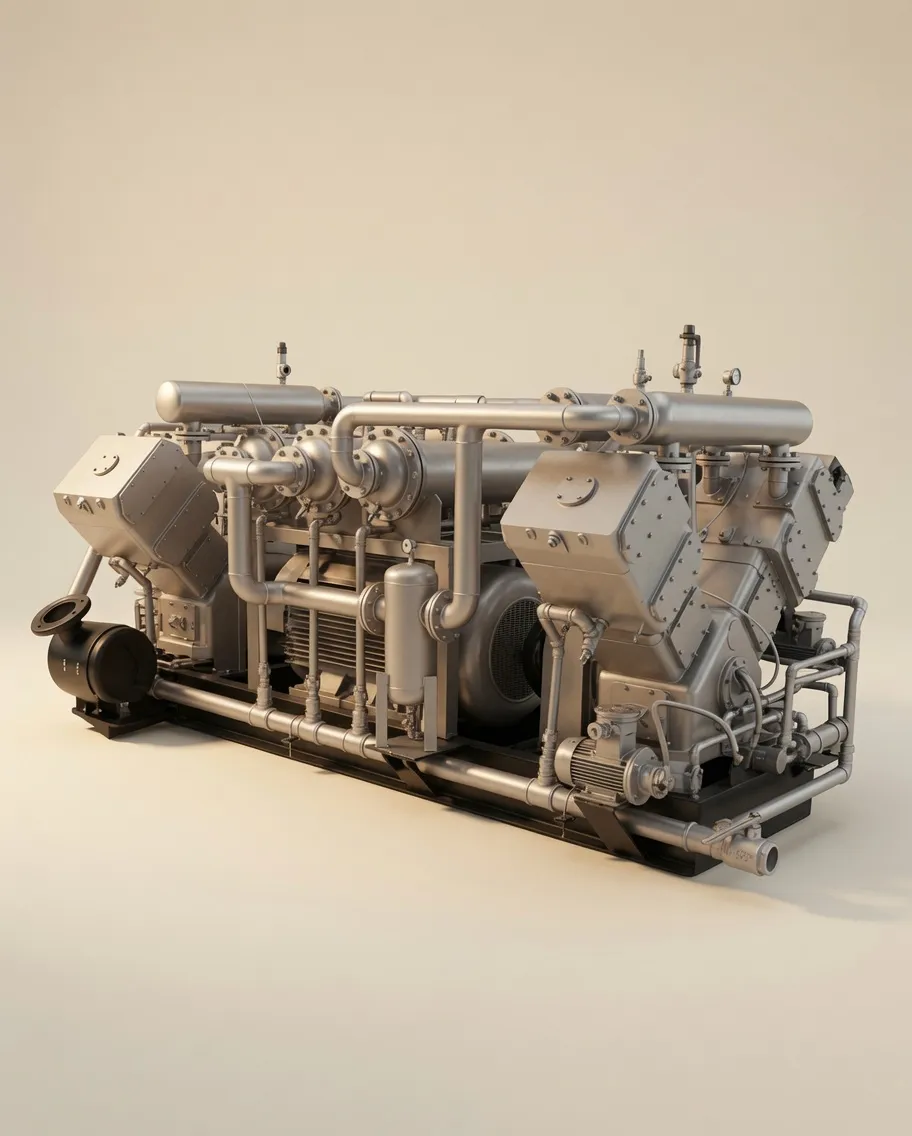
Annual air quality validation — the compliance evidence required by TGA GMP, BRCGS, SQF, and AS 2896 auditors. Australia Oil Free Air Compressor Co., Ltd. provides annual validation contracts covering testing, reporting, and QA documentation.
Component 6: Unplanned Repairs & Component 7: Residual Value
Unplanned Repairs — 2.5% of TCO
Unplanned repairs cover emergency part replacement, unexpected component failures, and air-end overhaul if scheduled maintenance was deferred or a wear event occurs outside the service interval. For water-lubricated oil-free screw compressors with a rigorous planned maintenance programme, unplanned repair frequency is low. Budget AUD 1,500–3,000/year for small to medium units (22–75 kW) as a risk-based reserve. Proactive tip seal and bearing replacement at scheduled intervals is consistently cheaper than reactive air-end overhaul — the ratio is typically 1:5 to 1:15 (planned replacement cost vs reactive air-end replacement).
Residual Value — A Negative Cost Item
Oil-free compressors retain higher resale and trade-in values than equivalent oil-lubricated machines in the Australian secondary market — because the pool of potential buyers includes regulated industry operators who cannot use oil-lubricated equipment. A well-maintained oil-free screw compressor retains approximately 15–25% of original purchase price at 10 years. Oil-lubricated machines also incur controlled waste oil disposal costs (AUD 200–600 per change) over their service life — a cost oil-free machines do not have. Net residual value advantage for oil-free over 10 years: approximately AUD 8,000–20,000 for a 75 kW unit.
Complete 10-Year TCO Summary
| TCO Component |
VSD Oil-Free (AUD) |
Fixed Oil-Lubricated (AUD) |
Oil-Free Saving |
| Capital & installation |
55,000 |
38,000 |
−17,000 |
| 10-yr energy (VSD at 65% avg load) |
558,600 |
703,000 |
+144,400 |
| 10-yr planned maintenance |
48,000 |
72,000 |
+24,000 |
| 10-yr unplanned repairs |
18,000 |
28,000 |
+10,000 |
| 10-yr downtime (food/pharma allowance) |
44,000 |
88,000 |
+44,000 |
| 10-yr compliance / validation |
15,000 |
0 (not applicable) |
— |
| 10-YEAR TCO TOTAL |
AUD 738,600 |
AUD 929,000 |
AUD 190,400 saved |
Lowest 10-Year TCO in Class
CM132DV VSD Water-Lubricated Oil-Free Compressor
The combination that delivers the lowest TCO: VSD energy efficiency + water-lubricated zero-oil-pathway design + 7,000-hour service intervals + ISO 8573-1 Class 0 certification. Annual service and validation contracts available to convert unpredictable maintenance spend into a fixed annual cost. Request a free site-specific 10-year TCO calculation from our team.
Request Free TCO Analysis →
Frequently Asked Questions
Why does energy dominate TCO so completely — is this the same for all compressor sizes?
+
Yes — the energy dominance is a fundamental characteristic of compressed air systems at all sizes and in all markets, and it is driven by the physics of gas compression. Compressing a gas to higher pressure requires work proportional to the compression ratio and the mass flow rate — for typical industrial compressors (0.7–0.9 MPa, 80–90% volumetric efficiency), theoretical minimum compression work is approximately 5–6 kW per m³/min FAD. Real machines use 6–8 kW/m³/min due to mechanical losses. Running a 75 kW machine for 6,000 hours draws 450,000 kWh — at $0.19/kWh that is $85,500 per year from physics alone. The purchase price of $55,000 is 65% of one year’s energy cost. This ratio holds across all compressor sizes because both capital cost and energy cost scale roughly proportionally with motor power — energy always dominates by roughly the same factor (10–15×) at typical Australian operating hours and electricity rates.
How should I build the business case for replacing a working oil-lubricated compressor with oil-free?
+
The most persuasive business case combines four elements: (1) Compliance risk quantification — for regulated industry, the cost of a single TGA critical finding, BRCGS certification suspension, or batch rejection event typically exceeds the total cost difference between oil-free and oil-lubricated systems over five years. Present the probability-weighted annual expected cost of a compliance event. (2) Energy efficiency delta — calculate the specific power of your current machine vs. a new VSD oil-free model; multiply by operating hours and electricity rate. A 15% specific power improvement saves $8,000–15,000/year for a 75 kW unit. (3) Maintenance savings — remove oil changes, separator elements, and waste disposal costs from your current maintenance budget; show the annual saving. (4) Lifecycle cost at end of current machine’s useful life — if the current machine is approaching 30,000–40,000 hours, the cost of an air-end overhaul or replacement is often comparable to the purchase premium for a new oil-free VSD unit, making the switch economically rational at the natural replacement point.
What is the best way to reduce compressor energy costs without replacing the machine?
+
Three interventions deliver the highest return on compressed air energy cost reduction without machine replacement: (1) System leak detection and repair — a facility with no active leak management programme typically loses 20–30% of compressed air through leaks. Ultrasonic leak detection survey (AUD 800–1,500) followed by repair typically reduces system energy consumption by 10–20% within three months. ROI is typically measured in weeks. (2) Pressure setpoint optimisation — many facilities run at 0.8–0.9 MPa when 0.7 MPa would meet all consumer requirements. Reducing system pressure by 0.1 MPa reduces compressor power consumption by approximately 6–8%. (3) VSD retrofit — if your current machine is a fixed-speed model with variable demand, adding a VSD retrofit kit (where manufacturer-supported) can reduce energy consumption by 15–25% at typical average load factors. Contact us for advice on whether a VSD retrofit is feasible for your model before considering full replacement.
Should I include heat recovery in my TCO calculation?
+
Yes — heat recovery is increasingly included in TCO analysis for facilities with space heating requirements. Air compressors reject 70–90% of their input energy as heat — primarily through the aftercooler and motor cooling system. This heat can be recovered and used for space heating, process water pre-heating, or industrial drying processes. For a 75 kW compressor running 6,000 hours/year, the recoverable heat represents approximately 340,000–400,000 kWh/year of thermal energy. At Australian gas prices of approximately $0.03–0.05/kWh thermal, this represents a potential AUD 10,000–20,000/year heating offset if the recovered heat can be usefully applied. Oil-free compressors with dry screw technology (higher discharge temperatures) offer more recoverable heat than water-lubricated designs — a factor worth noting if space heating is a significant facility cost. Ask our team about heat recovery integration options when discussing compressor specifications.
How do I get an accurate 10-year TCO estimate for a specific machine and site?
+
Request a site-specific TCO calculation from our team — we need five inputs: (1) your state (for the correct electricity rate); (2) estimated annual operating hours; (3) estimated average load factor (or we can estimate from your current compressor’s load statistics if available); (4) your application type (general industrial, pharmaceutical, food, dental, etc.) for the correct compliance and downtime cost assumptions; and (5) current electricity rate from your most recent utility bill (the actual rate your facility pays, not the published standard rate, as many medium-large facilities are on negotiated contracts). With these five inputs, we can provide a line-by-line 10-year TCO comparison between alternative machine specifications within 48 hours.