
What Is a Water-Injected Oil-Free Compressor?
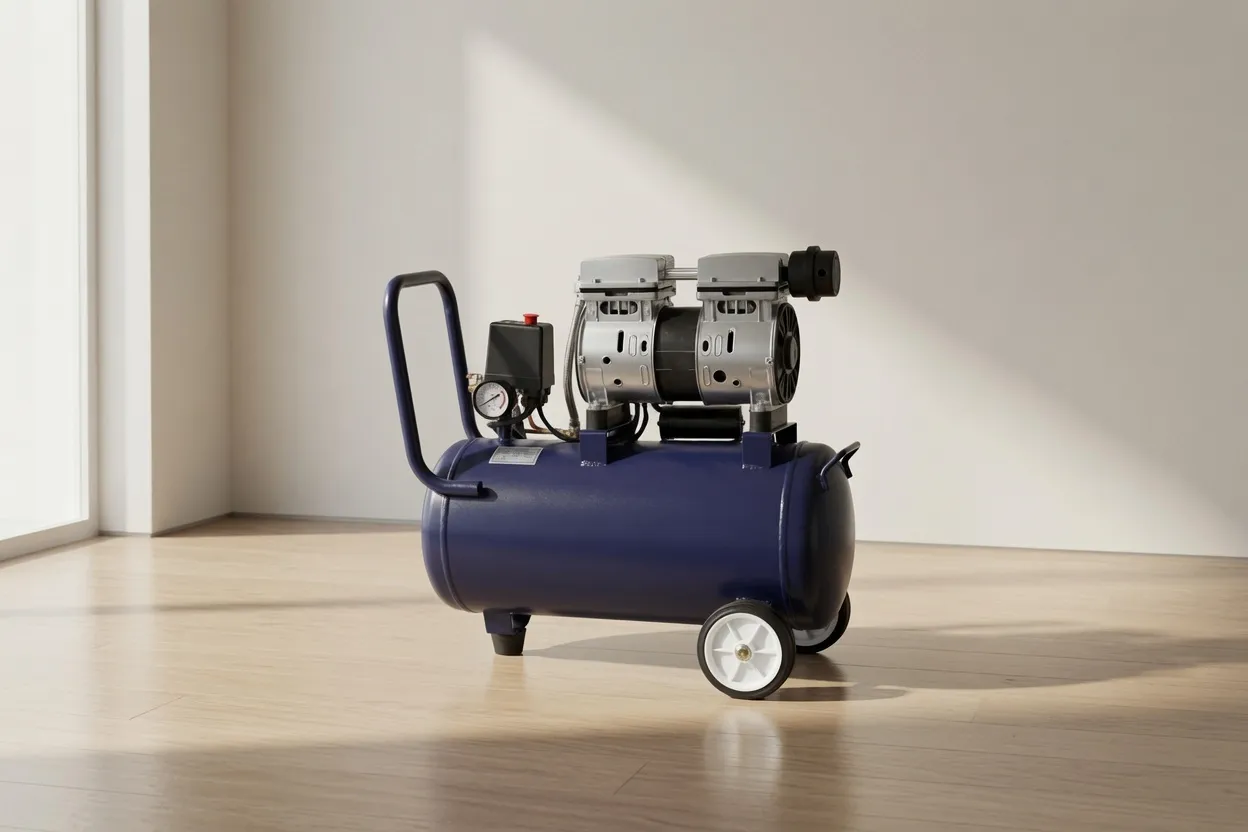
A water-injected compressor — also called a water-lubricated or water-flooded rotary screw compressor — uses purified water instead of oil as the sealing, cooling, and lubricating medium inside the compression element. The rotors never touch each other or the casing: a precisely maintained film of water fills the small clearances between the male and female rotors, performing the same sealing function that oil performs in an oil-injected machine — but without any risk of oil carryover into the compressed air stream.
This seemingly simple substitution — water for oil — has profound engineering consequences. Water has approximately four times the specific heat capacity of mineral compressor oil. This means it absorbs heat far more effectively per unit volume, keeping rotor and discharge temperatures dramatically lower than both oil-injected and dry oil-free designs. The practical result is a machine that runs cooler, more quietly, and with lower mechanical stress on its internal components than any competing technology at equivalent pressure and flow.
The water injected compressor concept was pioneered in the early 1990s and has been refined over three decades into a mature, field-proven technology. Today it is the preferred choice for pharmaceutical, food processing, semiconductor, and medical applications globally — precisely because it delivers genuine ISO Class 0 oil-free compressed air without the residual contamination risk associated with PTFE coatings or dry-running clearance designs.
How the Water-Injection Compression Cycle Works
The compression cycle of a water-injected rotary screw compressor follows a closed-loop process. Understanding each stage explains why the technology is so effective — and why discharge temperature, one of the most consequential variables in compressed air quality, is controlled so precisely.
Stage-by-Stage Breakdown
Highly purified water (typically deionised or reverse-osmosis treated to conductivity below 10 µS/cm) is injected directly into the compression chamber as the rotors begin their intake stroke. The water-to-air ratio is precisely controlled by the machine’s management system — typically 5–15% water by volume of compressed gas at inlet conditions.
As the rotors compress the air-water mixture, water absorbs the heat of compression almost as fast as it is generated — approaching isothermal (constant temperature) compression. Discharge temperatures of 30–50°C above ambient are typical, compared to 70–100°C above ambient for dry oil-free screws and 150–180°C for PTFE piston machines.
At discharge, the compressed air-water mixture passes through a high-efficiency centrifugal separator. Water droplets, being significantly denser than air, are flung to the separator walls and collected. Separation efficiency exceeds 99.9% for liquid water, leaving only dissolved water vapour — handled downstream by a compressed air dryer in the standard configuration.
Recovered water passes through a fine filtration system (typically 5–10 µm absolute) and a water cooler before being re-injected. A small bleed-off of 1–3% of circulating water volume is continuously replaced with fresh purified water to prevent mineral concentration build-up. This is why incoming water quality specifications must be observed — hard or contaminated water causes scaling that reduces cooling efficiency and eventually damages rotor surfaces.
7 Key Benefits of Water-Injected Oil-Free Compressors
Because no oil is present anywhere in the compression system, water-injected compressors are the only technology that can genuinely claim zero oil contamination risk at source — not relying on downstream filtration to achieve oil-free status. ISO 8573-1 Class 0 certification for these machines is verifiable by design, not by filtration performance testing. For pharmaceutical, food-contact, and semiconductor applications, this distinction is legally and operationally significant.
Typical discharge temperatures of 40–60°C versus 80–120°C for dry oil-free screws and 160–180°C for PTFE piston compressors. Lower discharge temperature means less thermal stress on downstream components, longer dryer and filter element service intervals, and significantly reduced risk of heat-related material degradation in sensitive applications. It also means lower aftercooler capacity is required — reducing system footprint and capital cost.
Water-injected compression approaches isothermal efficiency — the theoretical ideal. Compared to dry oil-free screw compression (which is adiabatic and generates more heat per unit of compression work), water-injected units deliver 5–12% better specific energy consumption (kW per 100 CFM) at equivalent pressure and flow. Over a 10-year operating life at typical Australian industrial electricity rates, this difference represents AUD $15,000–50,000 in cumulative energy savings for a 100 CFM unit.
Water serves as an acoustic damper within the compression chamber. Water-injected screws typically operate at 62–68 dB(A) at 1 metre — comparable to a normal conversation — versus 72–80 dB(A) for dry oil-free screw equivalents and 75–85 dB(A) for piston compressors. In dental clinics, medical facilities, and office-adjacent installations, this difference eliminates the need for separate compressor rooms or acoustic enclosures that would otherwise add cost and floor space.
Lower operating temperatures and the absence of PTFE ring wear mechanisms mean the core compression element of a water-injected machine typically achieves service intervals of 8,000–16,000 hours between major overhauls. Dry oil-free screw compressors typically require rotor coating overhaul at 20,000–40,000 hours; water-injected units with stainless steel or PEEK rotors have no coating to degrade. The rotor material life is essentially infinite under normal operating conditions.
Dry oil-free compressors — piston and screw types — rely on PTFE (Teflon) coatings or similar polymer materials on compression elements. As these coatings age, micro-particles can enter the airstream — a contamination mode that oil-free certification does not test for. Water-injected machines have no such coatings. Rotor materials are typically stainless steel or engineering polymers (PEEK) — stable, non-contaminating materials that do not shed particles during normal operation.
Higher purchase price than dry oil-free equivalents (typically 15–30% premium) is offset over a 5–7 year period by lower energy consumption, simpler downstream treatment (no oil aerosol removal required), longer service intervals, and the absence of coating replacement costs. Published total cost of ownership analyses from multiple manufacturers consistently show water-injected units delivering 8–18% lower 10-year TCO compared to dry oil-free screw compressors of equivalent capacity — driven primarily by energy savings and reduced maintenance burden.
Water-Injected vs Dry Oil-Free vs PTFE Piston: Technical Comparison
This side-by-side comparison covers the key parameters that determine suitability for industrial and process applications. The data is based on representative units in the 50–150 CFM range at 100–115 PSI operating pressure.
| Parameter | Water-Injected Screw | Dry Oil-Free Screw | PTFE Piston |
|---|---|---|---|
| Oil content in output air | 0 mg/m³ (absolute) | ≤0.01 mg/m³ (Class 1) | ≤0.01 mg/m³ (Class 1) |
| ISO 8573-1 oil class | Class 0 | Class 1 | Class 1 |
| Discharge temperature (above ambient) | +30–50°C | +70–100°C | +140–180°C |
| Typical noise level (dB(A) @ 1m) | 62–68 dB(A) | 72–78 dB(A) | 75–85 dB(A) |
| Specific energy (kW/100 CFM) | 15–17 kW | 17–20 kW | 20–28 kW |
| Duty cycle capability | 100% continuous | 100% continuous | 50–60% |
| Compression element overhaul interval | 8,000–16,000 hrs | 20,000–40,000 hrs | 2,000–6,000 hrs |
| Water quality requirement | Yes — purified water supply required | None | None |
| Condensate disposal requirement | Water only — drain to sewer | Oil-water mix — trade waste permit | Oil-water mix — trade waste permit |
| Relative purchase price | Premium (15–30% above dry screw) | Mid-range baseline | Lowest upfront cost |
Note: Overhaul intervals for water-injected units refer to bearing and seal replacement; rotor elements have no consumable coating and do not require periodic replacement under normal operating conditions.
Water Quality Requirements: The Critical Installation Parameter
The single operational requirement that distinguishes water-injected compressors from all other oil-free technologies is water quality. The circulating water must remain within specified purity limits to prevent three failure modes: mineral scaling on rotor and separator surfaces, microbiological growth in the water circuit, and corrosion of internal stainless steel components from chloride or acid contamination.
Most manufacturers specify incoming water conductivity below 10–50 µS/cm, pH between 6.5–8.5, no free chlorine above 0.1 mg/L, and total hardness below 5°dH. In most Australian urban locations, municipal water exceeds these limits and requires treatment — typically reverse osmosis or deionisation — before use in the closed circuit.
Calcium and magnesium deposits accumulate on rotor flanks and separator elements, reducing cooling efficiency and eventually causing rotor clearance reduction. Scale buildup progresses silently — typically not visible until discharge temperature rises 10–15°C above normal or pressure ratio increases unexpectedly.
Chlorine concentrations above 0.1 mg/L attack stainless steel passivation layers. While 304 stainless resists low chlorine concentrations, 316-grade components in the water circuit can still exhibit pitting corrosion at higher chlorine levels. Municipal water in Australia typically contains 0.2–1.0 mg/L residual chlorine — above the safe threshold for unmodified circuit materials.
Water with high total dissolved solids (TDS) conducts electricity between dissimilar metals in the circuit, creating galvanic corrosion at connection points. This is the reason most manufacturers specify conductivity limits — not as a proxy for general water quality, but specifically to limit galvanic corrosion risk at bearing housings and separator connections.
The water treatment requirement adds AUD $1,500–5,000 to the installation cost of a water-injected compressor, depending on local water quality. However, this is a one-time capital cost recovered within 2–3 years by the energy savings and reduced maintenance burden compared to dry oil-free alternatives. Australian cities with hard or high-TDS municipal water — including Perth, Adelaide, and regional Queensland — require RO treatment systems as standard.
Best Applications for Water-Injected Oil-Free Compressors
Water-injected technology is not appropriate for every application — its water quality requirement, higher purchase price, and the need for ongoing water management make it overkill for general workshop use. However, for applications that genuinely require ISO Class 0 air quality, continuous duty, low noise, or the specific benefits of near-isothermal compression, it is the clear engineering choice.
The Condensate Advantage: Clean Water vs Oil-Water Mixture
An often-overlooked operational advantage of water-injected technology is condensate management. Oil-injected and most dry oil-free compressors (which use oil for bearing lubrication even if not for compression element sealing) produce an oil-water condensate that is classified as a controlled waste product in all Australian states. This mixture must be processed through an oil-water separator before disposal — adding equipment cost, maintenance, and compliance obligations.
Water-injected compressors produce water-only condensate. With a conductivity check to confirm no contamination, this can be discharged directly to trade waste under standard sewer permits in most Australian jurisdictions — no oil-water separator required, no oil waste disposal contract, no ongoing compliance reporting for condensate. For facilities subject to strict environmental compliance regimes — food production, pharmaceutical, water catchment areas — this simplification is a genuine operational and regulatory benefit.
- → Oil-water emulsion (classified hazardous waste)
- → Requires oil-water separator (AUD $500–3,000+)
- → Separator cartridge replacement every 3–6 months
- → Residual oil measured — must be <20 mg/L before discharge
- → Trade waste permit with oil concentration limits required
- → Clean water (may contain trace atmospheric particulate)
- → No oil-water separator needed
- → Conductivity test confirms cleanliness
- → Direct sewer discharge permitted in most jurisdictions
- → Simplified trade waste permit — standard domestic discharge
Australia Oil Free Air Compressor: Water-Injected Technology You Can Rely On
Australia Oil Free Air Compressor Co., Ltd., based in the Charlton Industrial Area, supplies water-injected oil-free compressors to pharmaceutical, food processing, medical, and cleanroom facilities across Australia. Our water-lubricated range — the CM series — represents the mature, field-proven implementation of water-injection technology described in this article, with documented ISO 8573-1 Class 0 certification and full Australian compliance documentation.
Every water-injected unit we supply comes with a water quality assessment for your site’s incoming water supply, a treatment system recommendation where required, and commissioning support to ensure the water circuit is correctly set up for your local conditions. We do not ship a unit and leave water quality management to the installer — it is too critical to the machine’s long-term performance to treat as an afterthought.
Contact us at [email protected] to discuss water-injected compressor options for your application.
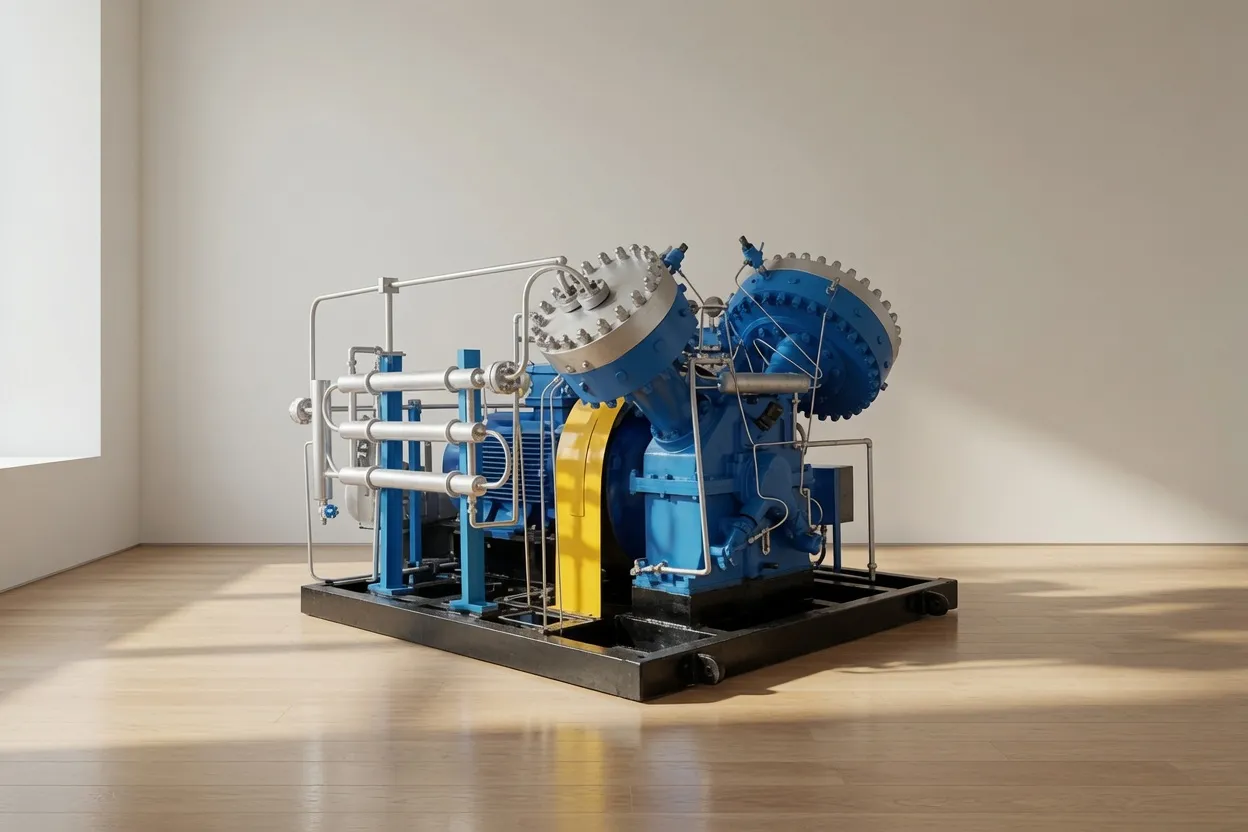
CM45D — Low-Pressure Oil-Free Screw Compressor (Water Lubrication)
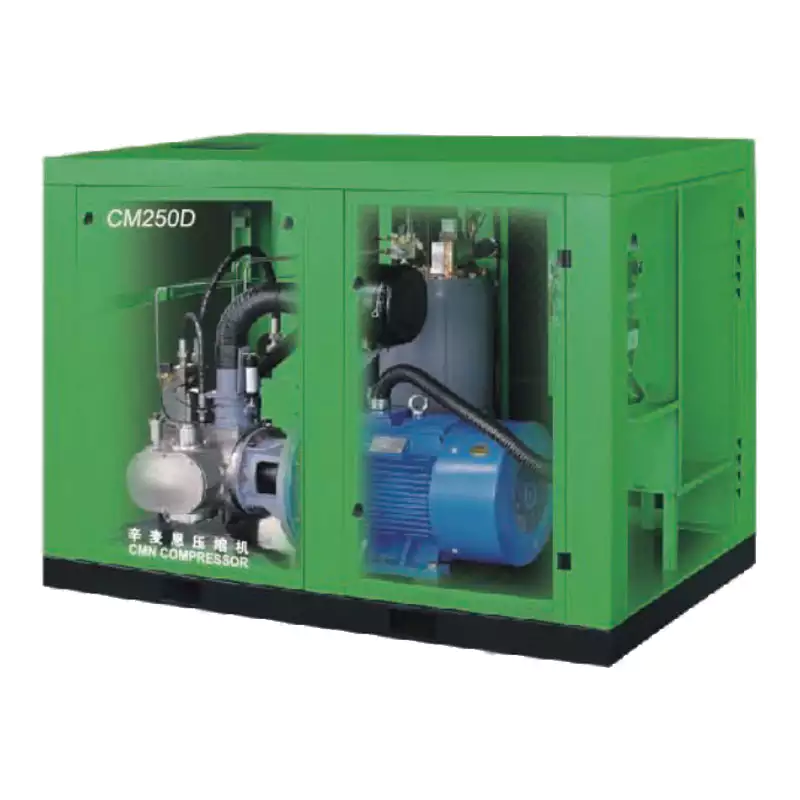
The CM45D embodies all the technical advantages described in this guide: genuine ISO Class 0 oil-free air delivery through water lubrication, 100% continuous duty, low discharge temperatures maintained by water’s superior heat capacity, and near-silent operation that makes it suitable for medical and dental installation environments. Water-only condensate eliminates the oil-water separator requirement. This is the entry-level unit in our water-lubricated range — covering the 30–60 CFM demand band most relevant to medical clinics, food processing start-ups, and pharmaceutical laboratories.
Frequently Asked Questions
Australia Oil Free Air Compressor Co., Ltd.
Charlton Industrial Area, Australia | [email protected]