
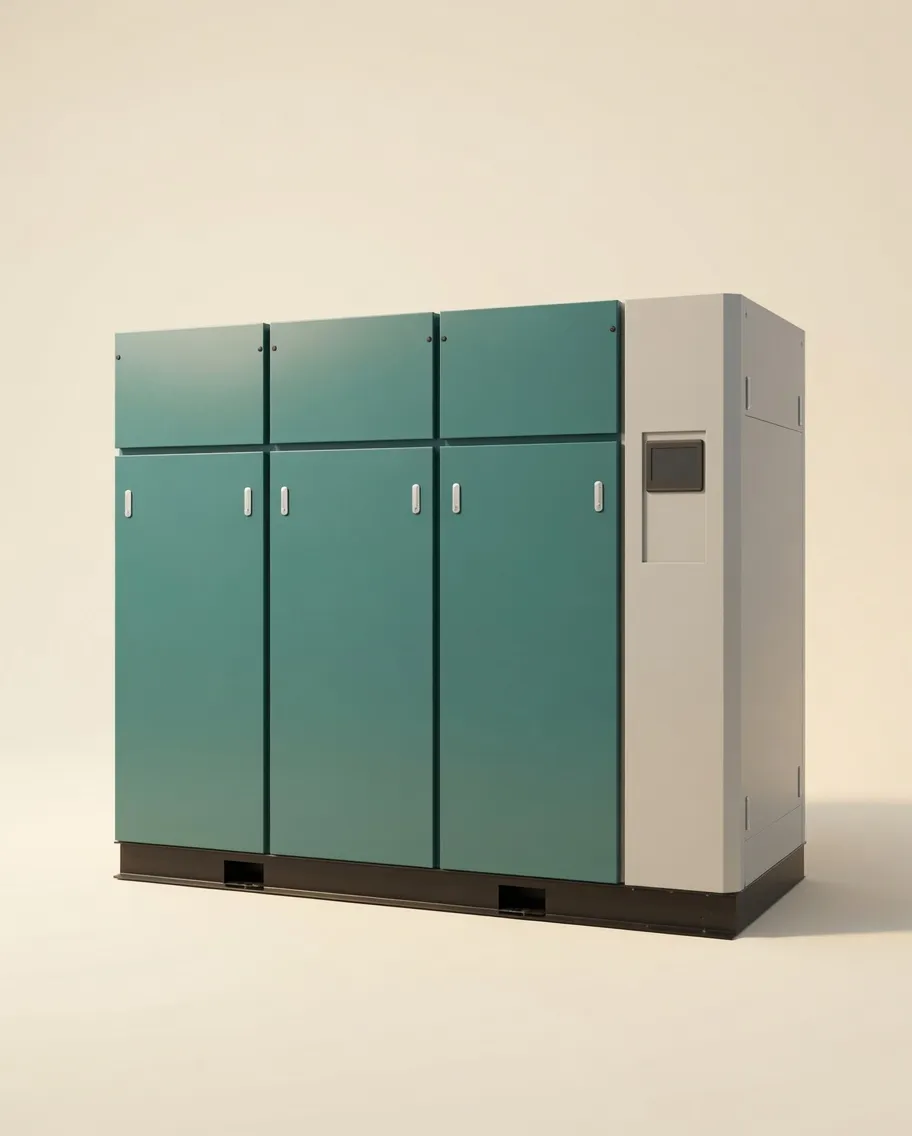
What Is a VSD Oil-Free Air Compressor?
A variable speed drive (VSD) oil-free air compressor — also called an inverter compressor or variable frequency drive (VFD) compressor — uses an electronic frequency converter to continuously adjust the speed of the drive motor. Rather than running at a fixed speed (and therefore fixed output) and cycling on and off to match demand, a VSD unit slows down when demand drops and speeds up when demand rises. The compressor runs almost continuously, but at the speed that matches actual consumption — not a fixed rated speed regardless of what is needed.
This concept applies to any compressor technology but is particularly valuable for oil-free rotary screw compressors, which have a wide efficient operating speed range (typically 25–70 Hz in most designs), can run continuously at any speed within that range, and are used in applications where demand variability is the norm. A VSD oil-free screw compressor combines the 100% continuous duty capability of screw technology with the energy matching of variable speed control — the most capable combination available in industrial compressed air today.
The term “inverter compressor” is sometimes used, particularly by Asian manufacturers. It refers to the same concept — the motor drive inverts DC power back to AC at the desired frequency, allowing speed control. VSD and VFD are equally correct technical terms; inverter is the colloquial equivalent.
Why Fixed-Speed Compressors Waste Energy at Partial Load
To understand the value of VSD, you first need to understand exactly how a fixed-speed compressor wastes energy when demand is below maximum. There are two waste mechanisms, and both are eliminated or reduced by VSD control.
When a fixed-speed screw compressor’s pressure reaches its cut-out setpoint, it enters “unload” mode — the inlet valve closes, but the motor continues running at full speed, compressing and recirculating air internally. This unloaded state consumes 15–25% of full-load power while delivering zero useful air. In a facility where demand averages 60% of compressor capacity, the machine may spend 30–40% of its running time unloaded — burning electricity for no output.
Fixed-speed compressors operate within a pressure band — typically a 15–20 PSI differential between load and unload setpoints. On average, the system pressure is above the minimum required by the application. Compressing to a higher pressure than needed requires more energy per CFM delivered. Every additional 1 PSI of operating pressure above the minimum required increases energy consumption by approximately 0.5% — a 15 PSI average over-pressure costs 7–8% extra energy continuously.
A VSD compressor eliminates unloaded running (the motor always runs at the speed needed, no more) and minimises over-pressure delivery (tight ±2 PSI pressure control versus ±8–10 PSI for load/unload systems). Together, these two improvements explain why energy savings of 15–35% are consistently measured in field installations where VSD replaces fixed-speed compressors in variable-demand applications.
Calculating Your Potential VSD Energy Savings
The energy saving from switching to a variable speed drive compressor depends on your demand profile — specifically, how much your air demand varies throughout the working day and week. The greater the variation, the greater the VSD saving. Here is a structured approach to estimating the saving for your facility.
Step 1: Estimate Your Weighted Average Load Factor
Review your production schedule and estimate what fraction of the compressor’s rated output you actually use during each period. Weight by hours per week at each load level to get a time-weighted average load factor (ALF). A typical variable-demand manufacturing facility has an ALF of 55–70%. A steady 24/7 continuous process might have an ALF of 85–95%.
VSD power at same load ≈ Full load kW × ALF^0.75 (cube root law approximation)
Annual saving (kWh) = (Fixed-speed − VSD) kW × Annual running hours
Annual saving (AUD) = kWh saving × electricity rate ($/kWh)
Worked Example: Medium Manufacturing Facility
A facility runs a 45 kW fixed-speed oil-free screw compressor, 5 days a week, 16 hours per day (4,160 hours/year). Average load factor is 62%.
VSD average power: 45 × (0.62)^0.75 = 45 × 0.688 = 31.0 kW
Power saved: 39.9 − 31.0 = 8.9 kW
Annual kWh saved: 8.9 × 4,160 hrs = 37,024 kWh/year
Annual AUD saving: 37,024 × $0.16/kWh = AUD $5,924/year
With a VSD compressor premium of approximately AUD $8,000–14,000 over a comparable fixed-speed unit, the simple payback period in this example is 1.4–2.4 years — well within the 3-year threshold typically used for energy investment decisions in Australian manufacturing. After payback, the saving continues for the remaining 8–12 years of the compressor’s service life.
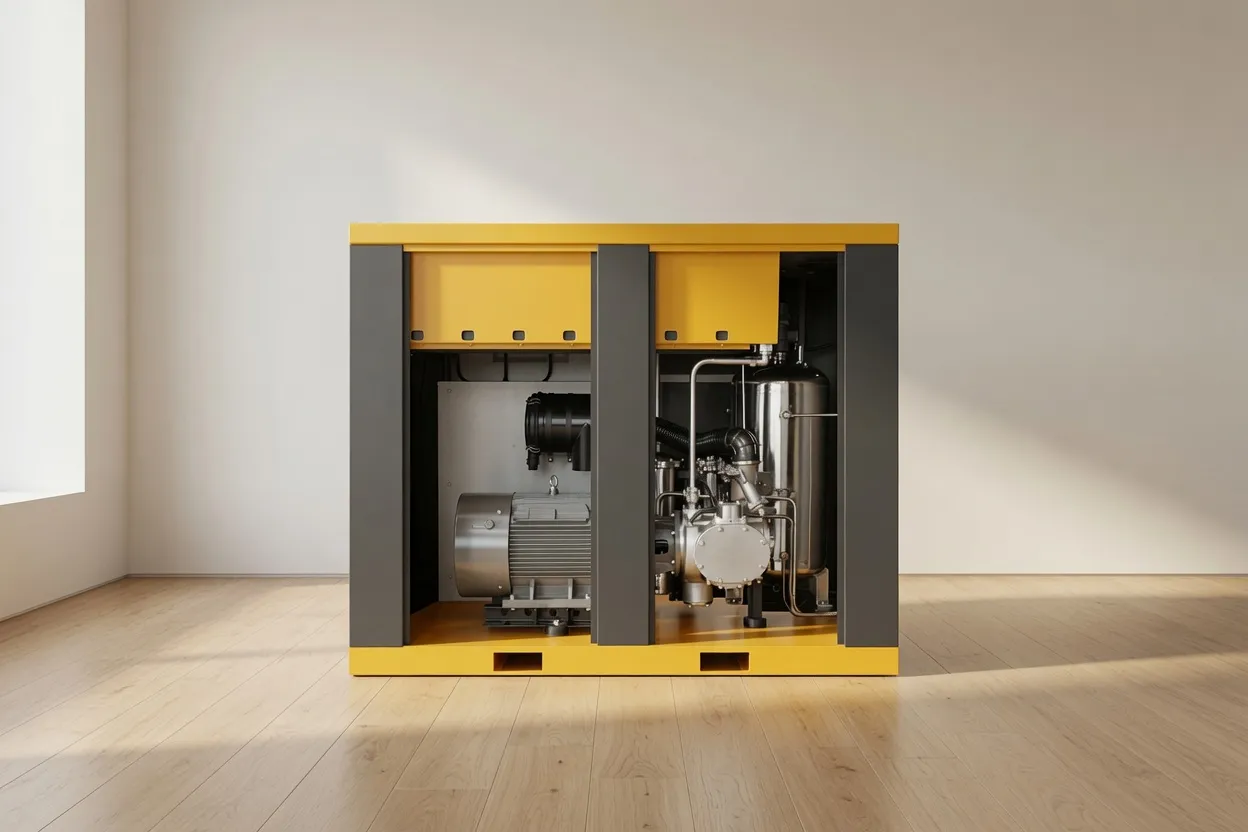
Benefits Beyond Energy Savings
Energy savings dominate the VSD conversation, but there are four additional operational advantages that independently justify VSD selection for many facilities — even where the energy saving alone might not fully justify the premium.
A fixed-speed motor starting direct-on-line draws 6–8× its running current for 0.5–2 seconds. For a 45 kW compressor, this inrush can reach 270–360 kW instantaneously — enough to trigger electricity demand charges in some commercial tariff structures, or to cause nuisance voltage dips affecting sensitive production equipment. A VSD motor always starts from zero speed and ramps up gradually, limiting starting current to 100–120% of running current. Facilities on demand-charge electricity tariffs can reduce their maximum demand peak by eliminating these current spikes.
VSD compressors maintain system pressure within ±2 PSI of setpoint, versus ±8–12 PSI for load/unload control. For pressure-sensitive processes — precision spray coating, dental handpieces, pharmaceutical filling valves, laser cutting assist gas — this tighter control directly improves product consistency. It also eliminates the need to set system pressure higher than needed to guarantee minimum pressure at the bottom of a wide pressure band, recovering 5–10 PSI of wasted over-pressure energy.
A VSD compressor running at 50–60% speed generates substantially less noise than at full speed — typically 5–8 dB(A) less, which the human ear perceives as roughly half as loud. In facilities where the compressor is near occupied work areas, the noise reduction at typical partial-load operating speeds meaningfully reduces workplace noise exposure compared to a fixed-speed machine cycling between full load and unload at a consistent high noise level.
Fixed-speed machines undergo mechanical stress at every start and load/unload transition — thermal cycling on valves and heads, motor winding stress at each current surge, and vibration spikes from abrupt speed changes. A VSD machine’s smooth speed modulation eliminates most of these stress cycles. Bearing fatigue life, which is strongly influenced by vibration amplitude, is typically extended by 20–40% in VSD machines compared to equivalently loaded fixed-speed units of the same design.
When Does VSD Make Economic Sense? A Decision Framework
VSD is not the right choice for every application. The premium over a comparable fixed-speed unit is real and must be justified by measurable savings. These decision criteria will determine whether VSD is economically warranted for your situation:
| Criterion | Favours VSD | Favours Fixed Speed |
|---|---|---|
| Demand variation | Swings >30% between peak and off-peak | Steady demand, variation <15% |
| Average load factor | 40–75% ALF | >85% ALF (nearly always fully loaded) |
| Annual running hours | >3,000 hours/year | <2,000 hours/year (saving too small) |
| Production schedule | Multi-shift, batch, or seasonal variation | Single steady production rate, 24/7 |
| Pressure sensitivity | Process requires stable ±2 PSI control | Wide pressure tolerance acceptable |
| Electricity tariff structure | Includes demand charge component | Flat consumption-only tariff |
| Operating pressure | 90–175 PSI (optimal VSD efficiency range) | >200 PSI (two-stage fixed often more cost-effective) |
VSD is almost never cost-justified when average load factor exceeds 90% — at this point the machine is always running at near-full speed anyway, and the VSD premium delivers minimal energy saving over a fixed-speed unit. Similarly, VSD is marginal below 2,500 annual running hours — the annual saving in kWh is too small to justify the premium within a reasonable payback period. The sweet spot for VSD is 3,000–7,000 annual hours at 45–75% average load factor.
VSD and Compressed Air Leaks: Important Interaction
A VSD compressor’s ability to modulate speed means it will silently compensate for compressed air leaks by running at a higher speed than necessary for production demand. This has two consequences:
Positive consequence: The system maintains pressure stability even as leaks develop, masking the symptom that would otherwise alert operators (pressure drop at peak demand) in a fixed-speed system.
Negative consequence: Leaks are invisible in a VSD system until they grow large enough to push the motor toward its maximum speed continuously. By this point, leakage may have reached 20–30% of system capacity — significantly above where a proactive leak management programme would have caught it.
If your compressor’s average speed has gradually drifted upward over 6–12 months without a corresponding increase in production, leaks are almost certainly the cause. A VSD system with a controller that logs motor speed over time provides an excellent leak development indicator — a rising baseline speed at stable production levels is a reliable early warning signal. Commission an ultrasonic leak survey annually to prevent this drift from eroding the energy savings VSD was installed to deliver.
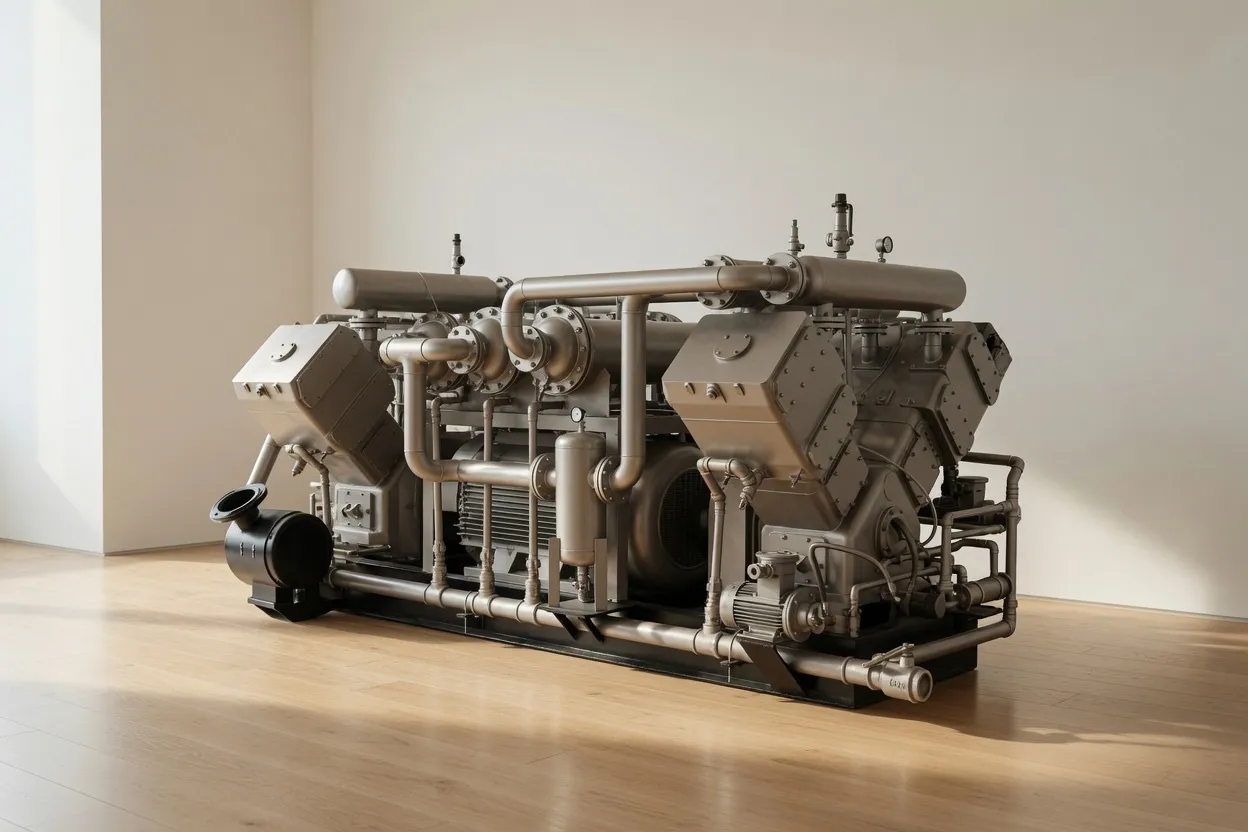
VSD and Duty Cycle: Always 100%, But With a Caveat
VSD oil-free rotary screw compressors carry a 100% duty cycle rating — they can run continuously 24/7 without mandated rest periods. However, VSD technology introduces one duty-related consideration that fixed-speed machines do not have: minimum speed behaviour.
Every VSD compressor has a minimum operational speed — typically 25–35 Hz (corresponding to 42–58% of rated output for a 60 Hz design). Below this threshold, rotor tip speeds are insufficient to maintain proper sealing clearances, and the machine shuts down and restarts when demand rises again. If your average demand falls below the compressor’s minimum speed delivery for extended periods, it effectively cycles — defeating part of the energy advantage and adding start-stop stress.
The minimum demand CFM on your system must be above the compressor’s minimum speed delivery rate. For a 100 CFM VSD compressor with a minimum speed of 35%, minimum delivery is 35 CFM. If your facility ever drops below 35 CFM demand (weekend mode, single-tool operation), the VSD will start cycling. Either size the VSD compressor to match minimum demand correctly, or use a smaller fixed-speed trim compressor for very low demand periods.
VSD Oil-Free Compressors from Australia Oil Free Air Compressor
Our VSD-equipped oil free compressor range at Australia Oil Free Air Compressor Co., Ltd. covers the full industrial demand spectrum from 30 CFM to 400+ CFM at pressures from 90 to 250 PSI. Every VSD unit in our range includes a built-in energy monitoring module that logs power consumption, average speed, and load factor — giving you the data to verify actual savings against pre-installation estimates and to detect leak development before it erodes performance.
Our sales engineering team provides pre-purchase energy saving calculations for every VSD proposal — based on your actual production schedule, tool inventory, and local electricity tariff. We do not quote energy savings as a marketing claim; we provide a documented calculation you can compare against actual operating data after installation. If the savings don’t materialise within the projected range, we investigate with you.
Contact us at [email protected] to request a VSD energy saving calculation for your facility.
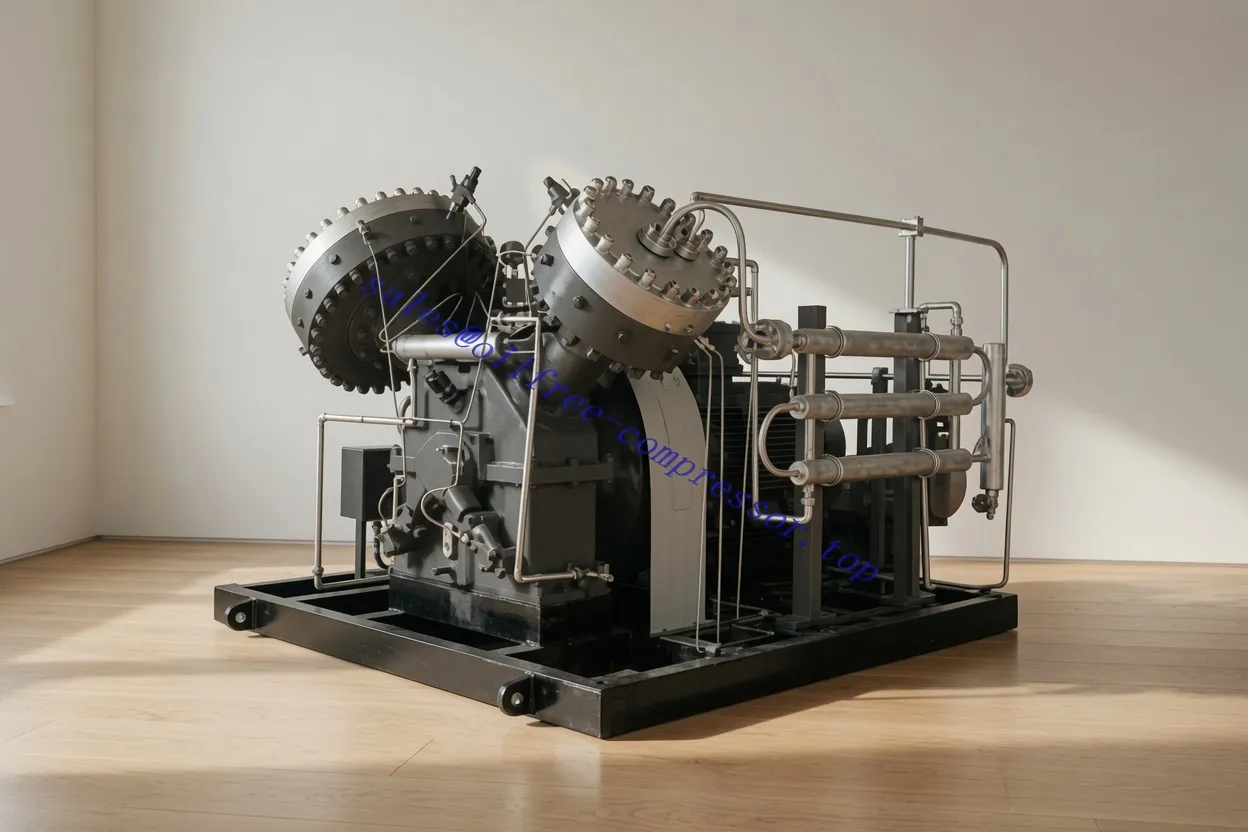
CM132DV — Low-Pressure VSD Oil-Free Screw Compressor (Water Lubrication)
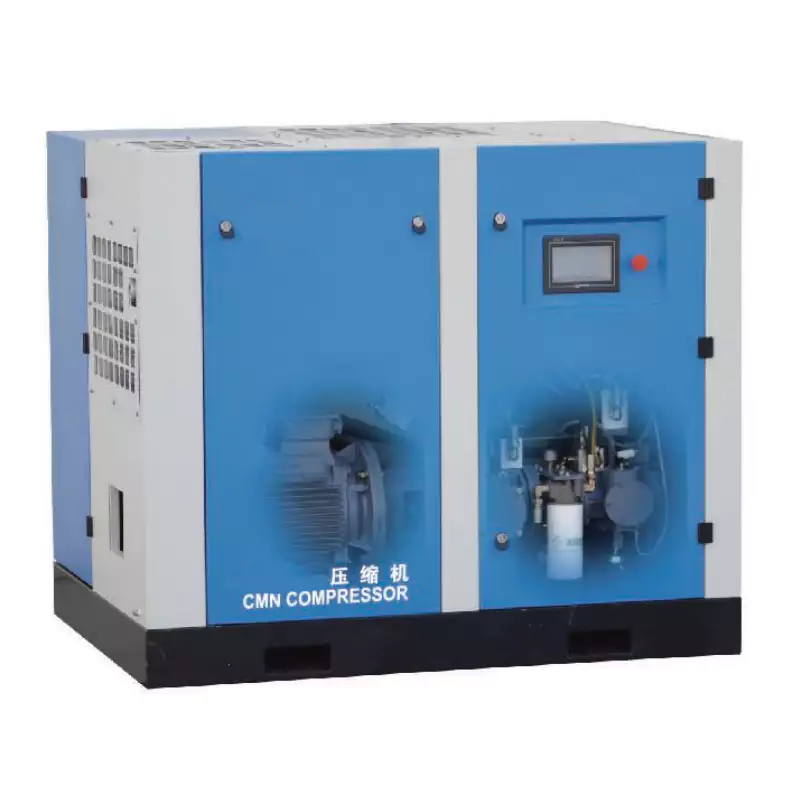
The CM132DV combines water-lubricated ISO Class 0 compression with VSD motor control — delivering the most energy-efficient configuration available in oil-free compressed air technology. The VSD drive modulates output to match demand with ±2 PSI precision; the water-injection cooling maintains near-isothermal compression efficiency; and the result is a machine with measured specific energy consumption consistently 15–25% below equivalent dry oil-free VSD designs. If your facility requires both the cleanest air and the lowest energy cost, the CM132DV is the benchmark unit in our range.
Frequently Asked Questions
Australia Oil Free Air Compressor Co., Ltd.
Charlton Industrial Area, Australia | [email protected]