
Why Aerospace Sets the Highest Bar for Compressed Air Quality
No industrial sector applies more rigorous quality management to its manufacturing processes than aerospace. Every part, process, and utility is governed by documented standards, supplier approvals, and traceability requirements — because the consequence of a quality failure in an aircraft component is categorically different from a quality failure in most other manufactured goods. Compressed air, as a process utility that contacts surfaces, instruments, coatings, and composite materials at dozens of points in a typical aerospace manufacturing operation, is subject to this same uncompromising scrutiny.
The stakes are highest in three areas: surface preparation before bonding or coating (where oil contamination causes adhesion failure); instrument and avionics testing (where moisture causes corrosion and shorts); and precision machining and measurement (where particulate contamination affects dimensional accuracy and surface finish). In each of these areas, a contaminated air event does not merely produce a rejected part — it can invalidate an entire batch of treated components, trigger an AS9100 non-conformance, and require a root cause analysis that consumes engineering resources for days or weeks.
The oil free compressor is the starting point for aerospace compressed air — not because a filter could not achieve low oil content, but because aerospace quality management demands that contamination be eliminated by design, not managed by filtration. A structural guarantee (no oil in the compressor) is categorically more defensible than a process guarantee (filter removes oil that the compressor produces) in any AS9100 audit.
The Aerospace Compressed Air Standards Framework
Aerospace compressed air quality is governed by an interlocking set of standards that operate at different levels — from the fundamental compressed air quality classification (ISO 8573) through process-specific standards to the overarching quality management systems (AS9100, Nadcap) that require all utilities to be controlled and documented.
Aerospace Compressed Air Applications: Requirements by Process
Aerospace manufacturing encompasses a wide range of processes, each with distinct compressed air quality requirements. A single facility may require different quality levels at different use points — understanding the requirement at each application prevents both under-specification (quality risk) and over-specification (unnecessary cost).
Oil contamination in spray air causes fish-eye defects, delamination, and coating adhesion failures — all of which are non-conformances requiring strip-and-repaint. Even at 0.01 mg/m³ (ISO Class 1 oil), trace oil in spray air can cause visible surface defects in high-gloss aerospace topcoats. Class 0 oil (oil-free compressor) is the only defensible specification. Moisture causes blushing, lifting, and micro-blistering in solvent and waterborne aerospace coatings — Class 2 water (−40°C pdp) is typically required. Point-of-use particulate filter immediately upstream of spray gun is essential.
Compressed air used to blow parts clean before chemical conversion coating (alodine, chromate conversion), anodising, or structural adhesive bonding must be completely oil-free. Oil contamination before surface treatment is essentially invisible but causes catastrophic bond failures at service loads. Nadcap auditors check compressed air quality specifications at pre-treatment stations as a standard audit item. Class 0 oil with desiccant drying (Class 2 water) is the standard for all pre-bond and pre-coat applications.
Carbon fibre reinforced polymer (CFRP) and glass fibre composites used in modern aerospace structures (fuselage panels, wing skins, control surfaces) are bonded with structural adhesives that require pristine surfaces. Compressed air contact with pre-bond surfaces must be from a source verified to ISO Class 0 oil. Moisture is particularly critical in composite bonding — water contamination of adhesive bondlines can reduce structural bond strength by 30–50%. Class 1 water (−26°C or better pdp) is required for composite work areas.
Avionics enclosures, pressure instruments, and flight control systems purged or tested with compressed air require extremely dry, particle-free, oil-free air. Oil vapour deposits on optical sensors, pressure ports, and circuit boards — contamination that is invisible at inspection but causes calibration drift and intermittent failures in service. Moisture causes corrosion of precision connectors and sensor diaphragms. Class 1:1:0 is the minimum specification; many avionics test processes specify Class 1:1:0 with additional particle cleanliness requirements under MIL-STD-1246.
Compressed air used for part cooling during precision machining of titanium, Inconel, and aluminium aerospace alloys must be oil-free to prevent contamination of the machined surface — which affects subsequent coating adhesion and NDT inspection accuracy. Chip clearance air at cutting tools similarly requires oil-free supply. Class 1:3:0 is typically adequate for machining applications where residual moisture above the cutting zone is less critical; tighter moisture specification is needed where parts are measured immediately after machining.
Compressed air used in ultrasonic immersion testing, eddy current scanning, and fluorescent penetrant inspection (FPI) processes must meet stringent purity requirements. In FPI — the most common NDT method for detecting surface cracks in aerospace components — compressed air is used to blow excess penetrant and developer from parts. Oil in the blow-off air can interfere with the penetrant chemistry, causing missed indications or false positives. Nadcap AC7114 (NDT) specifically addresses compressed air quality in penetrant inspection processes.
Selecting the Right Oil-Free Compressor Technology for Aerospace
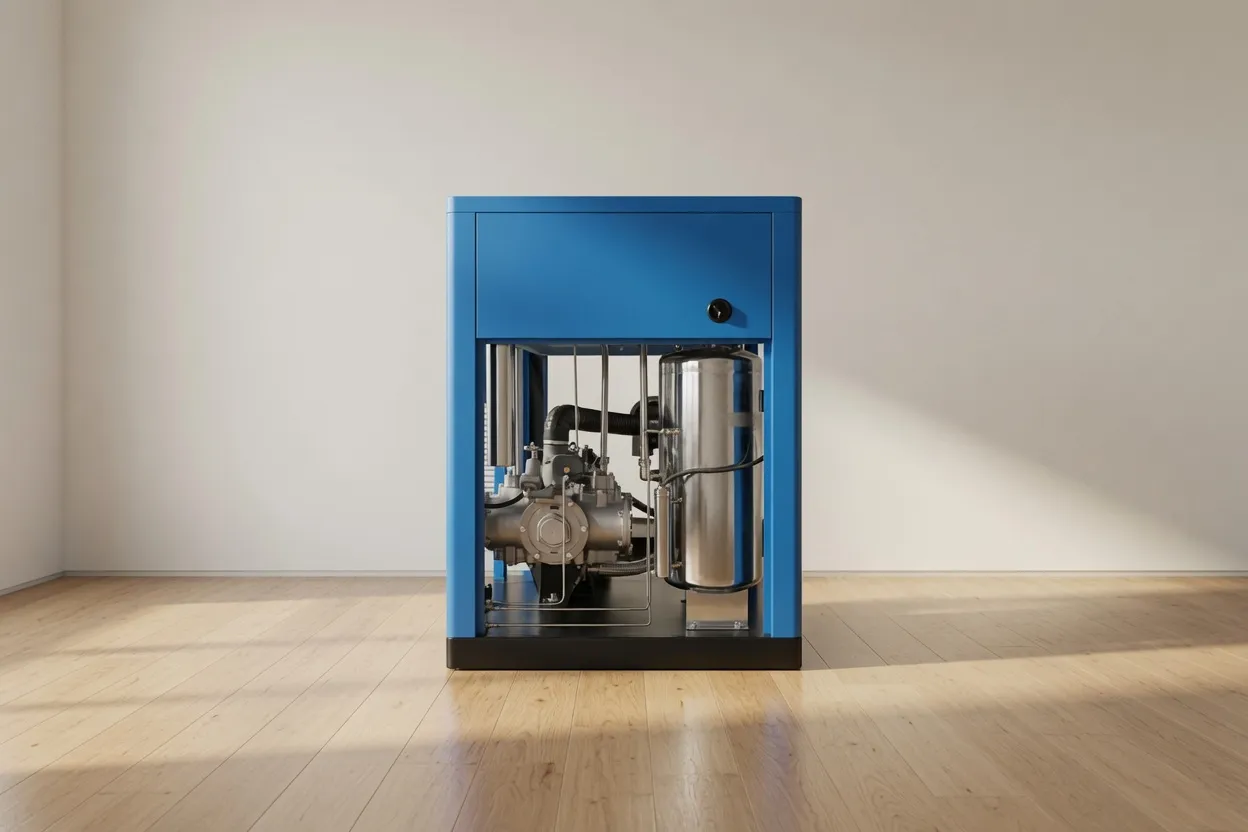
Not all oil-free compressors are equivalent for aerospace applications. The compressor technology determines the assurance level of the “oil-free” claim, the materials in contact with the air stream, and the compatibility with downstream drying and filtration requirements. Aerospace quality engineers should evaluate these factors when specifying compressor technology:
| Technology | Oil-Free Assurance | Dew Point Achievable | Duty Cycle | Aerospace Suitability |
|---|---|---|---|---|
| Water-lubricated screw | Highest — no oil in system | −40°C (with HOC dryer) | 100% continuous | ✅ Preferred for primary aerospace supply — highest assurance, 24/7 duty, HOC dryer compatible |
| Dry oil-free screw (PTFE rotors) | High — oil-free element | −40°C (HOC possible) | 100% continuous | ✅ Suitable — bearing oil isolated from airstream; note PTFE/bearing seal wear over time |
| Oil-free scroll | Good — PTFE tips | −40°C (with desiccant) | 75% typical | ⚠️ Limited to smaller flows; duty cycle limitation restricts HOC dryer use |
| Oil-free reciprocating piston | Good — PTFE rings | −40°C (with desiccant) | 50–70% | ⚠️ Acceptable for intermittent/small-flow applications; pulsating output requires adequate receiver |
For primary aerospace production compressed air supply — serving coating, bonding, NDT, and avionics testing — a water-lubricated oil-free rotary screw compressor operating 24/7 with HOC desiccant drying is the highest-assurance, lowest-lifecycle-cost configuration. The water-lubricated design provides ISO 8573-1 Class 0 oil by structural guarantee (no oil in the system), and HOC drying achieves Class 1 water (−40°C pdp) at zero additional energy cost.
For smaller facilities or tool room compressed air supplies serving occasional aerospace work, an oil-free scroll or piston compressor with heatless desiccant drying and coalescing filtration provides adequate compliance for most non-primary applications. The key is not the compressor size but the ability to document the system, demonstrate its performance, and maintain the qualification records required by AS9100.
The Aerospace Filter Train: Beyond ISO Class 0 at the Compressor Outlet
An oil-free compressor achieves ISO Class 0 oil at the compressor outlet — but aerospace compressed air quality must be verified at the point of use, not just at the compressor. Atmospheric particles, moisture from distribution pipework, and particulate shed by filter media itself can all compromise air quality between the compressor outlet and the spray gun, NDT station, or avionics test bench. The downstream filter and treatment train is therefore as important as the compressor choice.
Compressor
Receiver
Filter
0.01µm
Adsorber
Dryer
0.1µm
Pipework
Use
Material selection for filter housings and pipework is not a minor consideration in aerospace facilities. Carbon steel distribution pipework — common in general industrial applications — generates rust particulate that can contaminate the air stream and cause particle count failures at points of use. Aluminium modular pipework or 316SS welded distribution are the appropriate choices for aerospace compressed air distribution. All internal surfaces in contact with the air stream must be clean, corrosion-resistant, and free of machining lubricant residue from installation.
AS9100 Documentation Requirements for Compressed Air Systems
AS9100 Rev D requires that manufacturing processes — including utility systems — be documented, controlled, and maintained. For compressed air, this means the following documentation must be in place and available for AS9100 and Nadcap auditors:
- → P&ID of complete compressed air system
- → ISO 8573-1 quality specification per use point
- → Equipment list with model numbers and material certifications
- → Compressor oil-free declaration from manufacturer
- → Design rationale document linking specification to application requirements
- → Initial air quality test report at commissioning (all use points)
- → Instrument calibration certificates (dew point sensor, pressure gauges)
- → Filter element supplier certifications (efficiency, material, lot traceability)
- → Validation of any special processes using compressed air
- → Annual comprehensive air quality test reports (oil, particles, dew point)
- → Dew point monitoring logs (continuous or periodic)
- → Filter pressure drop inspection records
- → Corrective action records for any test exceedances
- → Preventive maintenance schedule and completion records
- → Filter element replacement records with lot numbers
- → Desiccant replacement records
- → Change control records for any system modification
- → Compressor service records linked to air quality verification
Aerospace-Grade Compressed Air Systems from Australia Oil Free Air Compressor
Australia Oil Free Air Compressor Co., Ltd. supplies oil-free compressed air systems to aerospace manufacturers and MRO (maintenance, repair, and overhaul) facilities throughout Australia, with the documentation package required for AS9100 and Nadcap audit readiness. We understand that an aerospace quality engineer needs more than a compressor — they need a complete system specification with ISO 8573-1 class certification, material declarations, filter train documentation, and a monitoring programme structured to satisfy AS9100 Clause 8.5.1.
Our water-lubricated oil-free compressor range provides the highest-assurance oil-free certification available — zero oil in the compression element, ISO 8573-1 Class 0 by structural design guarantee. We provide full material declarations for all air-path components, system P&IDs, and commissioning air quality test procedures to support the qualification documentation your AS9100 system requires.
Contact us at [email protected] with your aerospace application, required ISO 8573 specification, and current AS9100 or Nadcap scope for a system proposal with documentation support.
CM132DV — Water-Lubricated Oil-Free VSD Screw Compressor for Aerospace Manufacturing
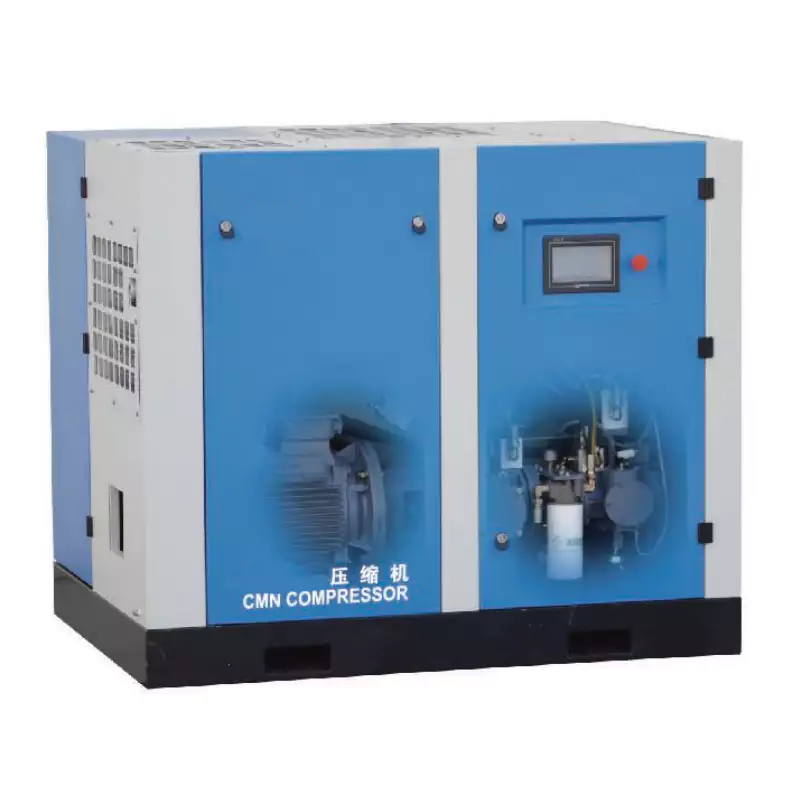
The CM132DV water-lubricated oil-free screw compressor provides the structural oil-free guarantee that aerospace quality engineers require — no oil anywhere in the compression element, certified ISO 8573-1 Class 0 oil content, with material declarations for all air-path components available for AS9100 IQ documentation. The VSD drive modulates to match production demand across shift patterns, while the HOC desiccant dryer compatibility enables Class 1 water (−40°C pdp) at zero additional energy cost — meeting the stringent dew point requirements of aerospace coating, bonding, and avionics testing applications. Available with full commissioning documentation package for AS9100 utility qualification.
Frequently Asked Questions
Australia Oil Free Air Compressor Co., Ltd.
Charlton Industrial Area, Australia | [email protected]