Testing & Verification Guide
Specifying the right compressed air quality is the first half of the job — verifying it is actually being delivered is the second half, and the half that most facilities neglect. A system that was commissioned at ISO Class 1:2:0 two years ago may be delivering Class 3:4:2 today if filters have degraded, desiccant is exhausted, or leaks have developed. This guide covers every test method, standard, and practical procedure you need to verify and document real compressed air quality.
✦ ISO 8573 Test Methods
✦ Field vs Lab Testing
✦ Audit-Ready Documentation
Why Compressed Air Testing Is Not Optional
Every oil-free air compressor leaves the factory producing air that meets its rated quality specification. The problem is that compressed air systems degrade — filters load and reduce effectiveness before they are replaced, desiccant becomes exhausted and allows moisture through, activated carbon saturates and passes vapour-phase contamination, and distribution pipework develops internal scale that adds particles to the air stream. None of these failure modes announce themselves; all of them are invisible to casual observation.
For food manufacturers under HACCP or FSMA, pharmaceutical facilities under GMP, and aerospace manufacturers under AS9100, periodic testing is not a best practice recommendation — it is a compliance requirement. Auditors from SQF, BRCGS, Nadcap, and FDA inspect the testing records, not the system design. A system that was correctly designed and built but never tested is a compliance failure waiting to be discovered.
For facilities without a formal quality management requirement, testing still makes economic sense. Contamination events in unregulated facilities — oil-damaged spray equipment, moisture-destroyed pneumatic actuators, blocked instrument ports — are frequently misdiagnosed as equipment failures. The contamination source goes unaddressed and the failure recurs. A simple annual air quality test costing AUD $500–2,000 typically identifies the root cause and prevents thousands of dollars in recurring equipment damage.
This guide covers the full spectrum of compressed air testing — from simple field indicator checks you can perform today to ISO 8573-validated laboratory methods required for GMP and food safety certification.
The Four Contamination Parameters You Must Test
A complete compressed air quality assessment addresses four independent contamination parameters — each requiring a different test method, and each independently capable of causing quality failures even when the others are within specification.
💧 Moisture (Dew Point)
ISO 8573-3
The pressure dew point — the temperature at which water vapour in the compressed air begins to condense at operating pressure. Reported in °C pdp. The most commonly monitored parameter because dew point transmitters can provide continuous real-time measurement. Critical for all applications; the parameter most likely to drift gradually as desiccant ages.
Test range: +10°C to −80°C pdp · ISO Water Classes 1–6
🛢️ Total Oil (Aerosol + Vapour + Liquid)
ISO 8573-2
Total oil content in all phases — aerosol droplets, vapour molecules, and any liquid carryover. The most important parameter for food, pharmaceutical, and electronics applications. Must be tested by NATA-accredited laboratory using solvent extraction and gas chromatography. Cannot be reliably estimated from system design alone.
Test range: <0.001 to >5 mg/m³ · ISO Oil Classes 0–4
🔴 Solid Particles (Count & Size)
ISO 8573-4
Particle count per cubic metre at defined size ranges (0.1–0.5 µm, 0.5–1.0 µm, 1.0–5.0 µm) and mass concentration above 5 µm. Measured using a laser particle counter connected to the compressed air sample point. Critical for pharmaceutical, semiconductor, and aerospace applications. Often elevated in systems with carbon steel pipework or old desiccant beds.
Test range: 0 to >400,000 particles/m³ · ISO Particle Classes 1–5
🦠 Viable Microorganisms
ISO 8573-7
Colony-forming units (CFU) per cubic metre of compressed air. Sampled using an impaction sampler or liquid impinger; incubated and counted. Only required for direct food contact, pharmaceutical, and medical applications. Requires specialist microbiological laboratory. Results take 5–7 days for incubation — cannot be used for real-time process control.
Test range: 0 to >100 CFU/m³ · No ISO 8573 class limits defined — user-specified
Test Methods in Detail: What Each Standard Actually Requires
Dew Point Testing — ISO 8573-3
Field + laboratory compatible
Capacitive sensor method (field use): The most practical method for on-site dew point verification. A thin-film aluminium oxide or polymer capacitance sensor responds to changes in water vapour partial pressure. Portable analysers provide readings in 3–10 minutes. Accuracy: ±2°C typical. Range: −80°C to +20°C pdp. Suitable for periodic field checks and continuous monitoring transmitters.
Chilled mirror method (reference / laboratory): A polished mirror is cooled by a Peltier element until condensation forms. The temperature at which dew appears is the dew point. Accuracy: ±0.1°C. This is the reference method for ISO 8573-3 compliance testing. Required when calibration traceability is needed for GMP documentation.
Sampling procedure: Connect sampling probe directly to a compression-side test port downstream of all treatment equipment. Allow 5–10 minutes stabilisation time before recording. For systems with desiccant dryers, test at the point in the regeneration cycle when dew point is expected to be worst (typically just before vessel switchover). Record ambient temperature, inlet pressure, and flow conditions alongside the measurement.
✅ Field portable: Yes — battery-operated units available from AUD $800–5,000
✅ Real-time reading: Yes — immediate result on display
✅ NATA accreditation required: Only for GMP/ISO formal compliance testing
✅ Frequency (GMP): Continuous monitoring preferred; minimum weekly manual check
✅ Frequency (food SQF/BRCGS): Quarterly to annual depending on scheme
⚠️ Common error: Testing at compressor outlet rather than point of use; not allowing sensor equilibration time
Total Oil Testing — ISO 8573-2
NATA-accredited laboratory required for compliance
Impaction sampling (ISO 8573-2 reference method): A stainless steel sorbent tube containing activated charcoal and silica gel is connected to the sampling point. Compressed air flows through at a controlled rate (typically 0.5–2 litres/minute) for 30–60 minutes. The sorbent tube is sealed and sent to the laboratory where it is extracted with carbon disulphide or dichloromethane and analysed by gas chromatography (GC-FID or GC-MS). The result is expressed as total oil in mg per cubic metre at the reference conditions (20°C, 1 bar absolute).
Indicator tube method (field screening only): A colorimetric detector tube responds to oil vapour — colour change indicates approximate oil vapour concentration. Accuracy is ±30–50% and the method does not measure liquid aerosol or total oil — only vapour phase. Suitable only for pass/fail screening; not acceptable as a compliance test for ISO 8573 certification.
Key sampling requirements: Sample must be taken at operating pressure using an isokinetic probe at the test point. Sample flow must not cause the oil to condense before reaching the sorbent tube. All tubing from the test point to the sorbent tube must be stainless steel (no PTFE or polymer tubing — oil adsorbs to polymer surfaces). Sample the same point used for the compliance specification.
✅ Sensitivity: 0.001 mg/m³ detection limit — sufficient for Class 0 verification
✅ Analytes: Total oil (aerosol + vapour + liquid in a single result)
❌ Field portable: No — laboratory analysis required (5–10 day turnaround)
⚠️ NATA accreditation: Mandatory for GMP, FDA, SQF, BRCGS compliance
✅ Frequency: Annual minimum; quarterly for high-risk applications
⚠️ Common error: Using polymer sampling tubes; not maintaining test pressure during sampling; sampling at compressor outlet rather than point of use
Particle Count Testing — ISO 8573-4
Field compatible with specialist equipment
Laser particle counter method: A calibrated laser optical particle counter is connected to the sampling point through a pressure-reducing regulator and flow controller. The compressed air is expanded to near atmospheric pressure before entering the counter — essential because most laser counters are not rated for high-pressure operation. ISO 8573-4 specifies particle size ranges and minimum sample volumes for each class level being verified.
For ISO Class 1 verification (≤20,000 particles/m³ at 0.1–0.5 µm), a minimum sample volume of 1 litre per size channel is required. At the particle densities expected in Class 1 air, this requires counting for 10–30 minutes to achieve statistically valid results. For Class 2 and above, shorter sample times are acceptable.
Critical setup requirement: The pressure-reducing regulator and all tubing upstream of the particle counter must be scrupulously clean — any particles dislodged from fittings or tubing walls during pressurisation will appear as false positives in the count. Always flush the sampling train at high flow for 5 minutes before starting the count measurement.
✅ Field portable: Yes — portable laser counters available AUD $3,000–15,000
✅ Real-time result: Yes — display updates during measurement
✅ Resolution: Measures 0.1–5.0 µm particle size ranges
⚠️ Setup critical: Clean sampling train essential — contaminated tubing invalidates results
✅ Frequency: Annual minimum; semi-annual after any system maintenance
⚠️ Common error: Insufficient sample flushing before measurement; wrong pressure at counter inlet (must be near atmospheric)
Microbiological Testing — ISO 8573-7
Specialist microbiology laboratory required
Impaction sampler method: The RCS Plus or equivalent impaction sampler draws compressed air (expanded to near atmospheric pressure) across a rotating drum coated with selective growth media (typically tryptic soy agar). Viable microorganisms impact onto the media surface. The drum is incubated at 30–35°C (for bacteria) and 20–25°C (for moulds/yeasts) for 5–7 days. Colony counts are expressed as CFU per cubic metre of sampled air at reference conditions.
Liquid impinger method: Air bubbles through a liquid growth medium for the sampling period. The liquid is then plated onto solid media and incubated. This method is slightly more sensitive than impaction for very low CFU concentrations expected in well-treated systems.
Practical considerations: Microbiological sampling must be performed by a trained microbiologist or under their supervision — sampling technique strongly affects results. Media must be within expiry, transported at correct temperature, and incubated at the correct temperature profile. All results must be reviewed by a qualified microbiologist. NATA accreditation for the microbiology laboratory is required for GMP compliance purposes. Results take 5–7 days from sample date — they cannot be used for batch release decisions in real time.
Where to Sample: Selecting Test Points That Give Meaningful Results
The location of compressed air sampling is as important as the test method. Sampling at the compressor outlet tells you what the compressor produces — it does not tell you what the tool, process, or instrument actually receives. For compliance and troubleshooting purposes, sampling must be representative of the actual use conditions.
1
At the compressor outlet (after aftercooler): Tests the compressor’s contribution to air quality. Useful for establishing that the compressor is performing to its certification. Should always be ISO Class 0 oil for water-lubricated oil-free compressors. Not representative of quality at the point of use — does not account for dryer, filter, or distribution system performance.
2
After each treatment stage (dryer, filter, carbon): Diagnostic sampling used to identify which treatment element is underperforming. If the dew point after the dryer is acceptable but elevated at the point of use, the problem is in the distribution system, not the dryer. Stage-by-stage sampling during a system assessment builds a complete picture of where the quality boundary is being lost.
3
At the critical use point (compliance testing location): The only location that represents actual air quality delivered to the process. Compliance testing for GMP, HACCP, and AS9100 must be performed at the point of use — not at the compressor or treatment train outlet. For facilities with multiple critical use points (filling line, spray booth, instrument test bench), sample each critical point separately. ISO Class 0 oil at the compressor outlet does not guarantee Class 0 at the point of use.
4
At the most remote/disadvantaged point in the distribution system: The furthest point from the compressor, lowest pressure point, and end-of-branch dead zones represent the worst-case air quality in the system. Moisture migrates to the ends of branches and low points; particles accumulate in dead legs. If the most disadvantaged point passes, all closer points will also pass. This is the appropriate worst-case test location for system qualification testing.
📋 Recommended Test Point Selection Strategy
For compliance testing: Test at each critical use point (food contact, instrument air, spray booth). Document exact test point location in test report.
For troubleshooting: Stage-by-stage from compressor outlet through each treatment element to problem use point.
For system qualification: Most remote point + most critical process point + compressor outlet as minimum three-point test plan.
For audit preparation: Same points tested consistently at each periodic assessment — creates a trend dataset auditors value above any single test result.
Testing Frequency by Application and Certification Requirement
Testing frequency must balance the risk of undetected quality deterioration against the cost of testing. More frequent testing catches problems sooner but costs more — the right frequency depends on the application’s consequence of failure and the instability of the parameter being measured.
| Application / Standard |
Dew Point |
Total Oil |
Particle Count |
Microbiological |
| GMP Pharma (aseptic) |
Continuous |
Quarterly |
Quarterly |
Quarterly |
| GMP Pharma (non-sterile) |
Weekly or continuous |
Annual |
Annual |
6-monthly |
| BRCGS / SQF Food |
Monthly / continuous |
Annual |
Annual |
Quarterly (direct contact) |
| AS9100 / Nadcap Aerospace |
Periodic / instrument |
Annual |
Annual |
N/A typically |
| FSMA Food (US export) |
Monthly |
Annual |
Annual |
Quarterly (direct contact) |
| General Industrial (no certification) |
Annual |
Annual |
Annual |
N/A |
These frequencies represent industry best practice. Actual requirements depend on specific scheme version, auditor interpretation, and risk assessment outcomes. Always verify current requirements directly with the relevant certification body before finalising your monitoring programme.
Field Screening Tools: What You Can Do In-House Between Formal Tests
While formal ISO 8573 compliance testing requires calibrated instruments and often NATA-accredited laboratories, several field screening methods provide useful early-warning indicators between formal test dates. These are not substitutes for formal testing but help detect significant deterioration before the next scheduled test date.
🌡️ Dew Point Indicator Cards
Disposable cards with humidity-sensitive dots that change colour at defined moisture levels. Press against an air flow from the test point for 30 seconds. Provides pass/fail indication at approximately +3°C and +7°C dew point thresholds.
Cost: AUD $5–15 per card · Accuracy: ±5°C · Use: monthly quick check between formal tests
🛢️ Oil Indicator Tubes
Colorimetric Dräger or Gastec indicator tubes respond to oil vapour by colour change. Pass air through the tube for 2–3 minutes. Indicates oil vapour above approximately 0.1 mg/m³ — useful as a gross contamination check but cannot detect the low levels required for Class 1 or Class 0 verification.
Cost: AUD $8–20 per tube · Detects: oil vapour >0.1 mg/m³ only · Not suitable for compliance testing
📊 Oil Aerosol Spot Test
Direct a stream of compressed air onto a piece of clean white blotter paper for 10 seconds. Any visible oil staining or wet patch indicates significant oil aerosol contamination (typically above 0.1–0.5 mg/m³). A clean result does not confirm Class 0 or Class 1 compliance — it only rules out gross contamination.
Cost: Near zero · Detects: gross oil contamination only · Use: quick sanity check; not compliance evidence
📉 Pressure Drop Monitoring
Record the differential pressure across each filter housing at each monthly inspection. A rising pressure drop indicates filter loading — plan element replacement before the end-of-life pressure drop point. A sudden increase in pressure drop may indicate moisture carryover that has loaded the filter elements rapidly.
Cost: Time only (using installed ΔP indicators) · Frequency: Monthly minimum · Documents: Filter element lifecycle performance
📋 Condensate Drain Check
Manually trigger each automatic condensate drain and visually confirm that condensate discharges. A drain that does not discharge may be stuck closed (condensate accumulating in system) or stuck open (continuously wasting compressed air). Record drain function at each monthly inspection as a maintenance log entry.
Cost: Time only · Frequency: Monthly · Documents: Drain function verification for HACCP/GMP records
🔊 Ultrasonic Leak Detection
An ultrasonic detector identifies the high-frequency sound signature of compressed air leaks that are inaudible to human ears. Walk the distribution system quarterly with a detector to identify and tag leaks. Each tagged leak is repaired at the next maintenance opportunity and re-tested to confirm repair. Annual leak quantification using a pressure decay test provides the leak rate baseline.
Cost: AUD $500–3,000 for detector · Frequency: Quarterly · Energy saving: AUD 5,000–20,000/year from leak repair
What a Compliant Compressed Air Test Report Must Include
A compressed air test report that does not contain all required information cannot be used for GMP, food safety, or AS9100 compliance — even if the testing was correctly performed. Auditors reviewing test reports look for specific elements that allow them to verify the test was representative, correctly conducted, and properly interpreted.
Mandatory Report Elements
- → Date and time of sampling (not just testing)
- → Exact location of each sample point (not just “main header”)
- → System operating conditions at time of sampling (pressure, flow, ambient temperature)
- → ISO 8573-1 edition year referenced (2001 or 2010)
- → Test method standard referenced for each parameter (ISO 8573-2, -3, -4, -7)
- → Result for each parameter with units and reference conditions
- → Comparison of result to specification class limit
- → Pass/fail determination against the specified class
- → Laboratory name, NATA accreditation number (if applicable)
- → Analyst name and qualification
- → Instrument identification and current calibration certificate reference
Common Report Deficiencies That Fail Audits
- → “Compressor room” as sample location — not specific enough
- → No ISO 8573 edition year — 2001 vs 2010 water class limits differ significantly
- → Oil result in mg/kg instead of mg/m³ — wrong units for ISO 8573
- → No comparison to specification class limits — result alone is not compliance evidence
- → Instrument calibration expired at time of testing
- → No NATA accreditation for oil testing laboratory
- → Only compressor outlet tested — not point of use
- → Dew point only — oil and particle tests absent
Compressed Air Testing Support from Australia Oil Free Air Compressor
Australia Oil Free Air Compressor Co., Ltd. supports compressed air quality verification as part of our complete system service offering. For new installations, we provide commissioning test protocols — the list of sample points, parameters, and test methods required to establish the initial quality baseline record that supports IQ documentation and audit readiness from day one.
For existing installations where annual testing has lapsed or results are unclear, we can connect you with NATA-accredited compressed air testing specialists who understand the ISO 8573 test methods and produce reports structured for food safety and GMP audit review. A clean test result report from a NATA-accredited laboratory, properly structured with all required elements, is the most efficient way to close a compressed air non-conformance from a food safety or pharmaceutical audit.
Contact us at [email protected] with your application and current compressed air quality documentation status for guidance on establishing or maintaining a compliant testing programme.
Recommended Product
CM45D — Water-Lubricated Oil-Free Screw Compressor: Testable Class 0 from the Source
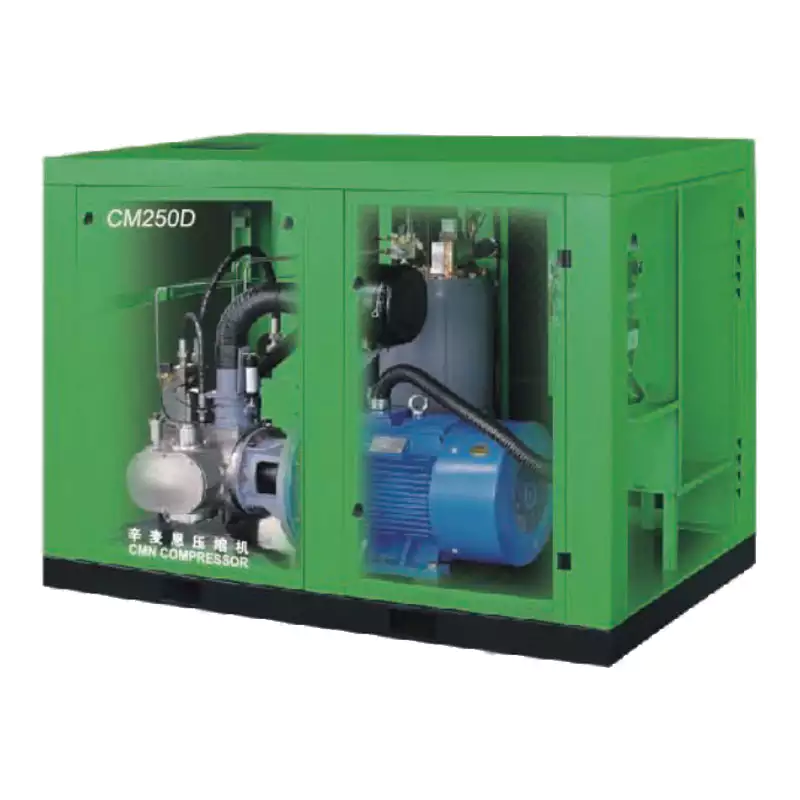
When testing compressed air quality, the CM45D water-lubricated oil-free screw compressor provides the clearest possible baseline: because there is no oil in the compression element, ISO 8573-2 oil testing at the compressor outlet should consistently return results at or near the instrument detection limit — typically <0.001 mg/m³. This makes the CM45D ideal as the starting point of a quality-critical compressed air system where testing must confirm Class 0 oil at the point of use. Any oil detected in downstream testing immediately identifies a carbon adsorber or filter issue, not a compressor issue — dramatically simplifying fault diagnosis when test results are reviewed.
View CM45D Specifications
Frequently Asked Questions
Can I use an oil test from my compressor manufacturer to satisfy a food safety audit?
+
No — for two reasons. First, the manufacturer’s test is performed at the factory outlet on a representative unit, not on your specific installed machine at your site. Second, the factory test does not account for the downstream treatment system, distribution pipework, or the specific point-of-use quality that your food safety plan specifies. SQF, BRCGS, and FSSC 22000 auditors require site-specific testing at the actual use points documented in your compressed air quality specification. Manufacturer certificates are useful supplementary documentation but cannot replace site-specific compliance testing.
How long does it take to get a compressed air test result back from a NATA laboratory?
+
Dew point results are immediate (field instrument). Particle count results are immediate (field instrument). Total oil analysis typically takes 5–10 business days from sample receipt at the laboratory — GC analysis requires instrument time scheduling and a qualified analyst review. Microbiological results take 7–10 business days from sample date for standard bacteria/mould incubation (5–7 days incubation plus plating and counting time). For urgent turnaround, some laboratories offer expedited oil analysis (2–3 days) at premium cost. Plan your testing schedule to allow the laboratory turnaround time before any audit date.
What should I do if a test result shows a quality failure?
+
For GMP and food safety systems, an out-of-specification result triggers a formal OOS (out-of-specification) or non-conformance procedure: (1) Immediately identify which products or processes may have been affected during the period the air quality was deficient; (2) Raise a corrective action — identify root cause (which treatment element failed and when); (3) Implement the corrective action (replace filter, service dryer, etc.); (4) Re-test to confirm return to specification before releasing affected products or resuming affected processes; (5) Implement preventive action — adjust maintenance schedule or add monitoring to detect the failure mode earlier. Document the entire sequence in your quality management records.
Do I need to test all use points or just a representative selection?
+
All critical use points (Category A — direct food or pharmaceutical product contact; or high-risk equivalent in other sectors) should be tested individually. Non-critical use points (general utility, non-contact) may be grouped with a single representative test from the most disadvantaged point in the group. The justification for any grouping must be documented — demonstrating that all grouped points receive air from the same supply header, post the same treatment train, and the tested point represents the worst-case quality in the group. A BRCGS or SQF auditor may ask to verify this justification, so it must be based on the documented system map, not stated from memory.
Can I install my own dew point transmitter instead of performing periodic testing?
+
A permanently installed calibrated dew point transmitter with data logging satisfies the dew point monitoring requirement for most food safety and GMP applications — and is strongly preferred because it provides continuous monitoring rather than point-in-time snapshots. However, the transmitter itself must be calibrated at defined intervals (typically annually) against a traceable standard, and the calibration certificate must be retained. A transmitter that has not been calibrated within its recommended interval does not provide defensible compliance evidence — the reading may be accurate, but it cannot be verified. For oil and particle parameters, transmitters are not available that provide continuous monitoring — laboratory testing remains required at the specified frequencies.
