Energy Efficiency Guide
A practical engineering guide to reducing compressed air energy costs — from VSD selection and specific power benchmarking through leak detection, pressure optimisation, and heat recovery, with AUD calculations at current Australian electricity rates.
Compressed air is one of the most expensive utilities in an industrial facility — and one of the least well-managed from an energy perspective. Studies by the Australian Industry Group and state energy agencies consistently find that 30–50% of compressed air energy is wasted: through system leaks, excessive pressure, unloaded compressor running, and oversized or poorly selected equipment. For a manufacturing facility running a 75 kW oil-free compressor at current Victorian electricity rates, that waste represents AUD 15,000–40,000 per year in avoidable electricity costs. This guide provides the complete, actionable framework for reducing oil-free air compressor energy costs in Australian industrial and regulated facilities — covering the eight highest-impact interventions, how to quantify the saving from each, the technology choices that deliver the best efficiency over the equipment’s service life, and how to build the business case for efficiency investments using current AUD data.
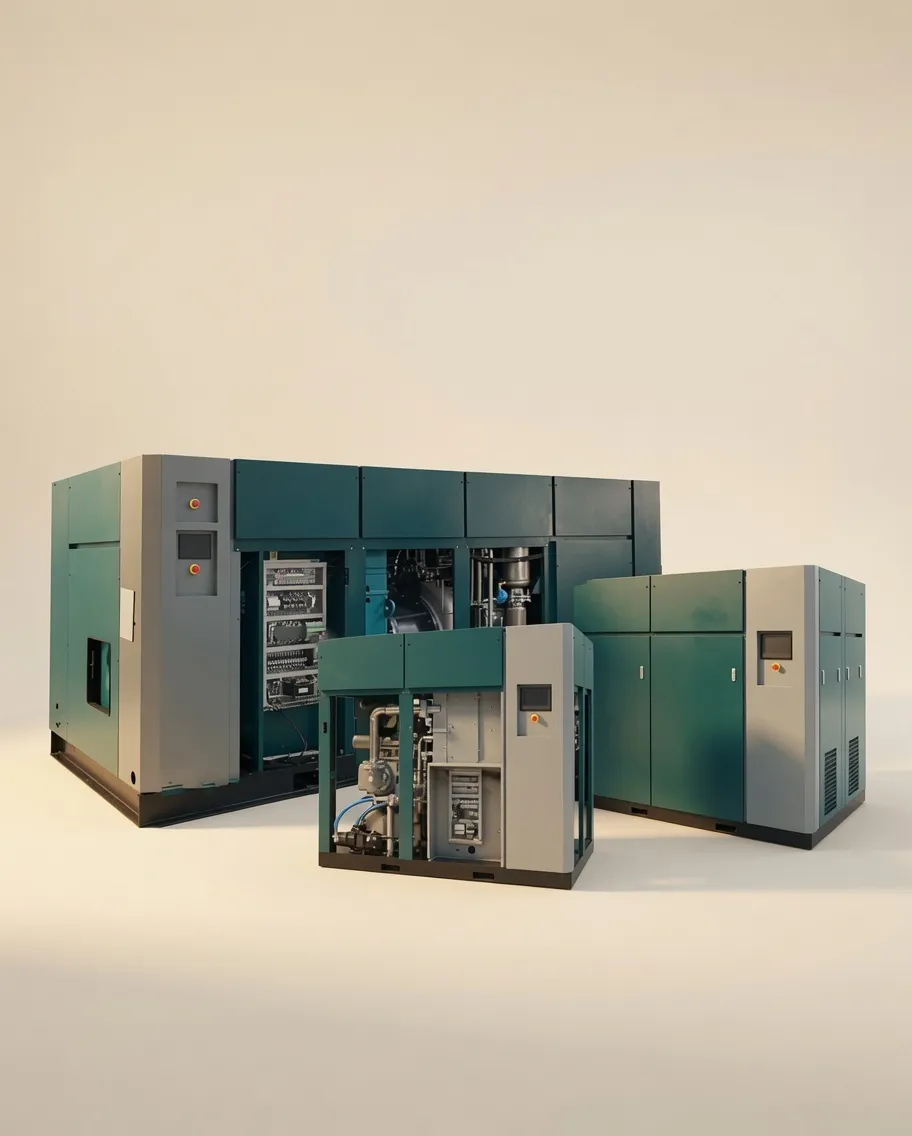
Energy monitoring dashboard — oil-free screw compressor with real-time specific power display, load factor tracking, and VSD performance data for continuous energy cost management.
Why Compressed Air Is the Costliest Industrial Utility
Generating compressed air is thermodynamically inefficient. Compressing air from atmospheric pressure to 0.8 MPa (8 bar) and then allowing it to expand again at the point of use recovers less than 10–20% of the input electrical energy as useful mechanical work. The remaining 80–90% becomes heat — which must be rejected to the environment through the aftercooler and compressor cooling system. This fundamental thermodynamic reality means that every cubic metre of compressed air delivered to a process point represents approximately 6–8 kJ of electrical input. At scale, across a 75 kW compressor running 6,000 hours/year, this translates to AUD 55,000–80,000 in annual electricity costs before any consideration of waste or inefficiency in the system.
The Compressed Air Cost Reality Check
76%
of compressor TCO is energy over 10 years
25%
average energy wasted through system leaks in unmanaged facilities
35%
35%
energy saved by VSD vs. fixed-speed at 65% average load
6–8%
energy saved per 0.1 MPa pressure reduction in distribution
The Eight Highest-Impact Energy Efficiency Interventions
The following interventions are ranked by their typical energy saving potential for a 75 kW oil-free screw compressor running 6,000 hours/year in Victoria at $0.19/kWh. Most can be implemented without replacing the compressor. Each includes an estimated annual saving in AUD and a typical implementation cost for payback calculation.
#1
Select a VSD (Variable Speed Drive) Oil-Free Compressor
AUD 9,120/yr saving
A VSD compressor adjusts motor speed in real time to match compressed air demand, eliminating the single largest source of energy waste in fixed-speed systems: unloaded running. A fixed-speed compressor consumes approximately 25–35% of full load power when running unloaded with the inlet valve closed. At 65% average load, a fixed-speed machine spends approximately 35% of its time unloaded — wasting energy delivering no compressed air. The CM132DV VSD water-lubricated oil-free compressor eliminates this waste entirely: at 65% demand, the motor runs at approximately 65% speed, consuming approximately 65% of rated power. No unloaded idle consumption.
AUD Calculation (75 kW, 6,000 hrs/yr, 65% avg load, $0.19/kWh)
Fixed-speed energy (effective 76.5 kW): 459,000 kWh/yr = $87,210
VSD energy (65% speed ≈ 57% power*): 410,400 kWh/yr = $77,976
Annual saving: ~AUD 9,234 | Implementation cost (new machine premium): AUD 15,000–20,000 | Payback: 16–26 months
*VSD cube-law approximation for centrifugal loads overstates saving vs. actual compressor performance; 15–20% saving is a conservative real-world figure.
#2
Systematic Leak Detection & Repair Programme
AUD 13,300/yr saving*
A facility with no active leak management programme loses 20–30% of its compressed air to leaks — worn quick-connect couplers, loose threaded fittings, degraded flexible hoses, and leaking valve stem packing. These leaks are inaudible at normal ambient noise levels but detectable with an ultrasonic leak detector. A 25% leak rate on a 75 kW compressor at 65% average load represents approximately 18.75 kW of compressor output being wasted, costing approximately AUD 21,375/year. Reducing leaks to 5% (achievable with one survey and repair programme) saves approximately AUD 13,300/year.
Survey cost (ultrasonic detection contractor): AUD 800–1,500
Typical repair cost for identified leaks: AUD 1,000–3,000
Annual saving at 25% → 5% leak rate: AUD ~13,300
Payback period: 1–4 months
Best ROI intervention available — payback measured in weeks to months. Re-survey recommended annually as new leaks develop.
*Based on 25% baseline leak rate; actual saving depends on current system leak rate.
#3
Reduce System Pressure to the Minimum Required
AUD 5,000–7,000/yr saving
Every 0.1 MPa (1 bar) reduction in system working pressure reduces compressor specific power by approximately 6–8% — a direct energy saving with no capital investment required. Many facilities run at 0.8–0.9 MPa when auditing demand shows the highest-pressure consumer actually requires only 0.6–0.7 MPa, with the excess pressure being set conservatively to compensate for distribution pressure drops that could instead be addressed by increasing pipe diameter. Identify the highest-pressure consumer; confirm its minimum operating pressure by measurement; reduce the compressor delivery setpoint to consumer minimum + system pressure drop allowance. Typical saving from a 0.1–0.2 MPa pressure reduction: AUD 5,000–7,000/year for a 75 kW unit.
Pressure Reduction Energy Saving Formula
Annual saving (AUD) ≈ Motor kW × Hours/yr × Load factor × Pressure reduction (MPa) × 0.07 × $/kWh
Example: 75 kW × 6,000 hrs × 0.65 × 0.1 MPa × 0.07 × $0.19 = AUD 3,094/year per 0.1 MPa reduction. Reducing by 0.2 MPa saves approximately AUD 6,188/year with zero capital cost.
#4
Right-Size the Compressor — Avoid Chronic Low-Load Operation
AUD 8,000–15,000/yr saving
An oversized compressor running at 30–40% average load wastes energy through two mechanisms in fixed-speed designs: frequent on-load/off-load cycling (each start and unloaded period wastes the energy of the start transient plus idle power); and poor compression efficiency at low pressure ratios in some designs. A compressor sized correctly for actual demand — running at 65–85% average load — operates at its design efficiency point. Measure your actual average load factor from the controller over a 4-week representative production period. If the average is below 50%, the compressor is oversized and a smaller VSD unit would reduce energy consumption by 15–30%.
#5
Maintain Filter Elements on Schedule
AUD 1,500–3,500/yr saving
A clogged inlet air filter increases inlet restriction, forcing the compressor to work harder against a higher pressure differential to draw in the same mass of air. Each 100 Pa increase in inlet restriction increases specific power by approximately 0.5–1.0%. A filter left in service 2,000 hours past its replacement interval may add 200–400 Pa of additional restriction — raising energy consumption by 1–4% above design. For a 75 kW unit at $0.19/kWh running 6,000 hours: 2% excess consumption = approximately AUD 1,710/year in avoidable electricity cost. The filter element costs AUD 80–200 to replace.
ROI: Filter replacement at AUD 120 that prevents AUD 1,700/year energy waste = 1,317% annual return. Replace inlet filter elements on schedule — never defer based on differential pressure alone if the service interval has been reached.
#6
Heat Recovery from Compression
AUD 10,000–20,000/yr offset
Air compressors reject 70–90% of their electrical input as heat — primarily through the aftercooler and motor cooling circuit. This waste heat can be captured and used for space heating, process water pre-heating, industrial drying, or building domestic hot water in winter months. For a 75 kW oil-free screw compressor running 6,000 hours/year, the theoretical recoverable heat energy is approximately 340,000–400,000 kWh per year. At natural gas equivalent pricing of AUD 0.03–0.05/kWh thermal, this represents a AUD 10,200–20,000/year heating offset if the recovered heat replaces gas heating in winter. Capital cost of a heat recovery system for a medium screw compressor: AUD 5,000–18,000 depending on the heat exchange configuration and distribution system required. Payback: typically 6–24 months.
#7
Reduce Distribution Pressure Drop — Correctly Sized Pipework
AUD 3,000–8,000/yr saving
Distribution pipework that is undersized for the flow rate creates pressure drop — requiring the compressor to run at higher delivery pressure to compensate, consuming more energy. The design target for distribution pressure drop is ≤0.05 MPa from the receiver to the farthest point of use. Exceeding this is often compensated by increasing the compressor setpoint instead of correcting the pipework — which is the more expensive “solution” in perpetuity. A looped ring main configuration reduces pressure drop by 50–75% compared to a dead-end distribution run at the same pipe diameter. For facilities with undersized long distribution runs, upsizing the main header from DN25 to DN40 typically reduces pressure drop by 70% and allows the compressor setpoint to be reduced by 0.05–0.15 MPa — an ongoing energy saving equivalent to AUD 1,500–4,600/year.
#8
Continuous Performance Monitoring & Trending
Enables all other savings
You cannot manage what you do not measure. Modern oil-free screw compressors — including the CM132DV — provide real-time specific power, load factor, pressure, and temperature data from their intelligent controllers. Logging this data and reviewing it weekly enables: immediate detection of new leaks (unexplained load factor increase); early warning of filter restriction (rising specific power + inlet temperature); identification of demand spikes that drive over-pressure operation; and confirmation that energy-saving interventions have actually delivered their predicted reduction. Facilities that deploy sub-metering on their compressor electrical supply and review monthly energy reports consistently achieve 5–15% better long-term energy performance than equivalent facilities without monitoring.
Specific Power: The Energy Efficiency Benchmark Your Supplier Must Provide
Specific power — expressed in kW per m³/min FAD at the rated delivery pressure — is the only meaningful measure for comparing the energy efficiency of different compressors. Never compare on motor power alone; a 75 kW motor delivering 8 m³/min is dramatically less efficient than a 75 kW motor delivering 12 m³/min at the same pressure. When evaluating compressor quotations, demand the ISO 1217 FAD and full-load motor power at that FAD, then calculate specific power yourself:
Specific Power (kW/m³/min) = Full-Load Motor Power (kW) ÷ FAD at Rated Pressure (m³/min)
Example: 75 kW motor, FAD = 12.5 m³/min at 0.8 MPa → Specific Power = 75 ÷ 12.5 = 6.0 kW/m³/min ✓ (excellent)
Example: 75 kW motor, FAD = 9.5 m³/min at 0.8 MPa → Specific Power = 75 ÷ 9.5 = 7.9 kW/m³/min ✗ (poor — reject or seek explanation)
| Technology |
Typical Specific Power (kW/m³/min at 0.8 MPa) |
Annual Energy 75 kW @ 6,000 hrs |
10-yr Cost ($0.19/kWh) |
| VSD water-lubricated oil-free screw |
5.5–6.2 |
294,000 kWh |
AUD 558,600 |
| Fixed-speed dry screw oil-free |
6.5–7.5 |
342,000 kWh |
AUD 649,800 |
| Fixed-speed oil-lubricated screw |
7.0–8.0 |
370,000 kWh |
AUD 703,000 |
| Oil-free piston (small-medium) |
9.0–12.0 |
456,000 kWh |
AUD 866,400 |
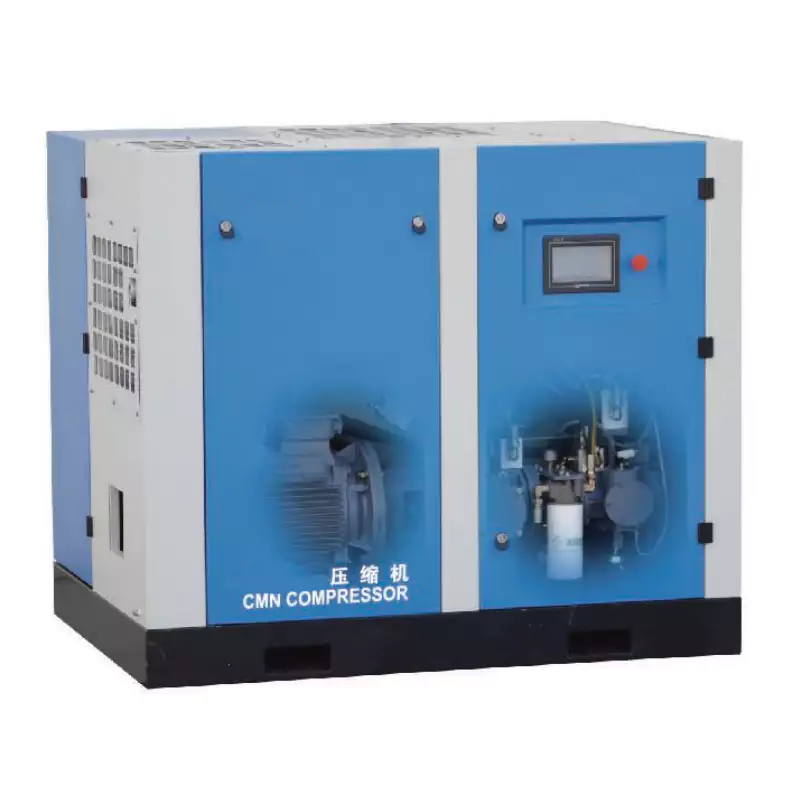
CM22G Series oil-free screw compressor with intelligent controller — real-time specific power display, integrated energy monitoring, and VSD option for variable-demand production environments.
Summary: All Eight Interventions, Ranked by Impact
| Rank |
Intervention |
Annual Saving (AUD) |
Implementation Cost |
Typical Payback |
| #1 |
VSD compressor (new purchase) |
AUD 9,120 |
AUD 15,000–20,000 |
16–26 months |
| #2 |
Leak detection & repair programme |
AUD 13,300* |
AUD 1,800–4,500 |
2–4 months |
| #3 |
Reduce system pressure |
AUD 3,000–6,200 |
$0 — setpoint change |
Immediate |
| #4 |
Right-size the compressor |
AUD 8,000–15,000 |
Capital replacement |
12–30 months |
| #5 |
Filter element replacement on schedule |
AUD 1,500–3,500 |
AUD 80–200/element |
<1 month |
| #6 |
Heat recovery installation |
AUD 10,000–20,000 offset |
AUD 5,000–18,000 |
6–24 months |
| #7 |
Upsized distribution pipework |
AUD 3,000–8,000 |
AUD 3,000–15,000 |
12–36 months |
| #8 |
Performance monitoring programme |
Enables all above |
AUD 0–2,000/yr |
Immediate |
| COMBINED MAXIMUM ANNUAL SAVING (realistic, non-overlapping) |
AUD 30,000–45,000 |
On a 75 kW compressor currently running at 65% average load with 25% leak rate; year 1 payback on all investments typically 8–18 months combined. |
Lowest Energy Cost in Class
CM132DV VSD Water-Lubricated Oil-Free Screw Compressor
The CM132DV combines the two most powerful energy efficiency technologies: VSD (eliminates unloaded running losses) and water-lubricated compression (achieves the lowest specific power in the oil-free screw category). Result: AUD 558,600 in 10-year energy cost versus AUD 703,000+ for fixed-speed alternatives. Our team provides free site-specific energy cost calculations with your operating hours and electricity rate.
View CM132DV & Energy Data →
Frequently Asked Questions
How do I find out how much energy my compressor is actually wasting right now?
+
Three measurements give you the full picture: (1) Load factor from the controller: read the compressor’s load % from the controller display or data log over a representative 4-week period. If average load is below 60%, the machine is oversized and/or the system has significant leaks. (2) Overnight pressure decay test: pressurise the system to working pressure, shut the compressor off at end of shift, and record the pressure after 8 hours (use the system pressure gauge or a data logger). Each bar (0.1 MPa) of pressure drop per hour represents approximately 1–3% of compressor capacity wasted as leaks, depending on system volume. (3) Sub-metering: install a clip-on power meter (available from electrical wholesalers for AUD 300–600) on the compressor electrical supply for a 2-week period to record actual kWh consumption. Compare to the rated motor power × operating hours × expected load factor — any significant excess indicates efficiency losses from filter restriction, incorrect pressure, or poor motor efficiency. These three measurements take less than one working day to set up and provide the data needed to quantify every major efficiency opportunity.
Is there a government rebate available for installing a VSD oil-free compressor?
+
Several state energy efficiency programmes are relevant to VSD compressor investments. Victoria’s Victorian Energy Upgrades (VEU) programme provides financial incentives for energy efficiency equipment upgrades; variable speed drive installations on industrial equipment including compressors have been eligible activities under the programme at various times — check the Essential Services Commission (ESC) website for current eligible activities. NSW’s Energy Savings Scheme (ESS) contains similar provisions for industrial equipment upgrades. The Australian Renewable Energy Agency (ARENA) and the Business Energy Advice Program (BEAP) have both provided grants or subsidised audits for industrial energy efficiency at different times. As programme eligibility changes regularly, we recommend requesting an energy efficiency assessment from your state energy authority or a certified energy auditor before purchase — an eligible installation can attract AUD 3,000–25,000 in rebates depending on the programme and compressor size. Our team can provide the performance data required to support a rebate application.
How much do system leaks actually cost and how do I detect them?
+
A single 1 mm orifice leak at 0.7 MPa gauge pressure costs approximately AUD 800–1,200 per year in energy (varies by electricity rate). Most industrial facilities accumulate 20–50 such leak points over time through connector wear and thread loosening — a total leak flow of 20–50 L/min free air, representing 5–15% of a medium compressor’s capacity. Detection: use a calibrated ultrasonic leak detector (available to hire from some industrial supply companies, or use an inspection contractor at AUD 800–1,500 per survey). The ultrasonic frequency (38–40 kHz) generated by escaping compressed air is detectable from 5–10 m distance even against high factory ambient noise. Focus on quick-disconnect coupler bodies, valve packing glands, threaded malleable iron fittings (particularly at thread roots), flexible hose end fittings, and pressure regulator diaphragm connections. Leak tagging and repair typically eliminates 80–90% of identified leaks in a single planned maintenance event.
Does reducing delivery pressure ever harm the processes I’m running?
+
Only if you reduce pressure below the minimum required for the highest-pressure consumer in your system. The correct approach: identify the consumer with the highest minimum operating pressure by checking its datasheet or measuring its inlet pressure during operation. Set the compressor delivery pressure at that value plus the system distribution pressure drop (target ≤0.05 MPa) plus a 0.05 MPa safety margin. In most facilities, this analysis shows the current setpoint is 0.1–0.3 MPa higher than required — set conservatively by an installer who did not audit actual demand. Reducing the setpoint to the correctly calculated minimum value saves energy while maintaining all consumer performance. If pressure-sensitive instruments or actuators report performance changes after a setpoint reduction, the distribution pressure drop is larger than calculated — identify and address the high-pressure-drop segment rather than raising the compressor setpoint back.
Our facility runs 24/7. Does a VSD still save energy at high constant load?
+
Yes — for two reasons. First, even 24/7 production operations have variation in compressed air demand: shift changes, tool changeovers, cleaning cycles, and maintenance windows create periods of reduced consumption. A VSD captures the energy saving during every such period. Second, even at constant 100% load, a water-lubricated VSD compressor achieves lower specific power than a fixed-speed dry screw or oil-lubricated equivalent — the energy saving comes from the water-lubricated design’s inherently better compression efficiency, not just from the VSD’s speed matching. The combined saving is typically 15–22% versus a fixed-speed oil-lubricated alternative even in an 85–90% average load scenario. For 24/7 high-load operations, the energy saving at current Australian electricity rates is in the range of AUD 5,000–12,000/year for a 75 kW unit — and the 10-year compound saving is large enough that the VSD premium is recovered rapidly even without the full benefit of demand variation.
Cut Your Compressed Air Energy Bill — Starting This Month
Australia Oil Free Air Compressor Co., Ltd. provides free energy assessments for compressed air systems — identifying your highest-impact savings opportunities and quantifying the AUD return from each intervention at your actual electricity rate.
Request Free Energy Assessment
Email: [email protected] | Contact Us | About Us