
An oil-free air compressor delivers its full performance and service life advantages only when its maintenance programme is executed correctly and consistently. The common misconception — that oil-free means maintenance-free — costs facilities dearly in premature air-end failures, degraded air quality, unplanned downtime, and voided equipment warranties. While oil-free designs do eliminate the most frequent oil-lubricated maintenance tasks (oil changes, oil separator replacement, lube oil analysis), they introduce their own maintenance requirements that, if neglected, are equally damaging. This guide provides the complete maintenance framework for oil-free screw air compressors: every essential check, every service interval, the correct consumable specifications, the documentation records your facility needs, and the warning signs that indicate a problem before it becomes a failure. Whether you operate a water-lubricated oil-free screw compressor in a pharmaceutical plant or a medium-pressure oil-free unit in a food manufacturing facility, the framework in this guide applies directly.
Why Oil-Free Compressor Maintenance Matters More Than You Think
Field data from compressor service organisations consistently identifies the same pattern: the majority of premature oil-free compressor failures are caused by inadequate maintenance — specifically neglected air filters, contaminated cooling systems, and deferred bearing inspections. Each of these failures has a predictable cascade effect on air quality, energy consumption, and machine longevity.
Neglected Air Filter → Energy Spike
A clogged inlet air filter increases inlet resistance by 100–300 Pa above the design value. Each 100 Pa of additional restriction increases specific power consumption by approximately 0.5–1%. A filter left in service 2,000 hours past its replacement interval on a 75 kW compressor running 6,000 hours/year can add AUD 1,500–3,000 in unnecessary electricity cost — far exceeding the AUD 80–200 cost of a replacement element.
Fouled Cooler → Thermal Shutdown
An air-blast cooler accumulates dust and debris at 0.1–0.3 mm per month in a typical industrial environment. After 12–18 months without cleaning, cooler fouling can raise discharge temperature by 15–25°C above design — triggering the high-temperature protective shutdown at the worst possible moment. Mid-production thermal shutdowns in food or pharmaceutical plants generate batch rejection risk, schedule disruption, and HACCP deviation events.
Deferred Bearing Check → Air-End Failure
Oil-free screw compressor air-end bearings are designed for 40,000–80,000 hours with correct lubrication and operating conditions. Deferred bearing grease replacement (typically due every 4,000–6,000 hours in most designs) accelerates wear exponentially once the grease loses its lubricating properties. An undetected failing bearing in a high-speed air-end can progress from early vibration signature to catastrophic rotor contact failure within 200–500 operating hours.
The Complete Maintenance Schedule: Interval by Interval
The schedule below applies to the majority of industrial oil-free screw air compressors in the 7.5–250 kW range, including both dry screw and water-lubricated designs. Manufacturer-specific intervals in your technical manual take precedence where they differ — always cross-reference this framework with your compressor’s maintenance manual. Intervals are expressed as operating hours; for site-based scheduling, use the first interval to fall (hours or calendar time, whichever comes first).
Operational Monitoring Checks
Routine Inspection Checks
Intermediate Service Tasks
Major Scheduled Service
Air-End Bearing Grease Replacement
High-speed air-end bearings require fresh grease of the specified grade (consult manual — typically Kluber ISOFLEX NBU 15 or equivalent) at 4,000–6,000 hour intervals. Over-greasing is as damaging as under-greasing — use a grease gun with a shot counter and follow the manufacturer’s specified quantity precisely. Record grease type, quantity, and application date in the maintenance log.
Timing Gear Oil Change (Dry Screw)
The timing gear housing in dry screw oil-free compressors uses a separate gear oil supply that must be changed at the manufacturer-specified interval (typically 4,000 hours or annually). Drain the gear oil warm (after 30 minutes’ operation), flush with fresh oil if recommended, refill with OEM-specified grade to the correct level mark. This is not the same oil circuit as a lubricated compressor — it serves only the timing gears, not the compression chamber.
Valve & Safety Device Re-Certification
Minimum unloading valve, minimum pressure check valve, and safety relief valve should be inspected and re-certified annually. Safety relief valves must be tested to confirm lift pressure is within 3% of the nameplate setting — a valve that lifts too high does not protect the receiver; one that lifts too low causes unnecessary shutdown. Retain test certificates for the life of the valve.
V-Belt & Drive Train Inspection
Belt-driven compressors require belt tension measurement and visual inspection at 4,000 hours or annually. Check for glazing, cracking, fraying, or uneven belt wear. Measure belt tension with a calibrated tension gauge — slack belts slip and overheat; over-tensioned belts overload air-end shaft bearings. Replace as a matched set if any belt in a multi-belt drive shows wear.
Motor Electrical Inspection
Annual check of motor terminal connections (tighten to specified torque — loose connections cause overheating and motor failure), insulation resistance test (minimum 100 MΩ with 500 V megger), motor winding temperature under load, and thermal protection device re-test. Document test results in the maintenance record with test instrument serial numbers for calibration traceability.
Air Quality Validation Test
Annual third-party air quality test confirming ISO 8573-1 Class 0 oil content, total particulate, and pressure dewpoint at key system outlets. For pharmaceutical and food manufacturing, this test generates the compliance documentation required by GMP, BRCGS, and SQF auditors. Retain results for minimum 5 years (10 years for pharmaceutical). Contact [email protected] to arrange this service.
Extended Interval Overhaul Tasks
At 8,000 hours or every two years (whichever is first), a comprehensive mechanical assessment of the compressor internals is required to confirm the machine remains within acceptable performance parameters. These tasks require specialist service personnel and are best covered under an OEM or authorised service provider contract.
Inspect PTFE, ceramic, or DLC rotor coating for wear, delamination, or scoring. Measure rotor clearances and compare to OEM design values. Rising specific power consumption (more than 3% above original commissioning values at the same pressure and flow) is the earliest indicator of rotor clearance increase from coating wear. Arrange air-end overhaul if clearances exceed OEM limits.
Many OEM maintenance schedules specify full bearing replacement at 8,000 hours regardless of apparent condition — because vibration analysis alone cannot reliably detect sub-surface bearing fatigue. Proactive bearing replacement at the scheduled interval costs AUD 800–2,500; a reactive bearing failure causing rotor contact in the air-end costs AUD 15,000–80,000 for a full air-end replacement.
For installations with desiccant dryers, the activated alumina or molecular sieve desiccant media degrades over approximately 6,000–8,000 hours of service, losing adsorption capacity. A dewpoint that progressively drifts from the design specification (−40°C or −70°C) before stabilising at a higher value is the indicator that desiccant replacement is due. Replacement restores dewpoint performance immediately.
Water-Lubricated Compressor: Additional Maintenance Requirements
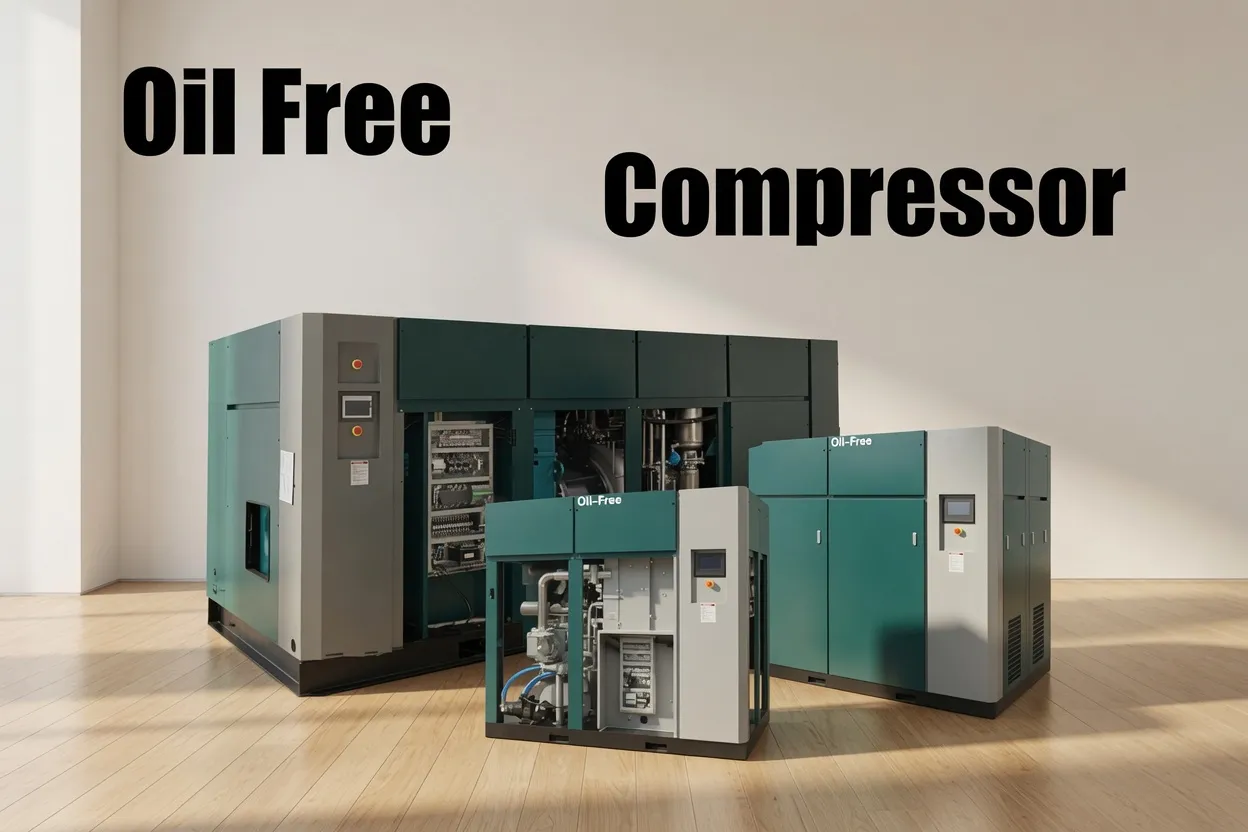
Water-lubricated oil-free screw compressors — such as the CM45D low-pressure water-lubricated compressor — require an additional layer of maintenance focused on the water management system. This is the most distinctive maintenance difference between water-lubricated and dry screw designs, and it is routinely the area where maintenance programmes are incomplete in facilities that have switched compressor types without updating their maintenance procedures.
Water pH Monitoring — Monthly
Maintain water pH between 6.5 and 8.5. Acidic water (pH <6.5) corrodes stainless steel internal surfaces; alkaline water (pH >8.5) promotes scale formation in the water separator and distribution circuit. Use pH test strips or a calibrated pH meter — test at the water reservoir and at the separator outlet. Record results; out-of-range pH triggers a water flush and recharge with fresh demineralised water.
Water Filter Element — Every 2,000 hrs
The water circuit inlet filter prevents particulates from entering the injection pump and rotor surfaces. Replace the water filter element at 2,000-hour intervals or if water differential pressure exceeds the design value, whichever is first. Always use demineralised or deionised water for recharge — tap water introduces mineral salts that accelerate scale formation and can deposit on rotor surfaces, reducing volumetric efficiency over time.
Water Separator Inspection — Every 4,000 hrs
The water separator removes injected water from the compressed air stream before the dryer. Inspect the separator element for scale accumulation, biofilm, or debris loading. A partially blocked water separator raises downstream moisture content, increasing dryer loading and reducing dewpoint performance. Clean or replace the separator element as required; a clean separator is the single most effective maintenance action for maintaining downstream air quality.
Scale & Biofilm Prevention
Hard water areas in Australia (particularly Western Australia and parts of Victoria and South Australia) present elevated scale risk. Where water hardness exceeds 150 ppm CaCO₃, install a water softener or RO unit upstream of the compressor water reservoir. Add an approved anti-scale dosing agent at the manufacturer-recommended concentration if softening is not practical. Annual water circuit flush with a citric acid solution removes accumulated scale deposits effectively without damaging stainless steel internal components.
Performance Trending: Your Early Warning System
The most cost-effective maintenance strategy for oil-free compressors goes beyond executing scheduled tasks — it tracks machine performance data over time to detect developing faults before they cause failure. Four key parameters should be trended from the compressor’s control system or energy monitoring infrastructure:
Maintenance Documentation: What to Record and Why
For regulated industries — pharmaceutical, food, medical device manufacturing, and dental — maintenance records are not merely good practice. They are audit-required documentation that directly supports regulatory compliance, product quality decisions, and equipment warranty claims. A maintenance record that cannot be produced during a TGA GMP inspection or BRCGS audit will be treated as a maintenance event that did not occur. The following minimum content applies to every maintenance record entry:
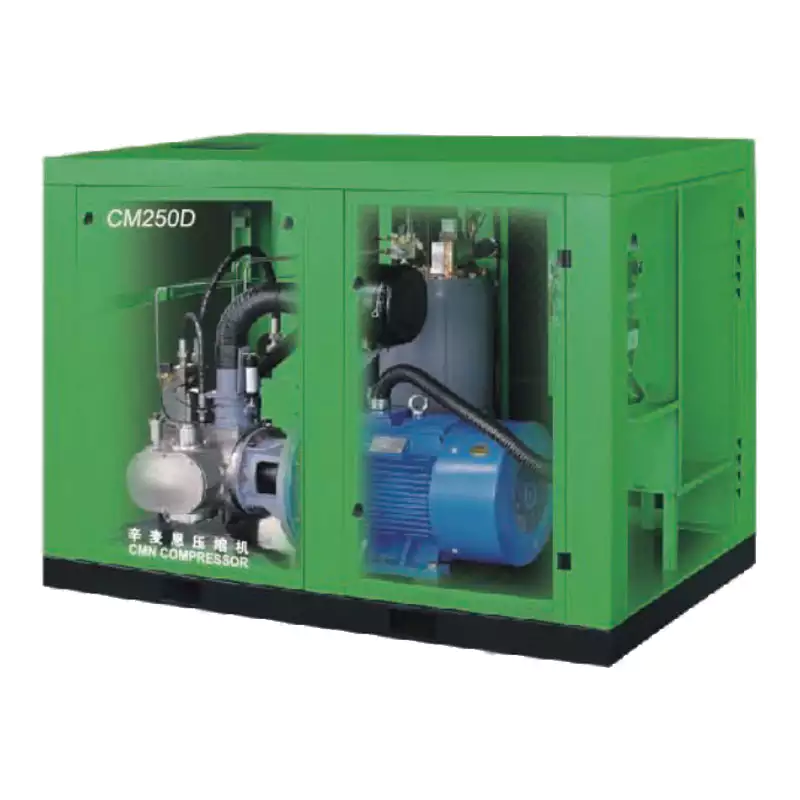
CM132DV Water-Lubricated Oil-Free Screw Compressor
Engineered for minimal maintenance burden: no timing gear oil changes, no rotor coating wear concerns, extended 7,000-hour service intervals, and an intelligent controller that monitors all performance parameters in real time — alerting your maintenance team before problems develop. Annual service contracts available from our Charlton Industrial Area base.
Frequently Asked Questions
Let Us Handle Your Compressor Maintenance
Australia Oil Free Air Compressor Co., Ltd. offers annual service contracts covering all scheduled maintenance, air quality validation, and compliance documentation for oil-free compressor installations across Australia.
Request a Maintenance Contract
Email: [email protected]
| Contact Us
| About Us