
Purchase price is the number that gets compared in compressed air procurement. Total cost of ownership (TCO) is the number that determines whether the decision was right. For oil-free air compressors, the gap between these two figures is typically wider than buyers anticipate — and systematically wider in oil-free’s favour when the analysis is done correctly. Energy accounts for 70–80% of a compressor’s TCO over a 10-year operating life. Maintenance, consumables, and compliance documentation add another 10–15%. The purchase price that dominates the procurement conversation typically represents only 8–12% of the machine’s true cost across its service life. This guide provides a rigorous, data-driven TCO framework for oil-free air compressor running costs in the Australian market: real energy cost calculations, actual maintenance cost schedules, downtime cost quantification, compliance cost allocation, and worked payback period examples that give procurement teams the financial evidence they need to make — and defend — the oil-free investment decision.
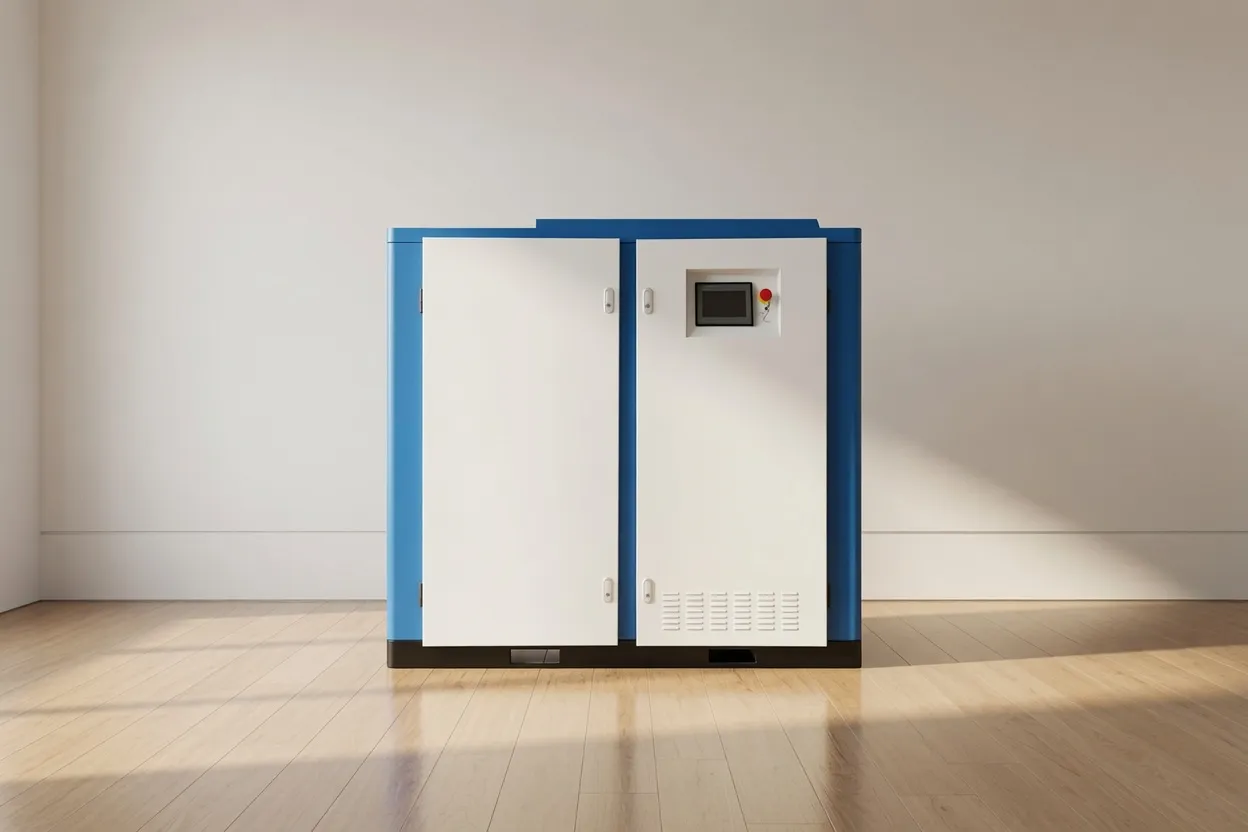
The TCO Framework: Seven Cost Components
A complete TCO analysis for an oil-free air compressor covers seven distinct cost components. Procurement analyses that omit any of these components systematically understate the true cost difference between options and frequently lead to decisions that appear to save money upfront while costing significantly more across the operating life.
8–12% of TCO
Compressor capital cost, installation materials (pipework, electrical, base), commissioning labour, and for regulated industries — initial qualification (IQ/OQ). Often the only cost captured in a purchase price comparison.
70–80% of TCO
Electricity to run the motor — the dominant TCO component by far. Heavily influenced by compressor specific power (kW per m³/min FAD), VSD vs. fixed-speed design, and ambient operating conditions. Even a 5% improvement in specific power saves AUD 15,000–40,000 over 10 years for a 75 kW unit in Australian industrial electricity pricing.
5–8% of TCO
Scheduled labour and consumables: inlet filters, downstream filter cartridges, dryer service, bearing grease, gear oil (dry screw), water circuit maintenance (WL models), safety valve certification, annual air quality test.
2–5% of TCO
Emergency call-out, unscheduled part replacements, and air-end overhauls. Oil-free designs typically have lower unplanned repair frequency than oil-lubricated machines due to absence of oil contamination-related failures, but bearing and valve replacement remain credible events.
Variable
Lost production revenue, batch rejection, emergency sourcing costs, and compliance deviation costs arising from compressor failure. Highest in pharmaceutical, food, and medical applications where downtime triggers batch quarantine or clinical incident protocols.
1–3% of TCO
Annual air quality testing, GMP requalification (pharma), BRCGS audit evidence compilation (food), AS 2896 validation (medical). Cost is fixed for oil-free; for oil-lubricated systems in regulated industries, the compliance cost is zero — because the oil-lubricated machine cannot be operated in those applications at all.
Negative cost
Trade-in or resale value of the compressor at end of service life (typically 10–15 years); disposal cost for waste oil and contaminated oil separator elements (oil-lubricated machines incur controlled waste disposal costs that oil-free machines do not). Oil-free machines retain higher resale values in the secondary market.
Energy Costs: The Number That Dominates Everything
Energy cost is the single largest component of oil-free compressor TCO — and the component that is most directly influenced by the purchasing decision. The key metrics that determine energy cost are: motor rated power (kW), specific power (kW per m³/min delivered), operating hours per year, load factor (% of time actually compressing), and the Australian industrial electricity price (AUD per kWh).
Australian Electricity Cost Baseline (2025–2026)
Australian industrial electricity prices have risen significantly since 2021. For mid-size manufacturing facilities on business tariffs across key states, the effective rate for continuous industrial loads is typically:
At these rates, a 75 kW oil-free compressor running at 75% average load for 6,000 hours/year generates AUD 44,000–78,000 in electricity costs per year. Over 10 years: AUD 440,000–780,000. The compressor’s purchase price of AUD 30,000–70,000 is dwarfed by the 10-year energy cost by a factor of 6–15×. This ratio explains why the specific power figure — not the purchase price — is the single most financially significant parameter in the procurement decision.
VSD vs. Fixed-Speed: The Energy Savings Calculation
Variable speed drive (VSD) oil-free compressors — such as the CM132DV — match motor speed to actual demand, eliminating the energy wasted during unloaded running in fixed-speed designs. In typical food, pharmaceutical, and manufacturing operations with variable production schedules, demand typically averages 60–75% of peak capacity across the working day. Here is what that means financially:
- Full-load power draw: 75 kW
- Unloaded power draw: ~25 kW (idle at 33%)
- Effective average at 65% demand: ~57 kW
- Annual energy: 57 × 6,000 = 342,000 kWh
- At $0.19/kWh: AUD 64,980/year
- 10-year energy cost: AUD 649,800
- Full-load power draw: 75 kW
- At 65% demand: ~49 kW (VSD scales proportionally)
- No unloaded loss — motor slows with demand
- Annual energy: 49 × 6,000 = 294,000 kWh
- At $0.19/kWh: AUD 55,860/year
- 10-year energy cost: AUD 558,600
AUD 91,200
The VSD premium (typically AUD 8,000–18,000 over equivalent fixed-speed) is recovered within 12–24 months from energy savings alone, at current Australian electricity rates. Carbon emissions reduction of approximately 48 tonnes CO₂ over 10 years is an additional benefit for sustainability reporting.
Maintenance Cost Schedule: Oil-Free vs. Oil-Lubricated
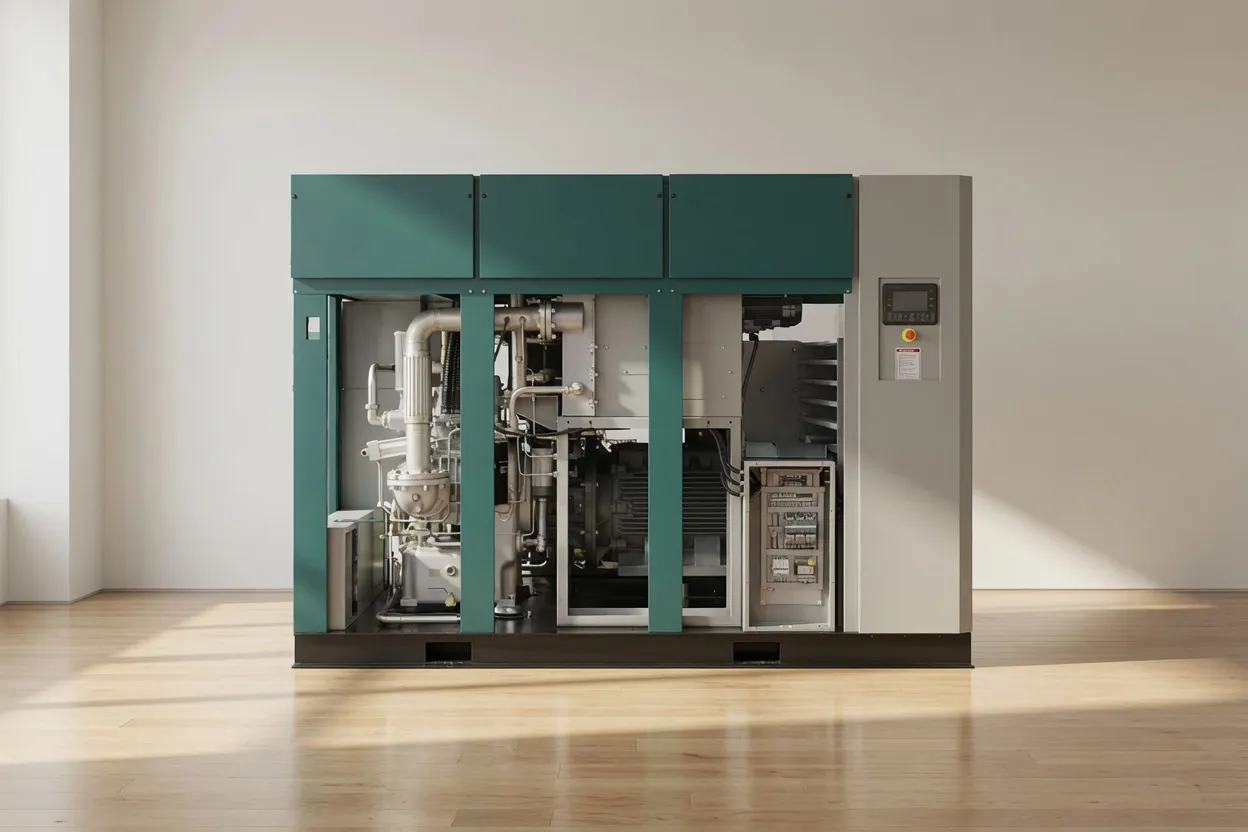
Maintenance costs for oil-free compressors are frequently misrepresented in both directions — some buyers assume oil-free maintenance is more expensive (it is not), others assume it is negligible (it is not that either). The following schedule provides realistic, current Australian market pricing for all scheduled maintenance tasks for a 75 kW oil-free screw compressor running 6,000 hours/year, compared with an equivalent oil-lubricated machine.
The oil-free advantage in annual maintenance cost — AUD 1,600–3,200 per year for a 75 kW unit — primarily comes from the elimination of lube oil changes, oil separator elements, and controlled waste oil disposal. Over 10 years, this represents an additional AUD 16,000–32,000 in maintenance cost savings on top of the energy savings already calculated.
Downtime Costs: The Variable That Changes Everything in Regulated Industries
For general industrial facilities, compressor downtime costs are real but manageable — typically measured in terms of delayed production and operator idle time. For regulated industries, downtime costs are fundamentally different in character and scale.
Food Manufacturing
A mid-scale food production facility generating AUD 15,000/day in revenue from 2 production lines loses AUD 7,500–15,000 for each day the compressed air system is down. At 2 unplanned shutdowns per year (realistic without adequate maintenance or N+1 redundancy), that is AUD 15,000–30,000 in annual downtime cost — before considering batch rejection or BRCGS non-conformance costs.
Pharmaceutical Manufacturing
A single compressed air failure during active pharmaceutical manufacturing can trigger batch quarantine across all in-process and recently completed batches — with batch values of AUD 50,000–500,000+ depending on the product. Additionally, the deviation investigation, root cause analysis, and revalidation process required before resuming GMP production typically adds 2–5 days of additional downtime beyond the repair event itself.
Medical & Dental Facilities
A dental practice generating AUD 8,000/day across 6 chairs loses 50–100% of revenue during a compressed air failure. For hospitals, the cost of diverting surgical cases and re-scheduling ICU patients is measured not only in direct financial terms but in clinical risk and regulatory reporting obligations. N+1 redundancy — two compressor units — is the standard response to this exposure in clinical facilities.
10-Year TCO Comparison: VSD Oil-Free vs. Fixed-Speed Oil-Lubricated
The following worked example compares a 75 kW VSD oil-free screw compressor (such as the CM45D) against a fixed-speed oil-lubricated screw compressor of equivalent capacity, in a food manufacturing facility in Victoria operating 6,000 hours/year with moderate air demand variability.
* Oil-lubricated compressor cannot be used in direct food contact applications — compliance cost is notional for comparison; in practice, the oil-lubricated machine would require replacement before use in a BRCGS-certified food facility.
Payback Period & ROI: How to Justify the Oil-Free Premium
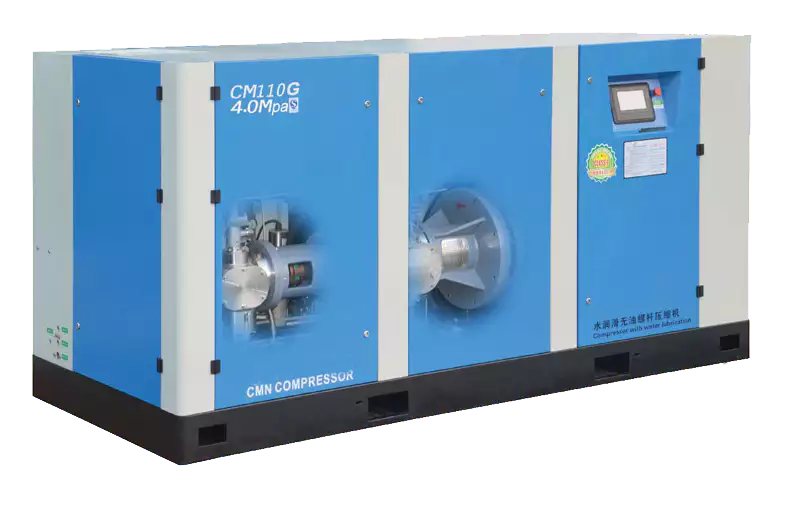
The capital premium for a VSD oil-free compressor over an equivalent fixed-speed oil-lubricated machine is typically AUD 12,000–25,000 for a 75 kW unit. Here is how to calculate and present the payback period for internal capital approval processes:
Energy saving (kWh/yr × $/kWh) + Maintenance saving ($/yr) + Downtime risk reduction ($/yr, annualised). For our worked example: $9,120 energy + $2,400 maintenance + $6,000 downtime risk = $17,520/yr
Oil-free VSD purchase price minus oil-lubricated fixed-speed purchase price. In our example: $55,000 − $38,000 = $17,000 premium
Capital premium ÷ annual savings = payback period. In our example: $17,000 ÷ $17,520 = 11.6 months payback on the VSD oil-free premium.
Annual savings × 10 years − Capital premium = net TCO saving. In our example: ($17,520 × 10) − $17,000 = $158,200 net saving over 10 years from the VSD oil-free investment.
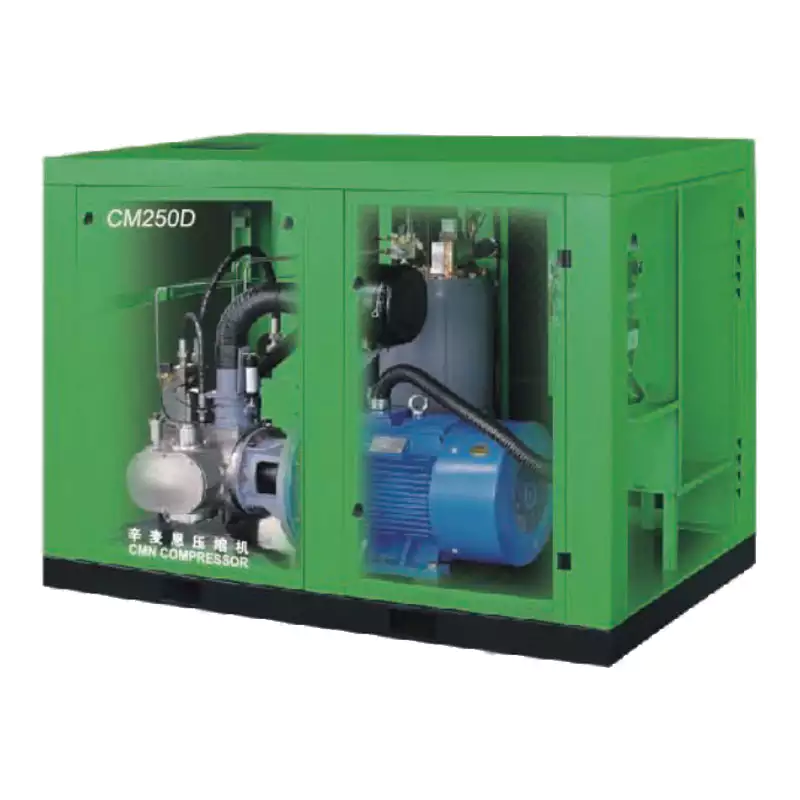
CM132DV Water-Lubricated VSD Oil-Free Screw Compressor
The combination of VSD energy efficiency, water-lubrication’s zero-oil maintenance advantage, 7,000-hour service intervals, and ISO 8573-1 Class 0 certification creates the industry’s strongest TCO case for food, pharmaceutical, and medical compressed air. Available with annual service and air quality validation contract to lock in your ongoing compliance and maintenance costs at a fixed annual rate. Request a site-specific TCO calculation from our team.
Frequently Asked Questions
Get a Site-Specific TCO Analysis
Australia Oil Free Air Compressor Co., Ltd. provides no-obligation site-specific TCO calculations — factoring in your actual operating hours, electricity rate, demand profile, and compliance requirements to give you the complete financial case for oil-free investment.
Request Your Free TCO Analysis
Email: [email protected] | Contact Us | About Us