
In pharmaceutical manufacturing, compressed air is not classified as a utility in the conventional engineering sense — it is a process material. When it contacts active pharmaceutical ingredients, excipients, primary packaging, or the internal surfaces of manufacturing vessels, it must meet the same contamination control standards as any other process input. The consequences of oil contamination from a non-compliant compressor source are far-reaching: batch rejection and destruction, critical GMP findings from the TGA, product recall under therapeutic goods legislation, and — in the most serious cases — patient harm. An oil-free air compressor is the foundation of every compliant pharmaceutical compressed air system, but the compressor itself is only the starting point. This article sets out the complete framework of key requirements governing oil-free compressed air in pharmaceutical manufacturing in Australia — covering regulatory obligations, technology selection, system qualification, air classification, monitoring, and maintenance — with the specificity and data depth that quality assurance and engineering teams need to build and operate a compliant system.
The Regulatory Landscape: TGA, PIC/S, and GMP Requirements
Australian pharmaceutical manufacturers are regulated by the Therapeutic Goods Administration (TGA) under the Therapeutic Goods Act 1989. The TGA’s GMP requirements are aligned with the PIC/S Guide to Good Manufacturing Practice for Medicinal Products (PE 009-16), the most widely adopted international GMP standard for pharmaceutical manufacturing. Understanding how these regulatory instruments apply to compressed air systems determines both the minimum requirements for compliance and the documentation framework that TGA inspectors examine during GMP audits.
PIC/S PE 009-16 — Annex 1 & Chapter 3
PIC/S PE 009-16 Annex 1 (Manufacture of Sterile Medicinal Products) contains the most stringent compressed air requirements in pharmaceutical GMP — applicable to any manufacturer of sterile injectables, ophthalmics, or aseptically filled products. The annex requires that compressed air used in sterile manufacturing zones be supplied from an oil-free source, filtered through 0.22 μm sterilising-grade membranes at the point of use, and monitored for viable and non-viable particulates. Chapter 3 (Premises and Equipment) applies to all pharmaceutical manufacturing categories and requires that utilities — including compressed air — be designed, installed, and operated in a manner that does not constitute a contamination risk to product. This is the statutory basis for the oil-free compressed air requirement across all pharmaceutical manufacturing categories, not only sterile production.
EU GMP Annex 15 — Qualification & Validation
Annex 15 of the EU GMP Guidelines (adopted in the PIC/S framework) establishes the qualification and validation requirements for pharmaceutical manufacturing equipment and utilities, including compressed air. It defines the IQ (Installation Qualification), OQ (Operational Qualification), and PQ (Performance Qualification) framework for utilities and sets out the minimum content of each qualification study. For a pharmaceutical compressed air system, Annex 15 means that a formal IQ/OQ/PQ qualification must be completed and documented before the system is used in production — and that any subsequent change to the system triggers a re-qualification protocol proportionate to the change’s potential impact on air quality.
ISO 8573-1 Class 0 in Pharmaceutical Context
ISO 8573-1 Class 0 — oil content below 0.01 mg/m³, independently certified — is the mandatory air quality target at product contact points in pharmaceutical manufacturing. This class is achievable only with a true oil-free compression source; as discussed in our broader guides on water-lubricated oil-free screw compressors, a filtered oil-lubricated system cannot achieve Class 0 certification under third-party audit. Non-product-contact applications within the same facility may be permitted at Class 1 with appropriate risk-based justification documented in the Pharmaceutical Quality System.
Classifying Compressed Air Uses: A Risk-Based Approach
GMP does not require every cubic metre of compressed air in a pharmaceutical facility to meet Class 0. A risk-based classification of compressed air uses — documented in the Pharmaceutical Quality System and approved by the site’s head of quality — allows proportionate specification of air quality, treatment, and monitoring for each use category. The following four-tier classification framework aligns with PIC/S guidance and reflects TGA audit expectations.
ISO 8573-1 Class 0
Direct Product Contact — Sterile
Purging aseptic filling lines, blanketing sterile vessels, compressed air contacting sterile product surfaces. Requires Class 0 + 0.22 μm sterilising-grade terminal filter + bioburden monitoring. Pressure dewpoint: −40°C minimum.
ISO 8573-1 Class 0
Direct Product Contact — Non-Sterile
Tablet coating pans, spray dryers, granulation vessels, fluid bed dryers, powder conveying, packaging machine purging in open product zones. Class 0 required; 0.01 μm fine filter at point of use. Pressure dewpoint: −20°C.
ISO 8573-1 Class 1
Incidental / Near-Contact
Pneumatic actuators in closed product handling, packaging machine mechanics in closed zones, instrument air for process control. Class 1 acceptable with risk justification. Pressure dewpoint: +3°C minimum.
ISO 8573-1 Class 2
Non-Product-Contact Utility
Engineering workshop tools, HVAC controls, building automation, refrigeration plant controls — physically segregated from manufacturing zones. Class 2 acceptable; oil-free still strongly recommended to prevent cross-connection risk.
Technology Selection: Why Water-Lubricated Screw Compressors Lead Pharma
Several oil-free compressor architectures can supply air that meets ISO 8573-1 Class 0 specifications. However, the pharmaceutical manufacturing environment has specific requirements that distinguish the preferred technology from technically adequate alternatives.
Water-Lubricated Oil-Free Screw Compressor — The Pharmaceutical Standard
The water-lubricated oil-free screw compressor has become the preferred technology for pharmaceutical compressed air plant worldwide, and particularly across Australian TGA-licensed facilities. The design principle is simple and verifiable: water — not oil — is injected into the compression chamber to seal rotor clearances, lubricate bearings, and carry away compression heat. Because water is the only fluid introduced into the compression pathway, there is zero theoretical hydrocarbon contamination pathway from the compression stage. Discharge temperatures are typically below 50°C (versus 160–200°C for dry screw designs), which extends the service life of downstream treatment equipment and reduces the thermal stress on sealing components throughout the distribution system.
The CM132DV water-lubricated compressor exemplifies what pharmaceutical manufacturers require: variable speed drive for energy efficiency under variable manufacturing demand, integrated water management system, and documented ISO 8573-1 Class 0 certification from an independent testing laboratory. For larger pharmaceutical plants with multiple manufacturing suites, the CM242GPV medium-pressure oil-free screw compressor provides the capacity to supply multiple Class B and Class C air circuits simultaneously from a single qualified plant room installation.
Dry Oil-Free Screw vs. Water-Lubricated: The Pharmaceutical Trade-off
IQ/OQ/PQ Qualification: What Pharmaceutical Plants Must Document
Qualification of the pharmaceutical compressed air system is not optional — it is a GMP requirement under Annex 15 and a core expectation of every TGA inspection of a licensed manufacturing facility. The qualification programme must be prospective (completed before use in production) and follow a defined, approved Qualification Plan. The following breakdown reflects TGA audit expectations for compressed air system qualification content.
Installation Qualification — What Was Installed As Specified
The IQ documents that the compressor system was installed in accordance with approved design specifications and manufacturer requirements. Key IQ elements include: confirmed compressor model and serial number matching the URS (User Requirements Specification); materials of construction verification for product-contact wetted components; pipework material specification and qualification (typically Type A/B copper or 316L stainless steel); filter housing specifications; P&ID (piping and instrumentation diagram) as-built verification; utility connections (electrical, drainage, ventilation); and calibration status of all measuring instruments incorporated into the system.
P&ID as-built check
Instrument calibration certificates
Material certificates
Operational Qualification — The System Performs as Designed
The OQ demonstrates that the system operates within its design parameters across its operational range. For a pharmaceutical compressed air system, OQ testing typically covers: delivered pressure at worst-case demand (maximum simultaneous draw across all Class A/B outlets); compressor cycling behaviour under variable load; automatic changeover between duty and standby compressors; alarm function verification (high temperature, pressure deviation, compressor fault); dryer performance verification (dewpoint measurement under load and at maximum ambient temperature); safety relief valve set pressure verification; and initial air quality sampling at defined test points to confirm ISO 8573-1 Class 0 at all product-contact outlets.
Alarm function checks
Changeover test
Initial air quality sampling
Performance Qualification — Consistent Performance in Production Conditions
The PQ demonstrates that the system consistently delivers compliant air quality under actual production conditions over a meaningful time period — typically three consecutive months of production. PQ air quality sampling is performed at a frequency and from sampling locations defined in an approved sampling plan. Results from all PQ sampling events must confirm ISO 8573-1 Class 0 at Class A and Class B outlets, Class 1 at Class C outlets, and dewpoint compliance throughout. The PQ summary report, signed by the head of quality, constitutes the system’s formal commissioning document and triggers its entry into the facility’s periodic requalification programme.
All outlet points covered
QP-approved sampling plan
Statistical trending analysis
System Design Requirements for Pharmaceutical Compressed Air
A GMP-compliant pharmaceutical compressed air system extends far beyond the compressor itself. Every component in the chain from compressor inlet to process outlet must be selected, installed, and qualified to pharmaceutical engineering standards. The following design principles reflect the requirements of PIC/S Annex 1 and Chapter 3, as applied by TGA inspectors in Australian pharmaceutical facility audits.
Inlet Air Quality & Location
Compressor intake must be sited away from combustion sources, solvent storage areas, HVAC exhaust, and loading docks. A minimum horizontal separation of 5 m from vehicle exhaust sources and 10 m from chemical storage is industry practice. Atmospheric CO, CO₂, and particulate levels at the intake location must be assessed during the IQ phase — because no downstream system can correct atmospheric contamination introduced at source.
N+1 Redundancy
For pharmaceutical manufacturing facilities with Class A or Class B compressed air uses, N+1 redundancy is required to prevent batch loss from compressor failure. Both the duty and standby compressors must be qualified and confirmed operational. The standby unit must be tested under load monthly and its test run documented. Automatic changeover — with alarm notification to the control room — is the preferred configuration for critical manufacturing areas.
GMP-Compliant Treatment Train
The post-compressor treatment train for Class A/B air: pre-filter (5 μm) → refrigerant dryer → coalescing filter (1 μm) → fine filter (0.01 μm) → desiccant dryer (−40°C PDP) → 0.22 μm sterilising terminal filter (Class A only). For Class B non-sterile, the terminal sterilising filter is replaced with a 0.01 μm fine filter. All filter housings must be GMP-cleanable with drain ports; filter change-outs must be performed under procedures and documented in the maintenance management system.
316L Stainless Steel Distribution Pipework
Class A and Class B pharmaceutical air distribution pipework must be constructed from electropolished 316L stainless steel with orbital butt-weld joints. Internal surface roughness Ra ≤ 0.8 μm is the standard specification for product-contact pharmaceutical pipework. All dead-legs must be eliminated or minimised to ≤ 3× pipe diameter to prevent particulate accumulation and microbial growth. System shall be drainable to prevent condensate pooling.
Continuous Quality Monitoring
For Class A pharmaceutical air circuits, continuous monitoring of pressure dewpoint (alarm at >−35°C), system pressure (alarm at <minimum design pressure), and particulate count (for Class A sterile zones) must be integrated into the facility’s Building Management System or Distributed Control System. Alarm events are recorded in the electronic batch record system and must be investigated under the site’s deviation management procedure before the affected batch is released.
Change Control
Any modification to the pharmaceutical compressed air system — compressor replacement, filter specification change, pipework addition, instrument recalibration — must be processed through the site’s formal change control procedure before implementation. The change control assessment must evaluate the potential impact on air quality, determine whether re-qualification is required, and document the rationale. Emergency changes must be retrospectively processed through change control within 24 hours and may not be used to bypass the IQ/OQ/PQ requirement for significant modifications.
Ongoing Monitoring & Periodic Requalification
A qualified pharmaceutical compressed air system must be maintained in a continuous state of validation. This requires two overlapping programmes: an ongoing monitoring programme that generates real-time and periodic evidence of air quality compliance, and a periodic requalification programme that formally re-confirms system performance against its qualification acceptance criteria at defined intervals.
Pressure Dewpoint & System Pressure Alarms
Continuous dewpoint monitoring at the main distribution header (alarm at >−35°C for Class A circuits) and system pressure monitoring (alarm at <minimum design pressure) are connected to the facility BMS/DCS. All alarm events are time-stamped, recorded, and trigger an automatic review of any batches manufactured during the alarm period. The alarm history log is reviewed monthly by the engineering team and quarterly by QA as part of the compressed air system review.
Air Quality Spot Testing at Class A/B Outlets
Quarterly air quality samples from a rotating selection of Class A and Class B outlet points — covering the full outlet inventory annually — tested for ISO 8573-1 oil content (Class 0 verification), total particulate (Class 1), and pressure dewpoint. Results are trended in the pharmaceutical quality system; any out-of-specification result triggers an immediate deviation investigation and temporary suspension of the affected outlet from production use pending root cause determination and corrective action.
Full System Requalification
Annual comprehensive requalification covering all outlet sampling points, full filter replacement programme, dryer performance re-verification, compressor performance check (specific power, discharge temperature, pressure output), safety device re-certification, and calibration verification for all monitoring instruments. The annual requalification report, approved by QA, extends the system’s validated status for the following 12 months and documents the basis for continued use in GMP production. Retain all records for the drug product shelf life plus one year, or 15 years minimum.
Why TGA-Licensed Manufacturers Choose Australia Oil Free Air Compressor Co., Ltd.
Pharmaceutical compressed air procurement is a quality-critical decision that belongs in the hands of a supplier with documented technical competence in GMP requirements — not a general industrial equipment vendor. Our pharmaceutical clients choose us for four specific capabilities that go beyond equipment supply.
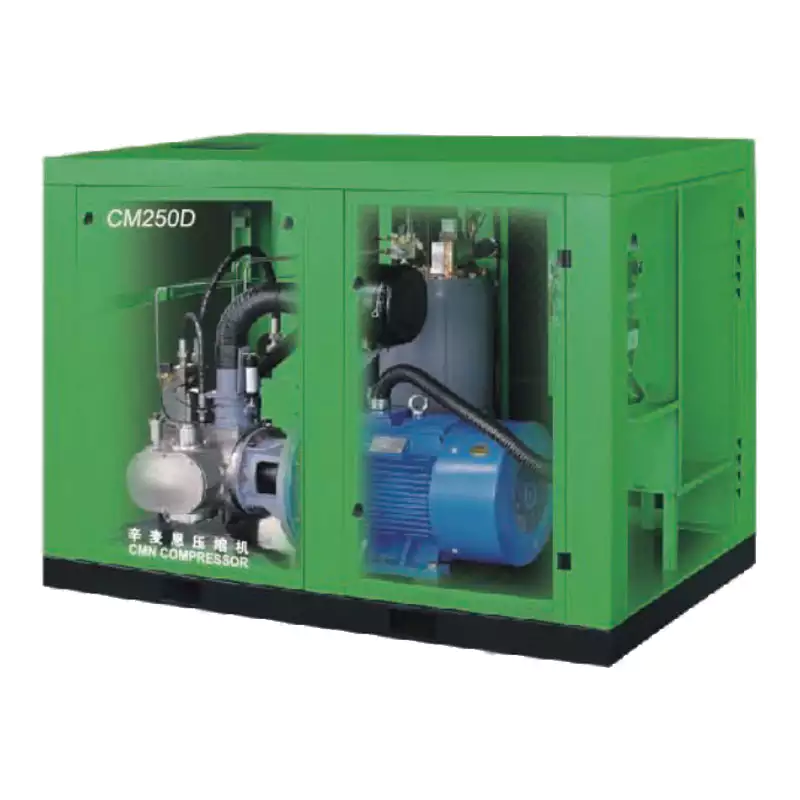
CM132DV Water-Lubricated Oil-Free Screw Compressor
Pharmaceutical-preferred water-lubricated design. Zero oil contamination pathway. ISO 8573-1 Class 0 certified. Discharge temperature below 50°C. Variable speed drive for energy efficiency under variable batch demand. Full IQ/OQ/PQ documentation package available. Annual requalification service contract available from our Charlton Industrial Area service base.
Frequently Asked Questions
Build a GMP-Ready Pharmaceutical Compressed Air System
Australia Oil Free Air Compressor Co., Ltd. supplies ISO 8573-1 Class 0 certified compressors and complete IQ/OQ/PQ qualification packages to TGA-licensed pharmaceutical manufacturers across Australia.
Request a Pharma Air Consultation
Email: [email protected]
| Contact Us
| About Us