
Why Every Oil-Free Compressor Needs a Dryer
A widespread misconception is that an oil-free air compressor produces dry air. It does not. Oil-free refers exclusively to the absence of lubricating oil contamination — it says nothing about moisture content. Atmospheric air contains water vapour, and when that air is compressed, the water vapour concentration increases proportionally with the pressure ratio. When compressed air cools in distribution pipework, this concentrated moisture condenses into liquid water — entering tools, valves, instruments, and processes.
The consequences of moisture in compressed air are well-documented. Liquid water causes corrosion in carbon steel pipework, accelerates wear in pneumatic tool cylinders, causes paint fish-eye defects in spray finishing, triggers microbiological growth in food and pharmaceutical process air, and can freeze in outdoor or cold-climate distribution systems — blocking lines and cracking fittings. None of these failure modes are related to oil contamination. They occur regardless of whether the compressor is oil-free or oil-injected.
The metric that characterises moisture removal is dew point — the temperature at which water vapour in the compressed air begins to condense. A dew point of +3°C (typical of a refrigerated dryer) means the air will not form liquid water above 3°C. A dew point of −40°C (from a desiccant dryer) means the air is extremely dry — suitable for outdoor use in sub-zero environments or for moisture-sensitive instruments. Matching dew point to application requirement is the primary dryer selection criterion.
The Three Dryer Technologies Used with Oil-Free Compressors
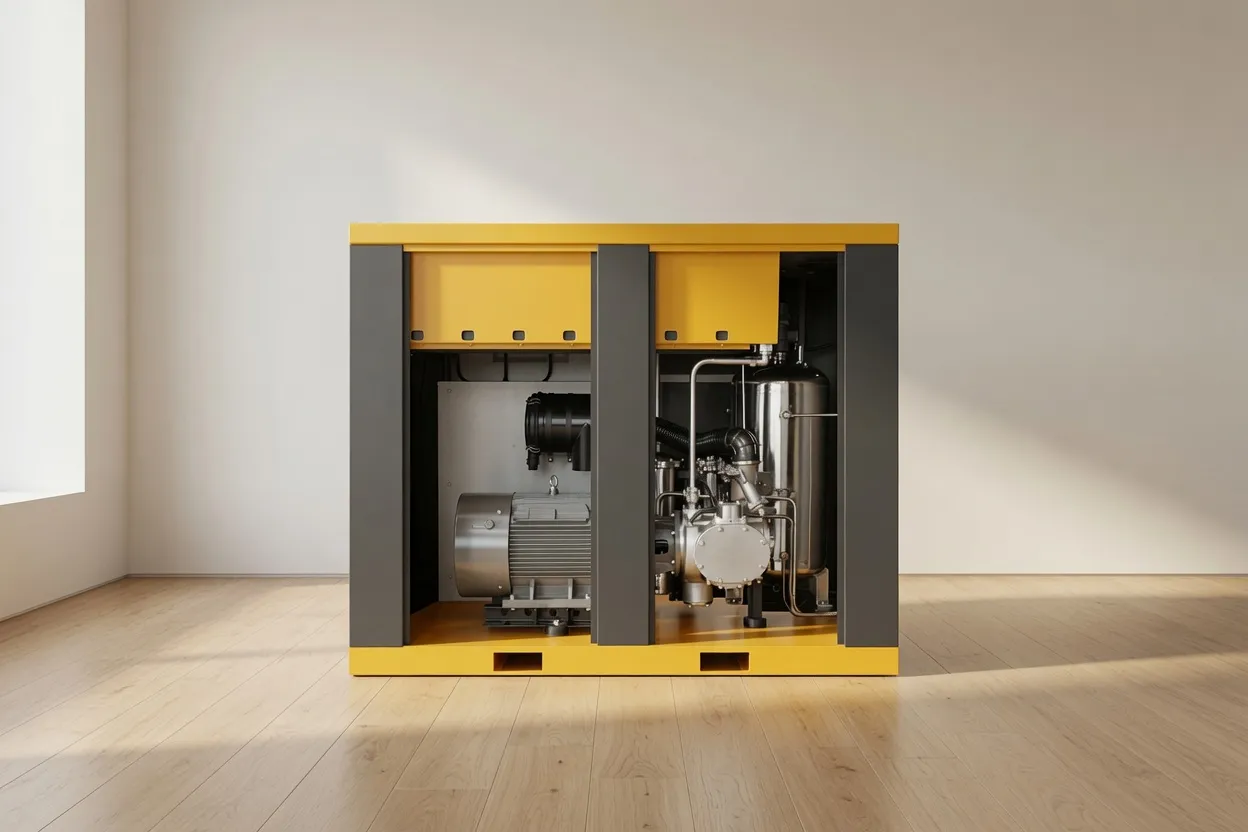
Integrated vs Standalone Dryer: Which Is Right for Your System?
Many manufacturers offer oil-free compressors with a dryer factory-fitted within the same enclosure — sometimes called an “all-in-one” or integrated compressed air system. Understanding the genuine advantages and limitations of this configuration helps determine whether it suits your specific application.
- → Single skid footprint — saves floor space in small compressor rooms
- → Pre-engineered system — dryer is correctly sized and matched to compressor output
- → Single electrical connection — simplified installation
- → Coordinated controls — dryer alarm integrates with compressor alarm output
- → Faster installation — reduced site connection work
- → Single service contact — compressor and dryer serviced by same technician
- → Lower capital for small systems — often cheaper than separate units below 50 CFM
- → No redundancy — dryer failure takes down the entire compressed air supply
- → Thermal interference — compressor heat affects refrigerated dryer performance in hot rooms
- → Dryer upgrade difficulty — changing dryer type later requires replacing the whole unit
- → Limited dryer sizing flexibility — integrated dryer sized for compressor, not future expansion
- → Higher ambient temperature sensitivity — combined unit needs better room ventilation
- → More expensive to repair — dryer failure often requires complete unit transport
Choose integrated when:
- System is below 50 CFM and space is limited
- Application does not require desiccant drying
- Single-shift intermittent use (redundancy not critical)
- Budget-constrained new installation
Choose standalone dryer when:
- System above 50 CFM where dryer failure impacts production
- Desiccant or HOC drying is required
- 24/7 production where supply continuity is critical
- Future expansion of compressor or dryer capacity is planned
Required Dew Point by Application and ISO 8573 Class
Specifying the wrong dryer type for your application — usually under-specifying — is the most common moisture management failure in compressed air systems. This table maps application requirements to the appropriate ISO 8573-1 water class and the dryer technology needed to achieve it:
| Application | Required Dew Point | ISO 8573 Water Class | Dryer Type Required |
|---|---|---|---|
| General workshop tools (indoor) | +7°C or better | Class 4–5 | Refrigerated |
| Spray painting, powder coating | +3°C or better | Class 3–4 | Refrigerated (cycling) |
| Food indirect contact (packaging) | +3°C or better | Class 3 | Refrigerated |
| Food direct contact, beverages | −26°C or better | Class 1 | Desiccant or HOC |
| Medical instrument air | −26°C or better | Class 1 | Desiccant |
| Pharmaceutical (GMP) | −40°C or better | Class 1 | Desiccant (heated) or HOC |
| Electronics / semiconductor | −40°C to −70°C | Class 1 | Desiccant (heated purge) |
| Outdoor piping (cold climate) | Below lowest ambient temp | Class 1–2 | Desiccant |
| Laser cutting assist gas | −26°C or better | Class 1–2 | Refrigerated + desiccant (combo) |
Note the laser cutting entry: a refrigerated pre-dryer followed by a desiccant polisher is a common configuration that balances energy efficiency (the refrigerated stage removes most moisture at low energy cost) with the dew point depth achieved by the desiccant stage (without the 10–15% purge penalty of a full-flow heatless unit).
Compressed Air Quality: Oil-Free + Dryer = Complete Compliance
The ISO 8573 standard classifies compressed air quality across three independent dimensions: solid particles, water content, and total oil. An oil-free compressor addresses only the oil dimension. A dryer addresses only the water dimension. Particle content is managed by filtration upstream and downstream of the dryer. True compressed air quality compliance — particularly to ISO 8573-1 Class 0 or Class 1 — requires all three elements to be correctly specified and maintained.
For contamination-free compressed air to Class 0 or Class 1 (the standard for medical, pharmaceutical, and food direct contact), all three elements must be in place and maintained. An oil-free compressor with an incorrectly sized dryer — or a dryer with clogged elements — fails the water class even while meeting the oil class requirement. Annual verification of achieved dew point (using a calibrated dew point sensor, not just trusting that the dryer is operational) is essential for any certified application.
5 Dryer Selection & Installation Mistakes That Cause Moisture Problems
Dryers are rated at specific inlet conditions (temperature, pressure, flow). Overshooting any of these — particularly inlet air temperature above 35°C or flow above rated CFM — causes the dryer to achieve a worse dew point than its specification. A 100 CFM dryer fed 120 CFM of compressed air at 42°C inlet will not achieve +3°C dew point — it may deliver +12°C or worse. Always size the dryer for your maximum flow and highest expected inlet temperature, not the nominal compressor output at 20°C ambient.
Refrigerated dryers rely on a heat exchanger to cool compressed air. Oil aerosol or water droplets entering without pre-filtration coat heat exchanger surfaces, progressively degrading thermal performance. A coalescing pre-filter rated for ≤1 µm and 0.1 mg/m³ oil removal is mandatory upstream of any refrigerated dryer. Without it, the dryer’s performance drops measurably within 6–12 months and is essentially invisible until a failure event occurs.
A refrigerated dryer achieving +3°C dew point delivers air that will condense moisture in any distribution pipework exposed to temperatures below 3°C. For any outdoor piping, underground runs, or equipment in cold-store environments, a desiccant dryer achieving −20°C or better is required. Australian facilities in alpine regions (Snowy Mountains, high-country Victoria) and cold-store operations regularly make this error with expensive consequences for pipework corrosion and valve freeze-up.
Desiccant beds have a finite service life — typically 3–5 years depending on inlet air quality, regeneration cycle frequency, and whether the desiccant has been contaminated by oil (which permanently deactivates molecular sieve beds). Operators frequently defer desiccant replacement beyond the recommended interval because the dryer “appears to be working.” Desiccant degradation is gradual — dew point worsens slowly, often unnoticed until a moisture-related process failure makes it visible.
Every dryer — refrigerated or desiccant — produces condensate that must be drained. Automatic drain valves fail silently: a stuck-open valve wastes compressed air continuously; a stuck-closed valve allows condensate to build up and be carried downstream as liquid water slugs. Annual drain valve inspection and functional test (verify condensate actually discharges when triggered) is the single highest-impact dryer maintenance task for moisture control.
Complete Dry Air System Design from Australia Oil Free Air Compressor
At Australia Oil Free Air Compressor Co., Ltd., every proposal for an oil free compressor above 15 CFM includes a dryer specification — not an optional add-on, but a standard part of the system design. Our team specifies the dryer technology, inlet conditions correction factor, filter train, and drain arrangement based on your application’s required dew point and ISO 8573 class.
We supply integrated compressor-dryer packages for small-format installations, and standalone dryer systems from all three technology types for larger or more demanding applications. Our service technicians maintain both components on the same schedule — eliminating the common situation where compressor and dryer are maintained by different contractors with no coordinated system view.
Contact us at [email protected] to specify the right dryer system for your application and compressed air quality requirement.
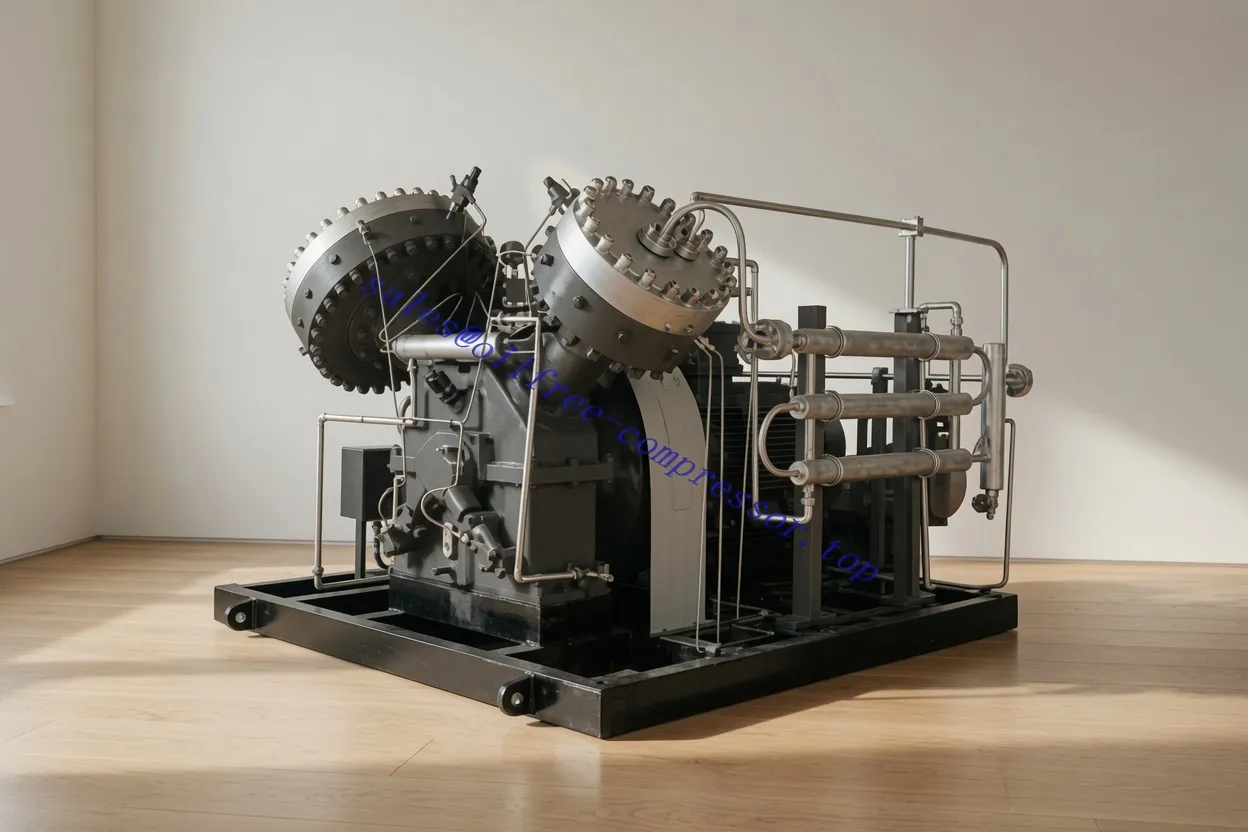
CM132DV — Low-Pressure Oil-Free Screw Compressor (Water Lubrication) with Dryer Integration
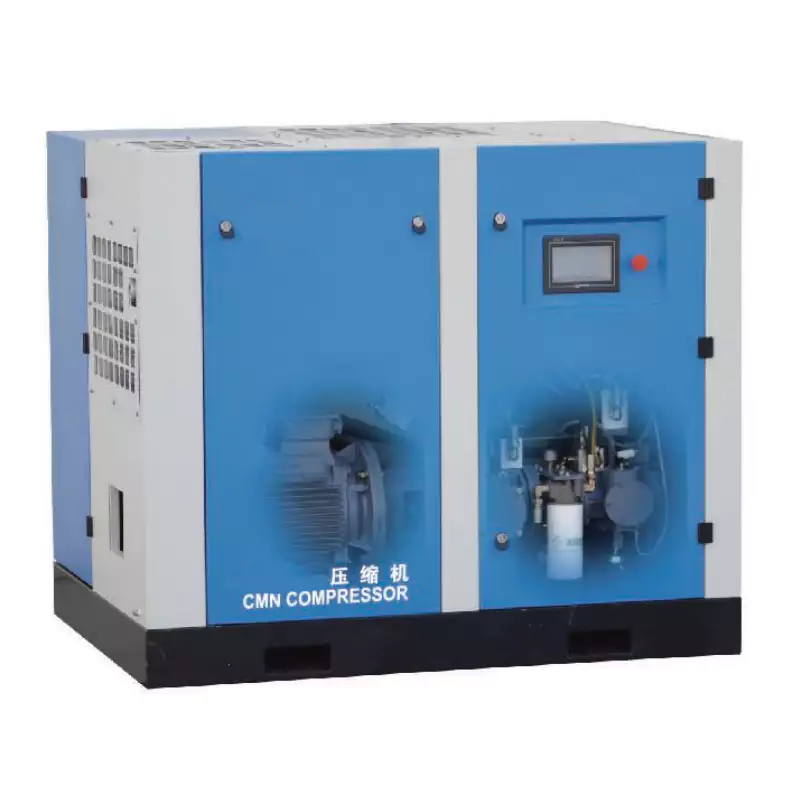
The CM132DV water-lubricated oil-free screw compressor is particularly well-suited for HOC (heat of compression) desiccant dryer integration. Its high discharge temperature — a consequence of near-isothermal compression rather than excessive thermal stress — provides the thermal driving force for HOC regeneration, allowing a −40°C dew point system to be achieved with zero additional energy input for the drying stage. For pharmaceutical, food direct-contact, and medical applications requiring both ISO Class 0 oil-free air and Class 1 dew point at the lowest possible lifecycle energy cost, the CM132DV combined with a factory-matched HOC dryer represents the most energy-efficient configuration in our range.
Frequently Asked Questions
Australia Oil Free Air Compressor Co., Ltd.
Charlton Industrial Area, Australia | [email protected]