
When a dental practice, laboratory, small medical facility, or light industrial workshop needs oil-free compressed air in the sub-15 kW range, two technologies dominate the market: the oil-free reciprocating (piston) compressor and the oil-free scroll compressor. Both deliver Class 0-quality air without lubricant contamination. Both operate without oil in the compression chamber. Yet they differ substantially in how they compress air, how quietly they operate, how long they last, what they cost, and which applications they serve best. Choosing the wrong technology for your application means overpaying for unnecessary capabilities, tolerating noise levels incompatible with your environment, or facing maintenance demands your team is not equipped to handle. This guide resolves those choices with a systematic, data-driven comparison of oil-free piston and scroll compressor technologies — giving engineers, facilities managers, and procurement teams the technical foundation to make an informed selection.
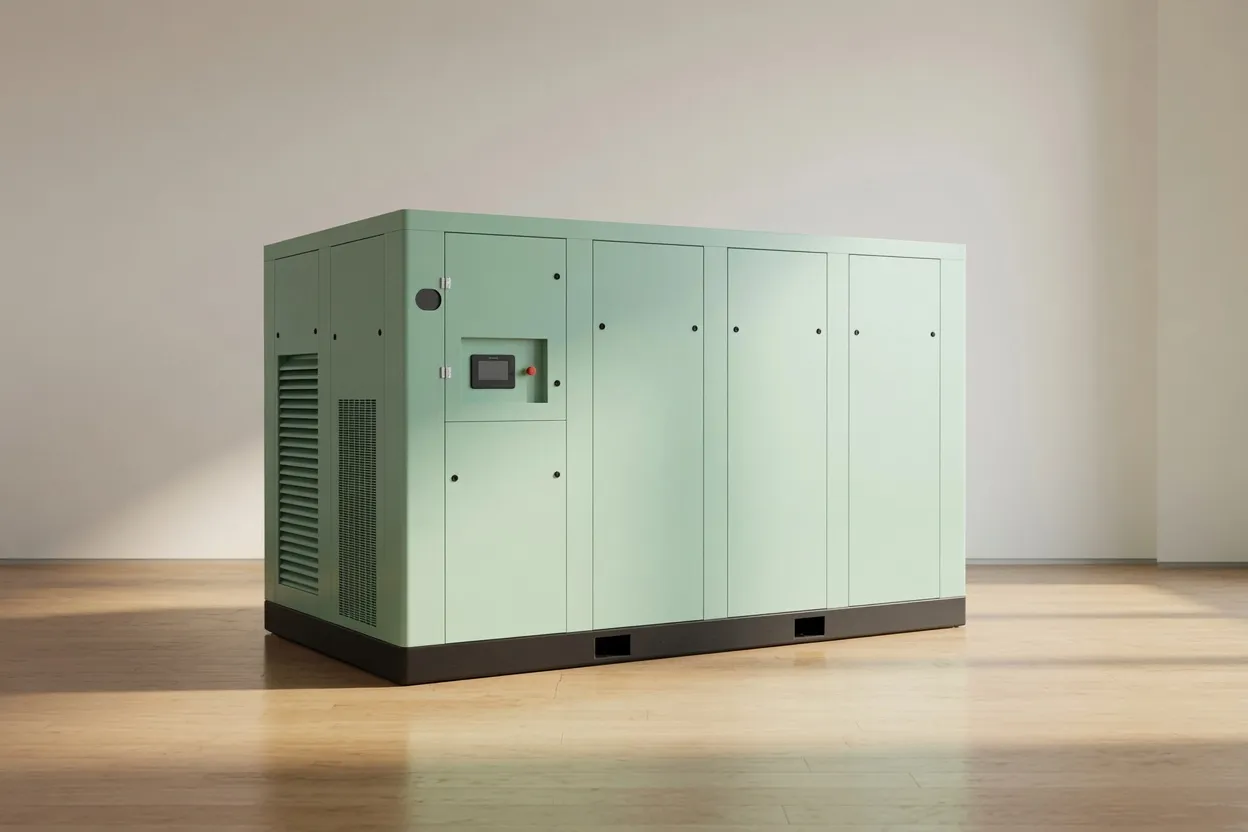
How Each Technology Works: Compression Principles
Oil-Free Piston (Reciprocating) Compressor
The oil-free reciprocating compressor operates on the same fundamental principle as its oil-lubricated counterpart — a motor-driven crankshaft converts rotary motion into the back-and-forth (reciprocating) movement of one or more pistons within cylinders. As the piston descends, it draws atmospheric air through an inlet valve into the cylinder. As it ascends, it compresses the trapped air against the closed inlet valve, forcing it through an outlet valve into the receiver at the delivery pressure. The critical difference from an oil-lubricated design is in how the piston seals against the cylinder wall: instead of an oil film, the piston uses PTFE (polytetrafluoroethylene) or composite dry-running rings that provide low-friction sealing without requiring lubrication. The connecting rod bearings and crankshaft are typically lubricated with oil that is physically isolated from the compression chamber by shaft seals — this is the “oil-free” design principle: no oil enters the compression pathway, even though oil exists in the crankcase.
Oil-free piston compressors are most commonly found in single-stage configurations (for pressures up to 0.8–1.0 MPa) and two-stage configurations (for pressures up to 1.2–1.6 MPa), with intercooling between stages. The intermittent compression cycle — compress, discharge, pause during inlet — means the motor loading is cyclical and the discharge air contains a characteristic pulsation that requires a receiver to smooth before distribution. Multi-cylinder designs (V-twin, W-type, or opposed configurations) reduce pulsation and improve balance but add mechanical complexity.
Oil-Free Scroll Compressor
The scroll compressor uses a fundamentally different compression mechanism. Two spiral-shaped scroll elements — one fixed, one orbiting — mesh together with a precise angular offset. The orbiting scroll is driven eccentrically by the motor (it orbits rather than rotates), drawing air pockets into the outer periphery of the scroll set and progressively compressing them toward the centre as the orbiting motion continues. Air exits at the central discharge port at the delivery pressure. Because the compression is a continuous orbital motion — not a pulsating reciprocating action — there are no inlet or outlet valves (the scroll geometry naturally opens and closes air passages), no connecting rod, no crankshaft throw, and no piston rings. The result is a mechanically elegant, low-vibration, extremely quiet compression process with inherently smooth, pulse-free discharge air.
In oil-free scroll designs, the scroll tip seals (the contact between the spiral tip and the opposite scroll’s face) are made from low-friction polymer materials — typically PTFE composites — that provide gas-tight sealing without oil. The motor-side shaft bearings may use grease lubrication that is physically isolated from the compression zone. This means that, like the oil-free piston, the “oil-free” designation refers specifically to the compression pathway — no oil enters the air stream — while mechanical bearings elsewhere in the machine use conventional lubrication kept separate from the airflow.
Head-to-Head: Key Parameters Compared
The following comparison covers every parameter that typically drives technology selection decisions for small oil-free compressor applications. Where performance differs between duty-cycle (intermittent) and continuous-duty variants of piston compressors, both are noted.
Noise: The Deciding Factor for Clinical and Laboratory Environments
In dental surgeries, medical consulting rooms, analytical laboratories, and veterinary clinics, the noise level of the compressor is often the single most important selection criterion — overriding purchase price, capacity, and even efficiency. The acoustic difference between piston and scroll technology is substantial and practically significant.
A standard oil-free piston compressor generates noise through three concurrent mechanisms: the mechanical impact of the piston reaching top dead centre and reversing direction; the rapid opening and closing of inlet and outlet valve reeds (a characteristic clicking-snapping sound); and the vibration of the compressor body, which is transmitted through the mounting surface into the building structure. Combined, these sources produce 62–85 dB(A) at one metre — broadly equivalent to a busy restaurant or a loud conversation. Even with an acoustic cabinet, typical noise-reduced piston compressors achieve 58–68 dB(A), which is still disruptive in a clinical or analytical environment.
An oil-free scroll compressor has no reciprocating masses, no valve reeds, and a well-balanced orbital mechanism. Its noise sources are primarily: the electric motor cooling fan; the low-level hiss of compressed air moving through the scroll set; and minor motor vibration. Resulting noise levels of 45–62 dB(A) — comparable to a quiet office — make scroll compressors uniquely suited to installation adjacent to patient areas, in open-plan laboratories, or in spaces where a piston compressor would require a separate plant room or acoustic enclosure. For dental chairs served from within the surgery suite itself, scroll compressors are the de facto standard worldwide precisely because of this acoustic advantage.
Where Piston Noise Is Acceptable
Dedicated plant rooms physically separate from occupied spaces; workshops and factories with existing ambient noise above 70 dB(A); outdoor or semi-outdoor installations; applications where the compressor runs only briefly during off-hours; portable workshop tools. In these contexts, the piston’s noise disadvantage is eliminated by environment.
Where Scroll’s Quiet Operation Is Essential
Dental surgeries (patient is conscious and seated beside the compressor); medical consulting rooms and day procedure rooms; analytical chemistry laboratories with open bench instruments; veterinary surgery suites; recording studios or broadcast environments; library or education settings; any space where a compressor running at 75 dB(A) would disrupt work or clinical care.
The Hidden Cost of Piston Noise in Clinical Settings
A dental practice that installs a piston compressor adjacent to a surgery suite may need to retrofit an acoustic enclosure (AUD 1,200–3,500) or relocate the compressor to a separate plant room (AUD 2,000–8,000 for room modification, new pipework, and electrical work). These remedial costs typically exceed the initial purchase price premium of choosing a scroll compressor from the outset.
Maintenance Requirements: A Practical Comparison
Both technologies require maintenance — but the frequency, complexity, and parts cost differ substantially. For facilities with limited technical maintenance capacity (dental practices, small clinics, laboratories), the simplicity and infrequency of scroll compressor maintenance is a practical advantage that extends well beyond the technical comparison.
Oil-Free Piston Compressor Maintenance Schedule
Oil-Free Scroll Compressor Maintenance Schedule
Annual maintenance cost comparison (at 4,000 hrs/yr): Oil-free piston typically costs AUD 1,400–3,200/year; oil-free scroll typically costs AUD 600–1,400/year. The scroll compressor’s lower maintenance frequency and higher tip seal longevity (versus piston ring replacement) make it 40–55% cheaper to maintain annually in continuous-duty applications.
Application Guide: Which Technology for Which Scenario
Dental Practice — 1 to 5 chairs
SCROLL — STRONGLY RECOMMENDED
Dental procedures run for 30–60 minutes with a conscious patient in the treatment chair, often 50–100 cm from the compressor. Noise above 60 dB(A) is clinically unacceptable. Scroll compressors running at 48–58 dB(A) are standard in dental surgeries globally. The AS/NZS 4492 oil-free requirement is met by both technologies, but scroll’s continuous duty cycle, quiet operation, and lower vibration make it the correct choice for 1–5 chair installations. For 4+ chair practices with higher air demand, a duplex scroll arrangement provides both capacity and N+1 redundancy.
Analytical Laboratory
SCROLL — RECOMMENDED
Analytical instruments (HPLC, GC, mass spectrometers) are sensitive to both air quality and vibration. Scroll compressors deliver hydrocarbon-free air with minimal pulsation — important for flow-sensitive instruments — at noise levels that do not disrupt analytical work or staff concentration. The absence of vibration transmission also protects sensitive balances and microbalances from positional drift. For LC-MS or ICP-MS applications requiring very dry air, a scroll compressor paired with a desiccant dryer delivers the −40°C PDP specification without additional complexity.
Small Medical / Allied Health Clinic
SCROLL — RECOMMENDED
Podiatry, cosmetic medicine, and minor procedure clinics using air-driven instruments require oil-free air at modest flow rates. The combination of quiet operation, 100% duty cycle capability, and low maintenance overhead makes scroll compressors ideal for single-room or multi-room installations where the compressor must operate throughout the treatment day without interruption. For AS 2896 compliance in medical gas applications, scroll compressors paired with appropriate treatment trains readily achieve the required air quality.
Workshop / Light Industrial (Intermittent Use)
PISTON — RECOMMENDED
For operations requiring oil-free air for intermittent pneumatic tools, spray painting of sensitive surfaces (electronics, automotive), or purging sensitive components — with usage patterns of 2–4 hours/day and no clinical noise constraints — an oil-free piston compressor offers the right balance of capital cost, adequate performance, and simplicity. The piston’s higher peak pressure capability (up to 1.6 MPa in two-stage designs) also makes it appropriate for applications requiring higher delivery pressure than a standard scroll can achieve. Choose a heavy-duty 100% duty cycle piston model if continuous operation is sometimes required.
Light Food Production / Small Pharma
SCROLL OR SCREW — CONSIDER CAPACITY
For demand above 15 kW and 24/7 production schedules, both piston and scroll reach their capacity limits and a water-lubricated oil-free screw compressor becomes the technically and economically superior choice. In the 7.5–15 kW range for light food or pharma applications, scroll compressors remain viable for continuous ISO 8573-1 Class 0 duty, but buyers should compare lifecycle costs carefully against entry-level screw models before committing.
When Neither Piston Nor Scroll Is the Right Answer
Both piston and scroll compressors are small-capacity technologies with defined upper limits. Applications that exceed these limits are best served by oil-free screw compressors — which offer superior energy efficiency, extended service intervals, and industrial-scale capacity that neither piston nor scroll can match.
Move to Oil-Free Screw Compressor Technology When:
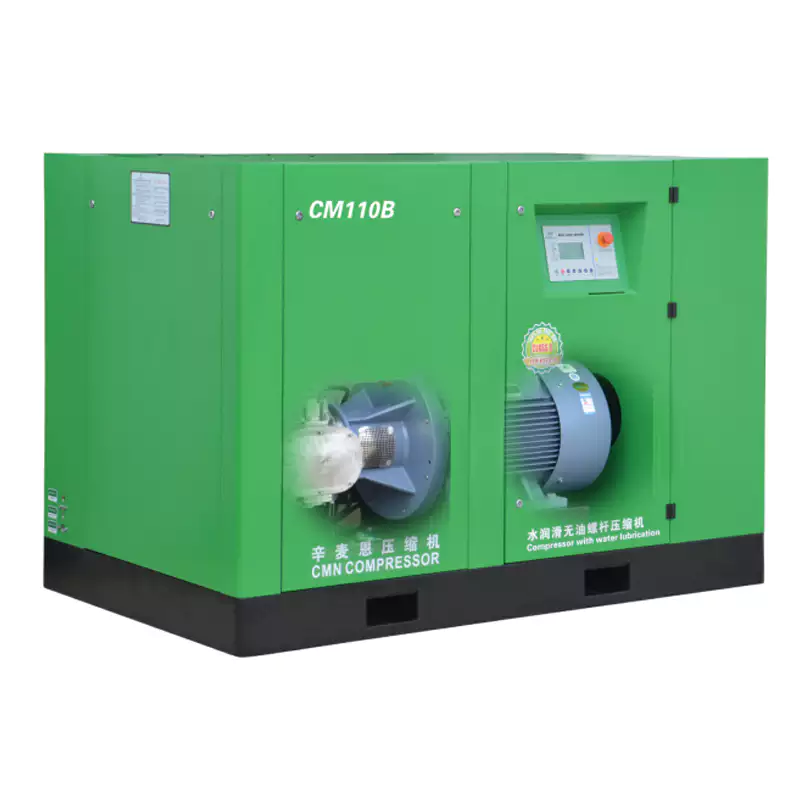
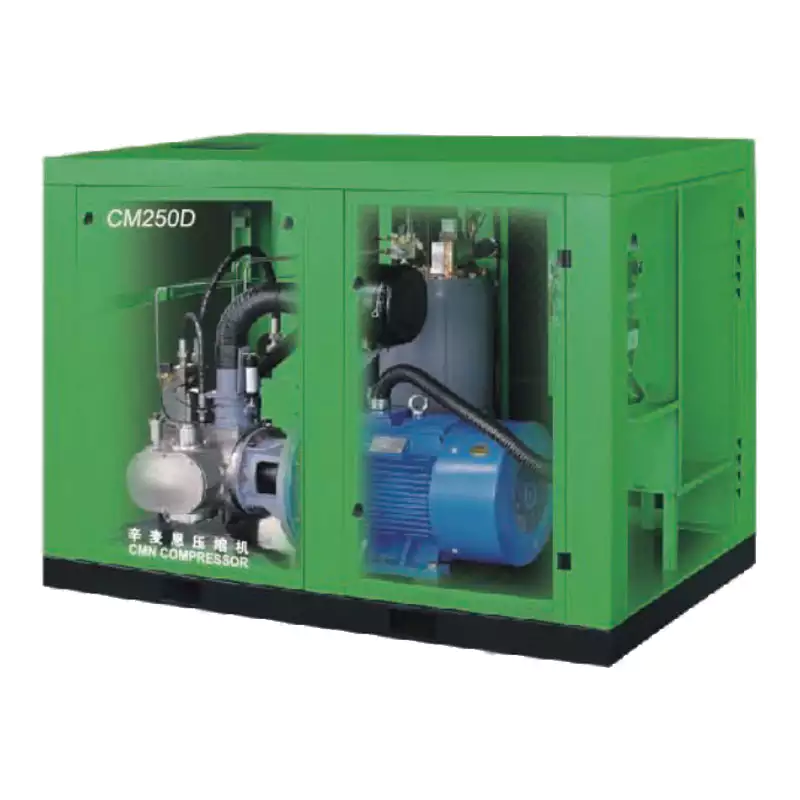
The CM45D and CM132DV water-lubricated oil-free screw compressors serve these higher-demand scenarios with ISO 8573-1 Class 0 certification and full documentation for regulated industry buyers.
CM45D Water-Lubricated Oil-Free Screw Compressor
When your facility’s demand grows beyond scroll or piston capacity — or when regulatory certification, 24/7 uptime, and VSD energy efficiency become requirements — the CM45D delivers ISO 8573-1 Class 0 certified air with industrial reliability. Zero oil contamination pathway, low discharge temperature, and service interval up to 7,000 hours. Full documentation package for pharmaceutical and food applications.
Frequently Asked Questions
Not Sure Which Technology Suits Your Application?
Australia Oil Free Air Compressor Co., Ltd. provides free application assessment and technology selection advice for dental, medical, laboratory, and industrial clients across Australia — matching the right oil-free technology to your specific operating environment, demand profile, and compliance requirements.
Get a Free Technology Recommendation
Email: [email protected] | Contact Us | About Us