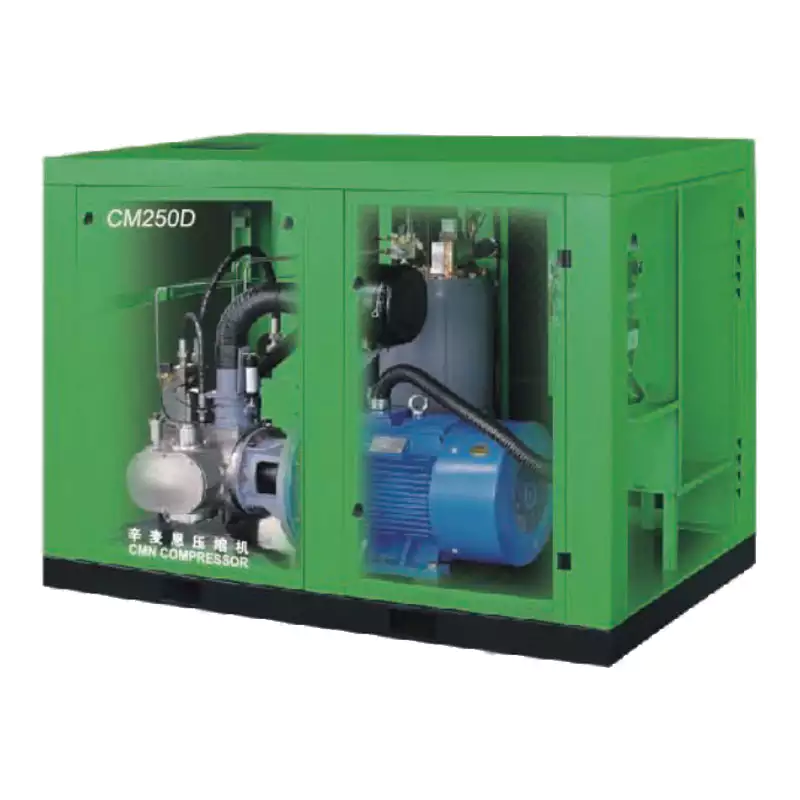
The Definitive Cost Comparison
The complete, data-driven cost comparison that goes beyond purchase price — covering energy, maintenance, compliance, downtime, environmental liability, and residual value to reveal the true 10-year financial winner in Australian industrial and regulated industry contexts.
The conversation about oil-free versus oil-lubricated air compressors is almost always framed around the wrong number. Purchase price dominates the discussion — and oil-lubricated compressors consistently win on purchase price by 20–40% at equivalent capacity. But purchase price represents 8–12% of a compressor’s total cost across its operating life. The remaining 88–92% accumulates through energy costs, maintenance, unplanned repairs, compliance obligations, environmental liability, and production downtime — and across every one of these categories except capital cost, oil-free compressors deliver equal or lower lifetime costs when applied to the right applications. This article provides the definitive, evidence-based 10-year cost comparison between oil-free and oil-lubricated compressed air in the Australian context — with real numbers, genuine trade-offs honestly acknowledged, and clear conclusions about which technology wins in which scenarios. No marketing spin. Just the data.
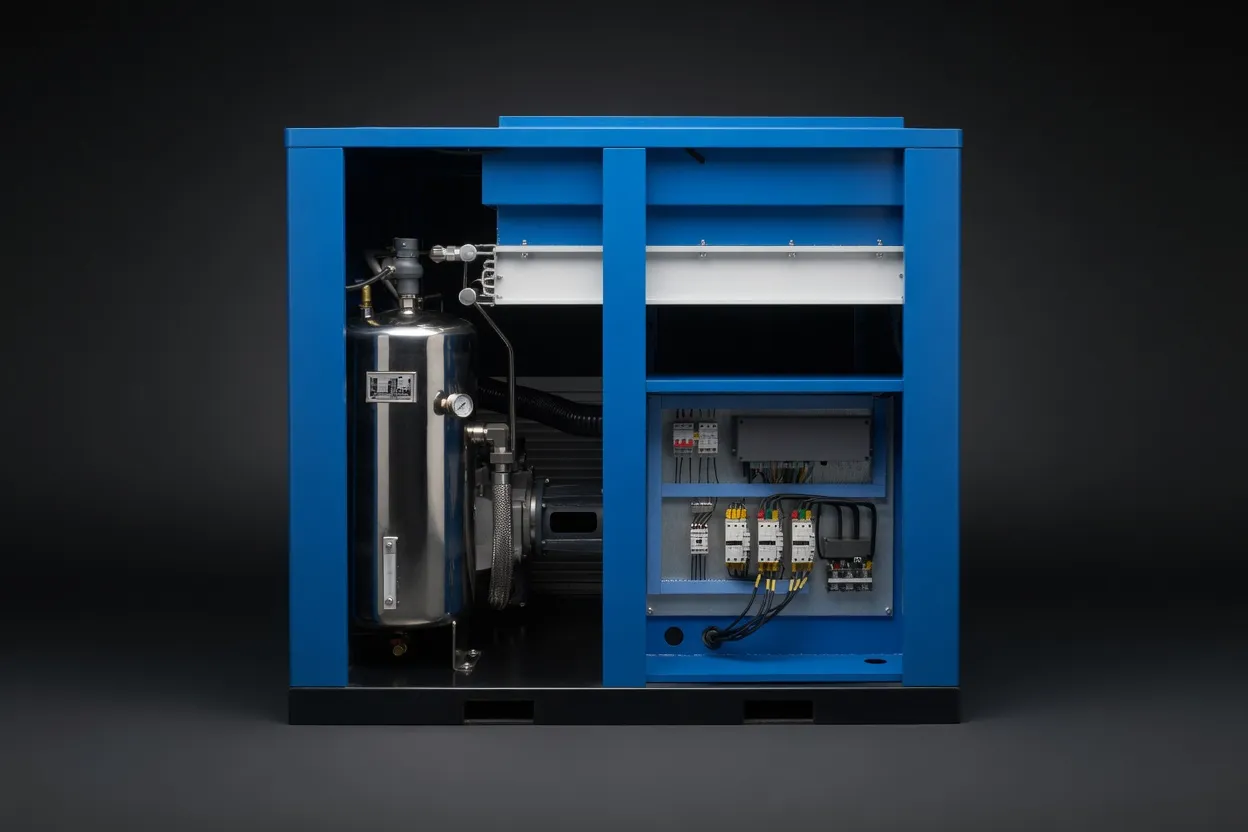
The true cost comparison over 10 years reveals a fundamentally different financial picture from the quotation-stage purchase price comparison — energy, compliance, and downtime costs reshape the winner in most regulated industry scenarios.
Setting Up the Comparison: The Ground Rules
A meaningful cost comparison requires precisely defined scenarios. Comparing a 5 kW piston compressor to a 250 kW screw tells you nothing useful. The following parameters define each comparison scenario used in this article:
Motor power75 kW (equivalent rated capacity both machines)
Delivery pressure0.8 MPa (8 bar / 116 PSI)
Operating hours6,000 hrs/year (industrial continuous shift)
Average load factor65% (typical variable-demand production)
Electricity rate$0.19/kWh (Victorian industrial mid-rate)
Analysis period10 years
Oil-free variantVSD water-lubricated screw (CM132DV class)
Oil-lubricated variantFixed-speed rotary screw (standard industrial)
Where Oil-Lubricated Genuinely Wins
A credible comparison acknowledges where the competition is genuinely stronger. Oil-lubricated compressed air compressors hold real advantages in specific areas — denying them weakens the overall analysis.
Purchase Price — Genuine Advantage
An oil-lubricated screw compressor costs AUD 38,000–50,000 for a 75 kW industrial unit. An equivalent oil-free VSD water-lubricated machine costs AUD 55,000–75,000. The AUD 17,000–25,000 capital premium for oil-free is real and non-trivial. For facilities with tight capital budgets, this difference matters at procurement time — even if it is recovered through operating savings within 12–30 months.
OIL-LUBRICATED WINS: AUD 17,000–25,000 capital cost advantage
Availability of Spare Parts
Oil-lubricated screw compressors have a larger global installed base and consequently broader spare parts availability, more competing aftermarket suppliers, and lower parts prices for commodity wear items like oil filters and oil separator elements. This advantage is modest for planned maintenance but meaningful for emergency repairs where parts lead time matters.
OIL-LUBRICATED WINS: Broader parts ecosystem, lower parts prices
Non-Regulated General Industrial — Equal or Marginal
For a workshop, construction site, or general manufacturing facility with no regulatory requirement for oil-free air, where air quality is a secondary concern and downtime costs are low, the capital cost advantage of oil-lubricated may not be fully offset by running cost savings within a 10-year period. In these applications, both technologies are economically viable and the choice can be made on capital cost grounds.
NEUTRAL: General industrial non-regulated applications
Where Oil-Free Wins — and By How Much
Energy Cost — VSD Oil-Free Wins by AUD 144,400 Over 10 Years
This is the single largest financial advantage of oil-free technology and the number that most consistently surprises procurement teams focused on purchase price. The advantage comes from two independent sources:
VSD vs. Fixed-Speed: AUD 91,200 saving
At 65% average load, a VSD compressor consumes approximately 65% of rated power. A fixed-speed machine consumes approximately 75–80% (full load × 65% + unloaded power × 35%). The VSD eliminates unloaded running losses — saving approximately 48,000 kWh/year at $0.19/kWh = $9,120/year × 10 = AUD 91,200.
Specific Power Advantage: AUD 53,200 saving
Water-lubricated oil-free screw compressors achieve specific power of 5.5–6.2 kW/m³/min; oil-lubricated fixed-speed screw machines typically achieve 7.0–8.0 kW/m³/min at 0.8 MPa. The 15–20% specific power improvement of oil-free reduces base energy consumption independently of VSD, saving approximately 28,000 kWh/year = $5,320/year × 10 = AUD 53,200.
Maintenance — Oil-Free Wins by AUD 24,000 Over 10 Years
The elimination of lube oil changes (3× per year at AUD 280–480 each), oil separator element replacement (annual at AUD 320–600), oil analysis programme (annual at AUD 200–400), and controlled waste oil disposal levy (AUD 80–200 per change event × 3/year) saves AUD 2,400/year in maintenance costs. Over 10 years: AUD 24,000. Water-lubricated designs add water circuit maintenance (pH monitoring, water filter: approximately AUD 400/year) — net saving remains approximately AUD 2,000/year.
Compliance — Oil-Lubricated Is Not Available, Not Comparable
For pharmaceutical, food, dental, and medical applications, the oil-lubricated compressor is simply not an eligible option. ISO 8573-1 Class 0 — required by TGA GMP, BRCGS, SQF, AS 2896, and AS/NZS 4492 — cannot be independently certified for an oil-lubricated machine. The compliance cost comparison in these applications is not “oil-free costs AUD 15,000/year for validation; oil-lubricated costs less” — it is “oil-free can operate in this facility; oil-lubricated cannot.” The compliance cost of oil-free is a cost of doing business in the regulated sector. There is no oil-lubricated alternative that achieves the same regulatory standing.
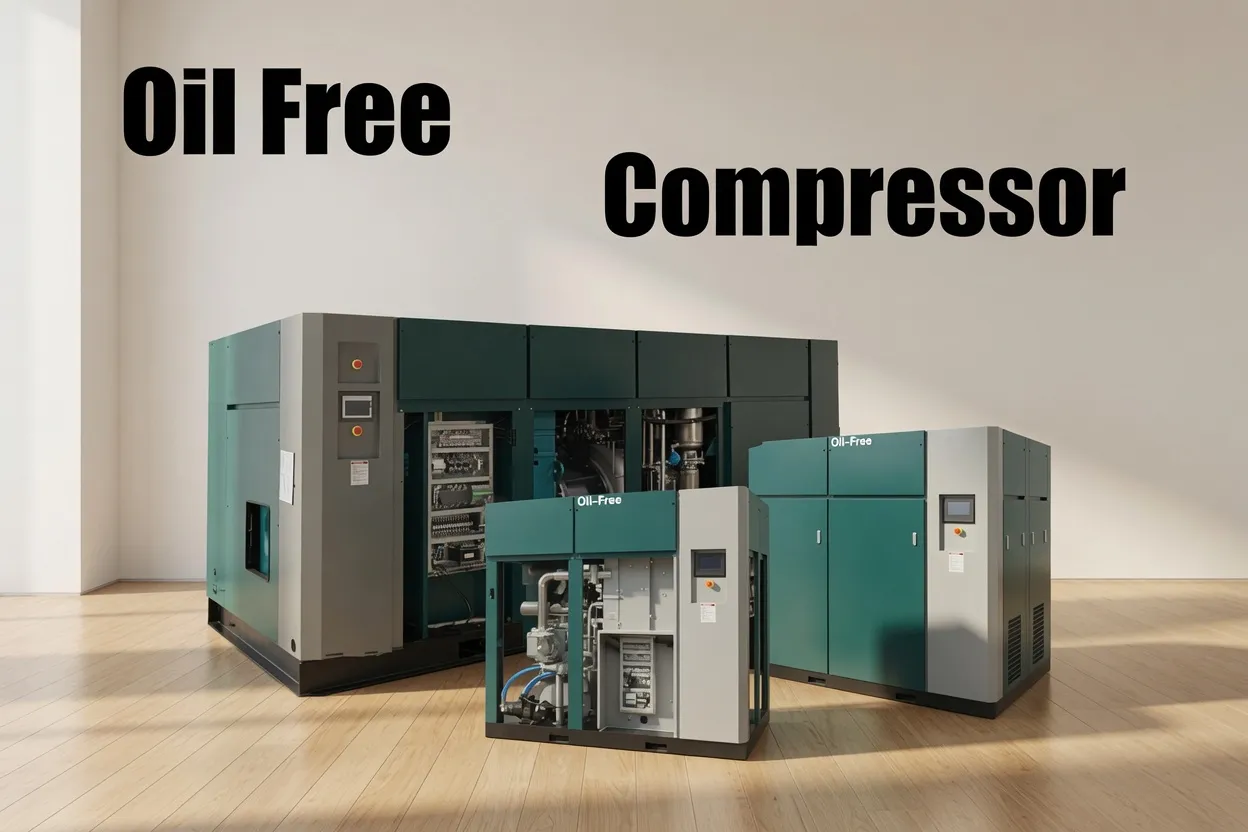
In pharmaceutical and food manufacturing, the choice is not oil-free vs. oil-lubricated — it is oil-free or non-compliance. ISO 8573-1 Class 0 is a regulatory prerequisite, not a premium specification.
Downtime — Oil-Free Wins by AUD 44,000+ Over 10 Years in Regulated Industries
Oil-free screw compressors — particularly water-lubricated designs with 7,000-hour service intervals and VSD operation — experience lower unplanned failure rates than oil-lubricated machines in continuous duty applications. The absence of oil contamination-related failures (separator element bypass, lube oil breakdown at elevated temperatures, oil filter blockage) removes a significant category of unplanned fault modes. In regulated industries where each downtime event triggers a compliance investigation, the cost per event is dramatically higher for oil-lubricated machines — even if their unplanned failure frequency were equal, their downtime cost per event would be higher because oil contamination events require contamination investigation and batch impact assessment before production can resume.
Environmental Liability — An Often-Ignored Cost
Oil-lubricated compressors generate regulated waste streams: lube oil (classified as hazardous waste in all Australian states), oil separator element (oil-contaminated filter media), and oil/water condensate (from the condensate drain — requires processing through an oil/water separator before discharge). The compliance and disposal costs for these streams are modest individually but are a recurring obligation. Beyond direct cost, a condensate oil/water separator failure resulting in oily condensate discharge to stormwater creates a contamination liability under state environmental protection legislation — with remediation costs and regulatory penalty exposures that dwarf the cost of the separator itself. Oil-free compressors generate no oil-contaminated waste streams and have no condensate oil/water separator to maintain or fail.
Application-Specific Verdicts: When Each Technology Wins
💊🥗🏥
Pharmaceutical / Food / Medical
OIL-FREE WINS DECISIVELY
Oil-lubricated is not an eligible technology in these applications. ISO 8573-1 Class 0 is non-negotiable under TGA GMP, BRCGS, AS 2896, and related regulatory frameworks. For these applications, the comparison is not financial — it is existential. An oil-lubricated compressor cannot legally supply product contact compressed air in a TGA-licensed pharmaceutical manufacturing facility, a BRCGS-certified food production line, or a hospital medical gas system. The 10-year TCO comparison is therefore: oil-free at AUD 738,600 versus oil-lubricated at infinite cost (non-compliant operations result in manufacturing licence suspension or certification revocation).
🔬🖥️
Analytical Lab / Precision Electronics
OIL-FREE WINS STRONGLY
While no specific legislation mandates oil-free in laboratory environments, oil contamination of analytical instruments causes column degradation (HPLC columns: AUD 800–2,500 each), detector contamination (GC/MS detectors: AUD 3,000–15,000 to clean or replace), and instrument warranty voidance. The practical cost of oil contamination through a laboratory instrument supply system over 10 years — even at very low contamination levels — consistently exceeds the total TCO premium of oil-free technology. Additionally, many laboratory accreditation requirements (ISO 17025, NATA) specify oil-free compressed air for instrument supply.
⚡🔩
Laser Cutting / High-Pressure Process
OIL-FREE WINS — TCO AND QUALITY
Oil contamination in laser cutting air degrades cut quality — oil aerosol on the cut surface causes surface discolouration (cosmetic rejection), lens fogging in the cutting head (expensive replacement: AUD 500–2,500 per lens), and nozzle fouling that disrupts the cutting assist gas flow. An oil-free laser cutting compressor eliminates these quality and maintenance costs. The 1.6 MPa oil-free model and 3.0 MPa two-stage oil-free are purpose-designed for this application.
🔧🏗️
General Industrial (Non-Regulated)
CONTEXT DEPENDENT
For workshop pneumatic tools, construction equipment, general pneumatics with no air quality compliance obligation, and applications where downtime costs are low — the oil-lubricated compressor may remain the financially rational choice based on capital cost. The VSD oil-free premium is recovered through energy savings in approximately 18–30 months in continuous production environments. In intermittent or low-hour applications (below 3,000 hours/year), the energy saving does not accumulate fast enough to overcome the purchase price difference within a 10-year horizon, and oil-lubricated represents the lower 10-year TCO.
The Master 10-Year Cost Comparison Table
The following table presents the complete head-to-head cost comparison using our standard scenario parameters (75 kW, Victoria, 6,000 hrs/yr, 65% average load, food manufacturing application). All AUD figures are expressed at today’s prices without inflation adjustment.
| Cost Category |
VSD Oil-Free Screw
(CM132DV class) |
Fixed-Speed Oil-Lubricated
(Standard industrial) |
Difference (Oil-Free) |
| Capital cost (compressor + install) |
AUD 75,000 |
AUD 55,000 |
−20,000 ↑OL wins |
| 10-yr energy cost |
AUD 558,600 |
AUD 703,000 |
+144,400 ↑OF wins |
| 10-yr planned maintenance |
AUD 48,000 |
AUD 72,000 |
+24,000 ↑OF wins |
| 10-yr unplanned repairs |
AUD 18,000 |
AUD 30,000 |
+12,000 ↑OF wins |
| 10-yr downtime (2 events/yr × AUD 6,000/event) |
AUD 60,000 |
AUD 120,000 |
+60,000 ↑OF wins |
| 10-yr compliance / validation |
AUD 15,000 |
N/A — ineligible* |
— |
| 10-yr environmental disposal |
AUD 0 |
AUD 6,000–15,000 |
+6,000–15,000 ↑OF wins |
| Residual value at 10 years |
AUD −12,000 (credit) |
AUD −6,000 (credit) |
+6,000 ↑OF wins |
| 10-YEAR TOTAL TCO |
AUD 762,600 |
AUD 980,000+ |
AUD 217,400 SAVED |
* Oil-lubricated compressor cannot be legally operated for direct food product contact under BRCGS, SQF, or FSANZ requirements — compliance cost for oil-lubricated in food manufacturing is infinite (non-compliance or cease manufacturing). Comparison uses general industrial downtime rate; regulated industry downtime costs are 5–20× higher.
Decision Framework: When to Switch and When to Stay
✅
Switch to Oil-Free When:
- Any regulatory compliance requirement applies (TGA, BRCGS, SQF, AS 2896, AS/NZS 4492)
- Operating hours exceed 4,000 per year
- Compressed air contacts food, pharmaceuticals, or patients
- Current machine is approaching end of service life (30,000+ hours)
- Energy cost reduction is a facility priority
- Oil contamination events have previously caused quality issues or customer complaints
- Sustainability reporting requires measurable carbon footprint reduction
⚖️
Stay Oil-Lubricated When:
- Application has no air quality compliance requirement
- Annual operating hours are below 3,000
- Capital budget is tightly constrained and payback period must be under 18 months
- Current machine has less than 20,000 hours and no performance degradation
- Application is general industrial with low downtime cost (e.g., workshop tools)
- Compressed air never contacts product, food, patients, or sensitive surfaces
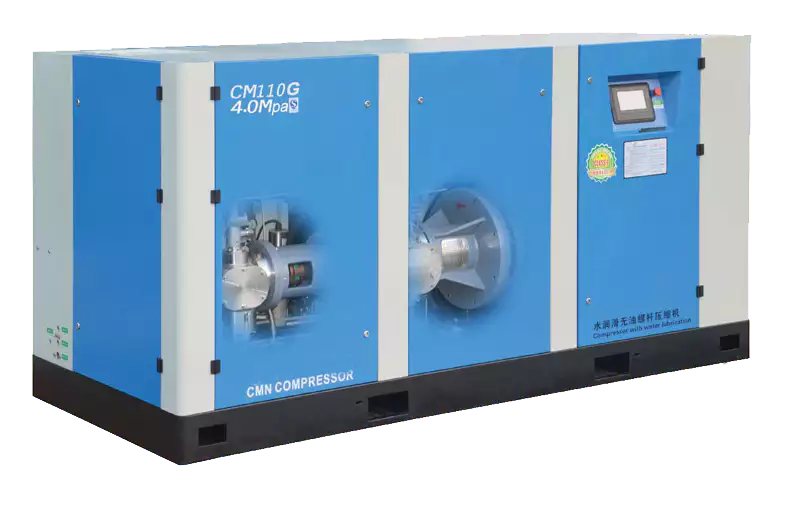
CM110G oil-free compressor — designed for continuous production environments where regulatory compliance, energy efficiency, and long service intervals create the maximum financial and quality advantage over oil-lubricated alternatives.
The 10-Year TCO Winner
CM132DV VSD Water-Lubricated Oil-Free Compressor
Over any 10-year period in regulated industry applications — pharmaceutical, food, medical, dental — the CM132DV’s combination of VSD energy efficiency, zero-oil-pathway water lubrication, 7,000-hour service intervals, ISO 8573-1 Class 0 certification, and IQ/OQ/PQ documentation capability delivers a minimum AUD 150,000–250,000 lower total cost of ownership than an equivalent oil-lubricated fixed-speed machine. The $20,000 capital premium is recovered in 12–18 months from energy savings alone.
View CM132DV & Request Comparison →
Frequently Asked Questions
At what operating hours does oil-free become clearly cheaper than oil-lubricated over 10 years?
+
The crossover point where VSD oil-free accumulates sufficient energy and maintenance savings to offset the AUD 17,000–25,000 capital premium is approximately 3,000–4,500 operating hours per year, depending on the electricity rate and average load factor. At 3,000 hours/year: payback in approximately 36–48 months (within 10-year period). At 6,000 hours/year: payback in approximately 12–18 months. At 2,000 hours/year: the capital premium may not be recovered within 10 years from operating savings alone — though compliance savings and downtime risk reduction often tip the balance for regulated industry applications even at low operating hours. For facilities running below 3,000 hours/year with no compliance requirements, oil-lubricated may remain the financially rational choice.
Does the comparison change significantly if my electricity rate is higher or lower?
+
Yes — substantially. The energy component of TCO scales directly with electricity rate. At $0.23/kWh (NSW upper industrial), energy is 19% more expensive than our $0.19/kWh comparison basis, making the VSD oil-free energy saving approximately AUD 16,500/year instead of $13,850/year — recovering the capital premium in approximately 10 months instead of 15. At $0.13/kWh (WA lower industrial rate), the energy saving is approximately $7,800/year — payback in approximately 27 months. The direction of the conclusion does not change: oil-free VSD wins on energy cost at all Australian industrial electricity rates. The magnitude of the advantage and the payback period vary with rate. We recommend using your actual electricity rate (from your utility bill, not the published standard rate) when performing site-specific calculations.
Can a high-efficiency oil-lubricated compressor with advanced filtration be competitive?
+
A premium oil-lubricated screw compressor with high-efficiency coalescing filtration can close the maintenance cost gap and reduce — but not eliminate — the energy efficiency gap. However, it cannot close the compliance gap: no amount of filtration converts an oil-lubricated compressor into an ISO 8573-1 Class 0 certified system for regulated industry purposes. The compliance position of “we have very good filtration” is exactly the control strategy that TGA GMP, BRCGS, and SQF audit frameworks classify as inadequate — they require source elimination (oil-free compression) rather than contamination reduction (filtration) for product contact applications. For non-regulated general industrial applications where air quality compliance is not a factor, a premium oil-lubricated VSD screw compressor narrows the TCO gap substantially — but current specific power data still shows oil-free water-lubricated designs at 5–10% lower specific power than the best oil-lubricated designs at equivalent rated conditions.
Our facility currently uses oil-lubricated compressors in a food plant. What is the process for switching?
+
Switching from oil-lubricated to oil-free in a food manufacturing environment requires four steps: (1) System decontamination — before connecting a new oil-free compressor, the entire distribution pipework must be degreased and flushed to remove residual oil deposits from the previous system. This is critical for achieving and maintaining Class 0 air quality at the new system’s outlet points. (2) Pipework replacement — if any distribution pipework shows corrosion, scale, or oil fouling that cannot be cleaned, replacement is required. (3) New compressor installation and commissioning — including full air quality baseline testing (ISO 8573-1) on the new system before any production use. (4) BRCGS/SQF documentation update — the compressed air section of your food safety management system documentation must be updated to reflect the new oil-free source, annual validation protocol, and monitoring programme. Our team provides a switchover package that includes the decontamination specification, commissioning procedure, and updated BRCGS documentation templates.
How do carbon emissions factor into the oil-free vs. oil-lubricated comparison?
+
VSD oil-free compressors consume approximately 15–25% less electricity than equivalent fixed-speed oil-lubricated machines under typical variable-demand operating conditions. For a 75 kW compressor running 6,000 hours/year, this represents approximately 48,000–75,000 kWh/year of electricity savings. At the current Australian National Grid Emission Factor of approximately 0.67 kg CO₂-e per kWh (and declining as renewable penetration increases), this translates to approximately 32–50 tonnes CO₂-e per year avoided — approximately 320–500 tonnes over 10 years. For facilities with Scope 2 emissions reporting obligations under the NGER Act or voluntary ESG reporting commitments, this emissions reduction is a tangible sustainability metric that supports internal investment justification and external reporting, in addition to the direct energy cost saving.
See the Numbers for Your Specific Application
Every facility has different operating hours, electricity rates, and compliance obligations. Australia Oil Free Air Compressor Co., Ltd. provides free, site-specific oil-free vs. oil-lubricated cost comparisons — with real numbers for your application, not generic industry averages.
Request a Free Cost Comparison
Email: [email protected] | Contact Us | About Us