
The phrase oil-free air compressor appears frequently in industrial procurement specifications, regulatory compliance documents, and equipment tenders — but the term encompasses a surprisingly broad family of machines with distinct operating principles, performance envelopes, and maintenance profiles. This guide unpacks the full definition, traces the engineering rationale for keeping oil out of the compression chamber, maps the major technology types available today, and explains precisely how each design achieves clean air delivery. By the time you finish reading, you will have a working knowledge of oil-free compressed air technology that goes well beyond marketing descriptions.
Defining the Oil-Free Air Compressor
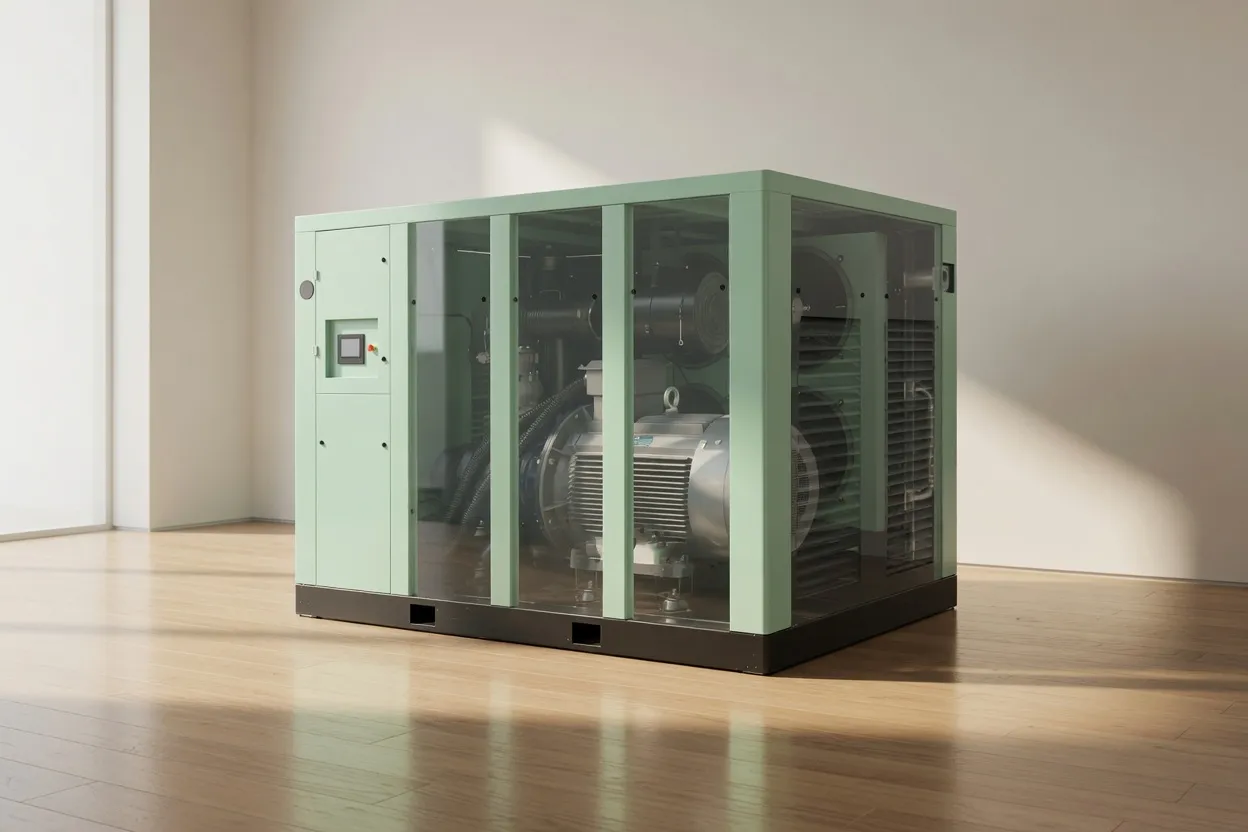
An oil-free air compressor is any machine that compresses atmospheric air to a higher pressure without the use of oil inside the compression chamber. This definition has a precise technical boundary: oil may still be present in bearing housings, gearboxes, or cooling circuits, but it is rigorously separated from the airflow path by mechanical seals, labyrinth barriers, or the complete absence of oil in the machine’s design. The result is compressed air that contains no hydrocarbon contamination originating from the compressor itself.
This distinction matters enormously at the point of use. Compressed air produced by an oil-free system carries zero risk of oil film deposition on food contact surfaces, pharmaceutical active ingredients, electronic components, or medical instruments. The international air quality standard ISO 8573-1 codifies this as Class 0 — the highest purity designation, specifying total oil content below 0.01 mg/m³ at the compressor outlet. Only oil-free designs can achieve this classification under independent third-party audit.
The ISO 8573-1 Class System at a Glance
How an Oil-Free Air Compressor Works
The compression process itself is governed by the same gas physics across all compressor types: a volume of gas is mechanically reduced, raising its pressure. The engineering challenge unique to oil-free designs is accomplishing this without lubrication inside the compression chamber — where temperatures can exceed 200°C during compression and rotor surfaces move at peripheral speeds above 30 m/s. Different technology types solve this challenge differently.
The Oil-Free Screw Compressor: Timing Gear Synchronisation
In an oil-free screw air compressor, two counter-rotating helical rotors are held in precise synchronisation by external timing gears — not by oil filling the inter-rotor gap. The rotors never touch; they are machined to micron tolerances that allow gas-tight sealing through minimal clearance. Air enters at the suction end, is trapped between the rotor lobes and the housing, and is progressively compressed as the lobes mesh toward the discharge end. The entire process is dry — no lubricant contacts the air. Cooling is handled either by inter-stage air-to-air heat exchangers (in two-stage designs) or by water injection.
Water-Lubricated Oil-Free Screw Compressors
Water-lubricated oil-free screw compressors inject a carefully controlled water flow directly into the compression chamber. Water serves three simultaneous functions: it creates a thin sealing film between rotor surfaces, lubricates the rotor bearings (which are also water-lubricated in many designs), and absorbs compression heat far more effectively than air cooling alone. The water mixes with compressed air and is then removed by a high-efficiency water separator before the air enters the distribution system. Because water is the only substance introduced into the compression pathway, the resulting air is verifiably free of hydrocarbon contamination. Models in our CM series — including the CM45D and CM132DV water-lubricated oil-free compressors — operate on exactly this principle.
Types of Oil-Free Air Compressors
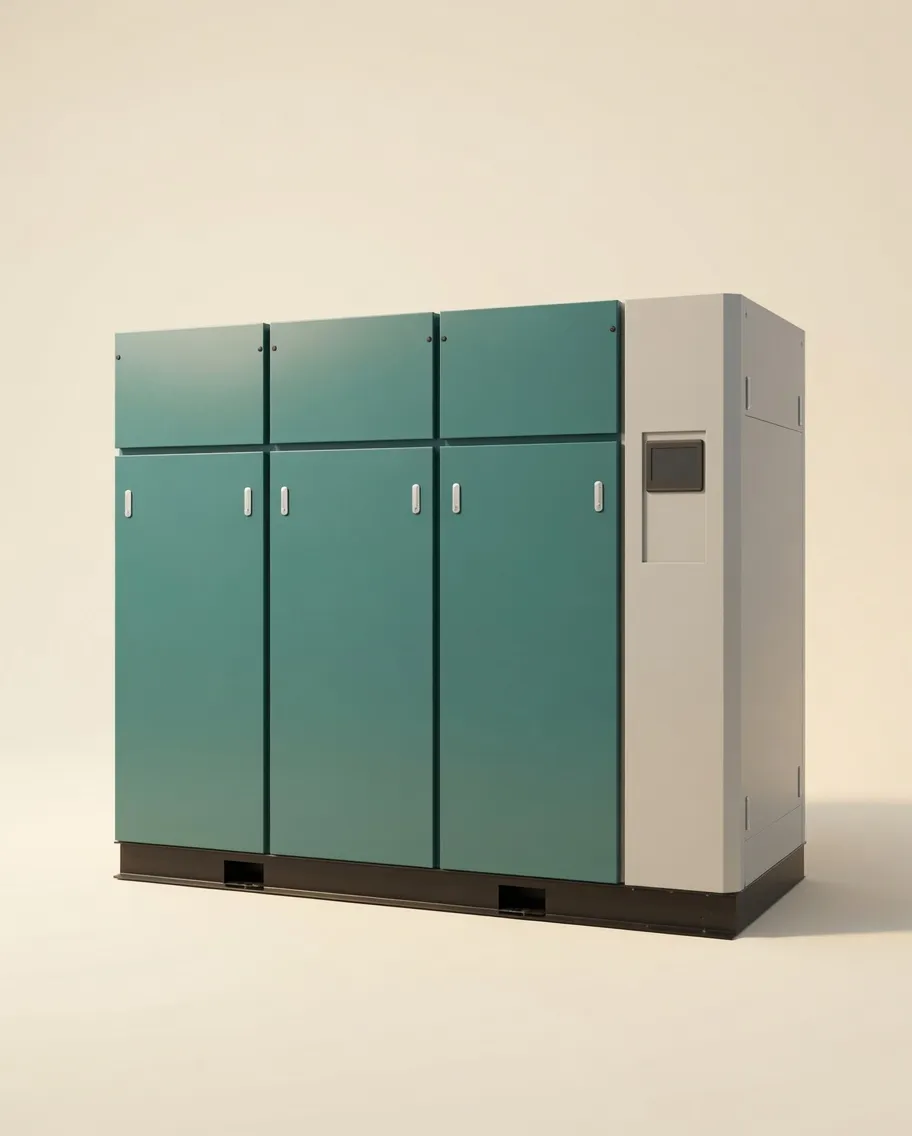
The term “oil-free” describes a purity outcome, not a single machine architecture. Multiple compression technologies achieve oil-free air delivery, each with its own performance sweet spot, cost profile, and application fit. Understanding these distinctions is essential for matching equipment to requirements rather than defaulting to a single-type specification.
Oil-Free Screw Air Compressor (Dry)
The most common type in industrial settings with demand above 15 kW. Twin helical rotors synchronised by timing gears compress air without any internal lubrication. Available in single-stage configurations for pressures up to 1.0 MPa and two-stage designs reaching 1.6 MPa. VSD (variable speed drive) variants deliver 20–35% energy savings by modulating motor speed to match demand fluctuations.
0.7–1.6 MPa
ISO Class 0 certified
Continuous duty
Water-Lubricated Oil-Free Screw Compressor
Water injection replaces oil as the internal fluid medium. This approach achieves lower inter-stage temperatures than dry screw designs — typically below 50°C at discharge — which enables single-stage compression to higher pressures without thermal stress on rotor coatings. Particularly well-suited to food manufacturing, pharmaceutical production, and any application where even indirect oil vapour exposure must be eliminated as a theoretical risk.
Minimal rotor wear
GMP compatible
7,000–10,000 hr service
Two-Stage High-Pressure Oil-Free Screw Compressor
Two-stage oil-free screw compressors compress air in sequential stages with inter-stage cooling between them. First-stage compression raises pressure to an intermediate level (typically 0.4–0.5 MPa); inter-stage cooling removes the heat of compression; second-stage compression boosts pressure to the final delivery level of 1.6 MPa, 2.0 MPa, or up to 3.0 MPa. This staged approach dramatically reduces specific power consumption compared to single-stage designs at high pressures, and is the technology of choice for laser cutting assist-gas delivery at 1.6–3.0 MPa.
Laser cutting ready
Superior energy efficiency
Micro-oil or 100% oil-free
Oil-Free Piston (Reciprocating) Compressor
Reciprocating piston compressors in oil-free form use PTFE-lined or polymer-coated piston rings and cylinder bores to eliminate the need for lubricating oil. They are simpler in construction than screw types, operate at lower duty cycles (typically 50–70%), and are well-suited to intermittent demand applications from 0.75 kW to approximately 15 kW. Medical dental chairs, laboratory gas supply, and small-scale food packaging machines commonly use oil-free piston compressors for their low capital cost and straightforward maintenance.
Low capital cost
Intermittent duty
Simple maintenance
Oil-Free Centrifugal (Turbo) Compressor
Centrifugal compressors use high-speed impellers — rotating at 20,000–100,000 RPM — to impart kinetic energy to air, which is then converted to pressure through a diffuser. Because there are no contacting rotor surfaces, oil contamination from the compression stage is impossible by design. Centrifugal oil-free compressors dominate large-scale installations above 150 kW where flow capacity exceeds what screw designs can practically deliver, and are common in petrochemical, power generation, and large pharmaceutical manufacturing sites.
Very high flow capacity
Non-contacting design
Large industrial sites
Key Components of an Oil-Free Air Compressor System
Understanding the function of each major component helps you specify the right accessories, plan maintenance intervals accurately, and diagnose performance deviations when they occur. A complete oil-free compressed air system consists of more than just the compressor itself.
Air-End (Compression Module)
The core mechanical assembly containing the rotors, timing gears, and housing. The heart of the machine — machined to tolerances measured in micrometres. Typically rated for 40,000–80,000 operating hours before overhaul.
Inter-Stage and After-Coolers
Air-to-air or air-to-water heat exchangers that reduce compressed air temperature between compression stages and at the final outlet. Effective cooling directly reduces the moisture load on downstream dryers and improves compressor efficiency by 5–12%.
Refrigerant or Desiccant Air Dryer
Removes moisture from compressed air to ISO 8573-1 Class 1–4 dewpoint targets. Refrigerant dryers achieve +3°C PDP economically; desiccant dryers deliver -40°C to -70°C PDP for moisture-critical processes. Correctly sized dryers protect downstream equipment from condensation and corrosion.
Particulate and Sterile Filtration
Even oil-free systems require particulate filtration to Class 1 (0.1 μm) or finer for cleanroom and pharmaceutical applications. Sterile-grade terminal filters with 0.01 μm ratings protect against bacterial contamination where air contacts product directly.
Intelligent Control System
Modern oil-free compressors integrate PLC-based controllers that monitor discharge pressure, temperature, energy consumption, and service intervals in real time. Remote monitoring via Modbus, Ethernet, or proprietary app interfaces enables predictive maintenance scheduling without manual inspection.
Air Receiver Tank
A pressure vessel that buffers demand spikes, allows condensate separation, and extends compressor load cycles to reduce motor start frequency. Industry guideline: receiver volume in litres ≈ 6–10 times the compressor FAD output in m³/min for stable system pressure.
Selecting the Right Type for Your Application
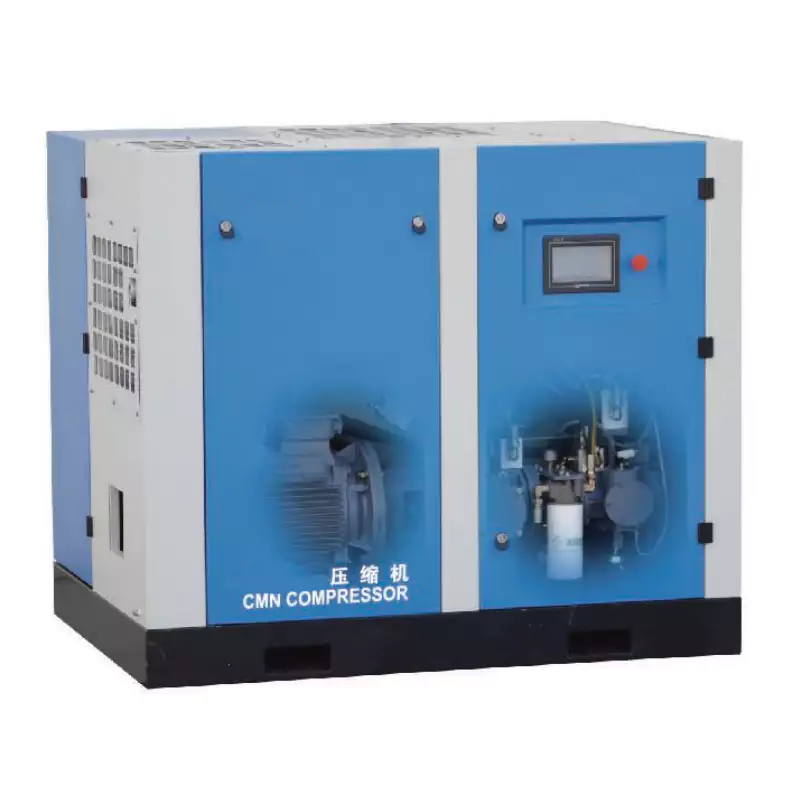
With five major oil-free compressor architectures available, the selection process requires systematic evaluation of four variables: required flow (m³/min), required pressure (MPa), duty cycle (continuous vs. intermittent), and required air purity class. The matrix below provides a quick reference to narrow your shortlist before engaging with technical specifications.
The Compression Cycle: Step-by-Step
Walking through the full compression cycle of an oil-free screw compressor makes the engineering rationale behind each design choice concrete. The sequence below applies to a typical two-stage dry screw unit with VSD and integrated refrigerant dryer.
Intake Air Filtration
Ambient air passes through a dry-type intake filter (typically rated 3–5 μm) to remove airborne particulates, dust, and insects that would erode rotor coatings. Filter differential pressure is monitored electronically; a blocked filter increases specific power by 2–3% per 100 Pa of additional restriction.
First-Stage Compression
Air enters the first-stage air-end. Counter-rotating helical rotors (driven by timing gears) trap air volumes and reduce them as rotor lobes mesh. Air pressure rises from atmospheric (approximately 0.1 MPa absolute) to the inter-stage pressure (0.35–0.5 MPa). Discharge temperature from first stage is typically 160–200°C.
Inter-Stage Cooling
The hot first-stage discharge air passes through an air-to-air or air-to-water inter-cooler that reduces temperature to 35–45°C before second-stage inlet. This cooling step recovers approximately 12–18% of compression work by reducing the specific volume entering the second stage — a key efficiency mechanism unique to multi-stage designs.
Second-Stage Compression
Cooled air enters the second-stage air-end at near-ambient temperature and is compressed to the final delivery pressure (0.7 MPa, 1.0 MPa, 1.6 MPa, or higher depending on model). Because the inlet air is cooler and denser, the second stage works more efficiently than the first — and all with zero oil contact throughout both stages.
After-Cooling, Drying and Distribution
Final discharge air passes through the after-cooler, then the refrigerant dryer (or desiccant dryer for low dewpoint requirements), then a final particulate filter before entering the distribution ring main. At this point the air is verified clean, dry, and ready for use at the required pressure — with no oil contamination pathway in the entire system.
Real-World Applications of Oil-Free Air Compressors
The versatility of oil-free compressed air technology spans industries that look nothing alike on the surface but share a common requirement: clean, reliable compressed air that cannot introduce contamination into the product or process. The following represent the highest-volume applications served by Australia Oil Free Air Compressor Co., Ltd.
PET Bottle Blowing
High-pressure (2.5–4.0 MPa) oil-free air drives the stretch blow-moulding cycle. Any oil carry-over would contaminate bottle interiors and compromise food safety certifications, making oil-free technology the only viable option for beverage manufacturers globally.
Laser Cutting
Oil-free assist gas at 1.6–3.0 MPa purges the cutting zone, ejects molten material, and protects the focusing optic. Lens replacement costs — AUD 800–2,000 per event — are effectively eliminated when oil-free air replaces nitrogen or contaminated compressed air as the assist medium.
Food & Beverage Processing
From product conveying and packaging to fermentation vessel blanketing and CIP system actuation, food manufacturing relies on clean instrument air that meets HACCP requirements at every contact and near-contact point across the production line.
Pharmaceutical Manufacturing
GMP (Good Manufacturing Practice) regulations require that compressed air touching active pharmaceutical ingredients meets ISO 8573-1 Class 0. A documented audit trail of air quality forms part of product batch records — only oil-free systems can provide this with confidence.
Electronics & Semiconductor
Cleanroom environments demand particulate and oil-free air for wafer handling, component placement, and enclosure purging. Trace hydrocarbons cause dielectric failures and bond wire oxidation in semiconductor packages — contamination modes that are completely avoided with verified oil-free supply.
Medical & Dental Facilities
HTM 02-01 (UK) and equivalent Australian standards mandate oil-free compressed air for medical gas pipelines. Oil contamination in surgical tool air or ventilator supply represents an immediate patient safety risk — regulatory compliance and oil-free technology are inseparable in healthcare settings.
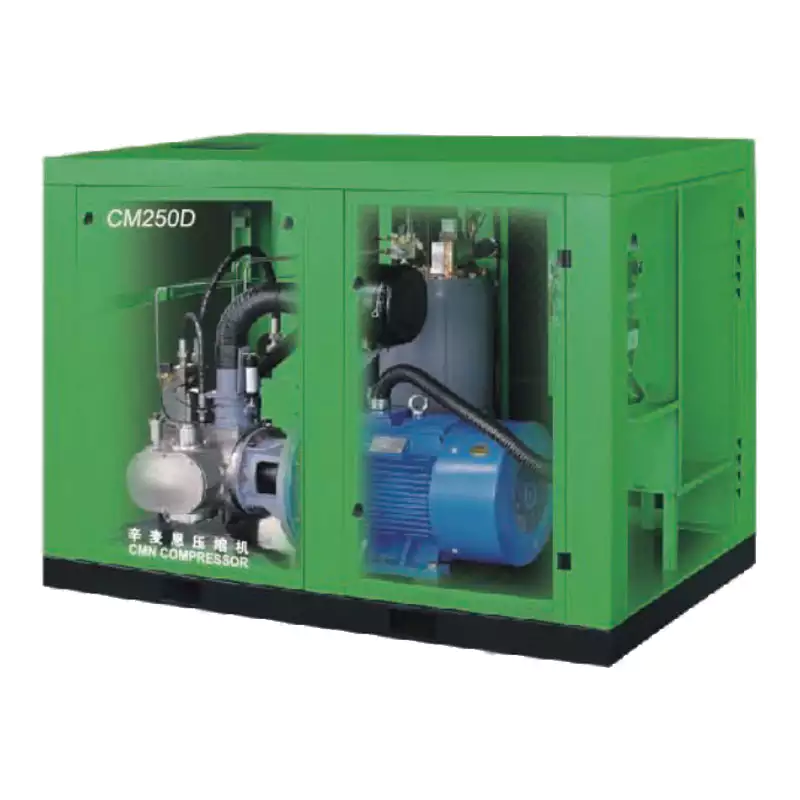
CM45D Water-Lubricated Oil-Free Screw Compressor
Flagship water-lubricated design. ISO Class 0 certified. Discharge temperature below 50°C. Ideal for pharmaceutical, food, and medical applications where zero oil risk is a non-negotiable requirement. Low maintenance with 7,000-hour service intervals.
Frequently Asked Questions
Need Help Selecting the Right Oil-Free Compressor Type?
Our engineers at Australia Oil Free Air Compressor Co., Ltd. will match your flow, pressure, and purity requirements to the optimal technology type — at no charge.
Email: [email protected] | Contact Us Online